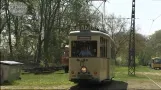
Vienna railcar 4037
In operation as a museum vehicleTrams from Vienna
Select vehicle type: Articulated trams, freight cars, grinder cars, horse-drawn trams, low-floor articulated trams, motor freight cars, railcars, service vehicles, and sidecars.
Railcars from Vienna
Select vehicle number: 1, 10, 23, 33, 82, 110, 141, 200, 324, 345, 405, 431, 777, 1668, 2019, 2051, 2101, 2150, 2260, 2283, 2319, 2406, 2423, 2447, 2510, 2523, 2614, 2625, 2714, 2872, 2992, 4004, 4033, 4037, 4048, 4077, 4143, and 6857.
The history of the tram
Wiener Linien
Operational
May 24, 1928: Delivered as Vienna railcar 4037, type M Wien, width 2.24 m, length 11.60 m, weight 13.9 t, manufactured 1927-1929, with 24 seats and 41 standing places, 2 axles, 2 engines, power output 46 kW.
Electric Tram Museum Amsterdam (EMA)
Open regularly
July 14, 1978: Arrived at the museum as Amsterdam railcar 4037 (ex Vienna railcar 4037), manufacturer Simmering, type N, series 2711-2736, width 2.24 m, length 11.60 m, weight 16.6 t, with 24 seats and 60 standing places.
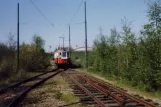
Hannoversches Straßenbahn-Museum (HSM)
Open regularly
2003: Taken over by the museum as Hannover railcar 4037 (ex Vienna railcar 4037), manufacturer Simmering, type N, series 2711-2736, width 2.24 m, length 11.60 m, weight 16.6 t, with 24 seats and 60 standing places.
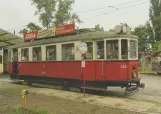 Postcard: Hannover Hohenfelser Wald with railcar 4037 at Straßenbahn-Haltestelle (2003)By Hannoversches Straßenbahn-Museum (HSM), Henrik Boye, J. Schulz.
July 26, 2003.
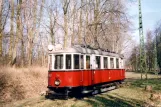 Hannover Hohenfelser Wald with railcar 4037 on Straßenbahn-Museum (2004)By Henrik Boye.
March 13, 2004.
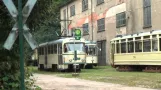
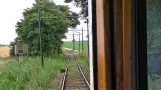
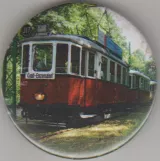 Bottle opener: Hannover Hohenfelser Wald with railcar 4037 (2020)By Hannoversches Straßenbahn-Museum (HSM), Henrik Boye.
2020.