TRAM TRAVELS

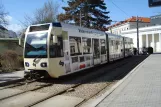
Vienna low-floor articulated tram 407

Operational
Trams from Vienna

Select vehicle type: Articulated trams, freight cars, grinder cars, horse-drawn trams, low-floor articulated trams, motor freight cars, railcars, service vehicles, and sidecars.

Low-floor articulated trams from Vienna

Select vehicle number: 3, 5, 11, 12, 19, 21, 30, 31, 35, 47, 401, 404, 407, 410, 411, 412, 601, 606, 608, 612, 613, 630, 639, 643, 647, 650, 652, 654, 696, 710, 727, 738, 750, 758, 763, and 764.

The history of the tram

Wiener Lokalbahnen (WLB)
Operational

: Delivered as Vienna low-floor articulated tram 407, type Reihe 400.
130 Years of Vienna Local Railways (2018)
6:27
130 Years of Vienna Local Railways (2018)From the beginnings of the Vienna local railways in 1888 to today: The Badner Bahn is celebrating its 130th anniversary in 2018! In 1886, the first steam-powered local railway began operations, starting in Vienna, Gaudenzdorf. The initial route extended to the terminus in Wiener Neudorf. During the first two years, 280,000 passengers and 20 million bricks were transported. In 1888, the Vienna Local Railway Company was established. Just before the turn of the century, construction began on the railway line connecting Vienna, the imperial capital, to Baden, a spa town. After completion in 1899, steam-powered trains took passengers to Guntramsdorf, where they transferred to electric trains heading to Baden. A few years later, in 1906, the entire line was upgraded to utilize alternating current, leading to a rapid increase in passenger numbers, reaching four million. In 1911, the TV 200 was named Autosalon Bahn. As a luxury partner railway, it was operated for pleasure trips to Baden, which passengers appreciated. The initial train sets resembled those retired in the late 1990s. The timetable was maintained at every hour and six minutes, later increased to every ten minutes. Berlin announced plans for a new train set to provide faster service. Not much difference was expected, as the new technology allowed a shorter pre-time buffer of 2 minutes. After both World Wars, the railway was converted to direct current, and infrastructure investments were made. Modern stops first opened in the 1970s, and new traction was introduced with the TW 101 series, increasing line speeds to 80 km/h. Over the following years, passenger numbers steadily grew. From 1984 to the early 2000s, service frequency increased from every half hour to every seven and a half minutes. As part of modernization, the T 400 railcar was introduced, featuring a more comfortable passenger braking system. Overall, significant improvements have been made. Change presents a good challenge for city operations and is implemented gradually—stopping and starting carefully. Outside, ÖBB operates on signals. From 2007 onward, investments focused on track systems, safety technology, and digital passenger displays. The infrastructure was made accessible, and a new building was constructed as the central signal box. We are contacted for various reasons—whether to access the tracks for work, clean or lubricate switches, or register with us to monitor line activity and ensure safety. By 2014, Badner Bahn became Austria's most popular regional railway, with a record of 12 million passengers. A major milestone was the start of construction on the new Vienna Local Railways center in Enzersdorf, zip code 6200. The new facility, built on 1,000 square meters, includes a 200-meter-long depot for 32 locomotives. After 26 months of construction, the depot was scheduled to open in March 2018. This location centralizes the various work areas of the local railway, now overseen by the locomotive driver. Prior to that, I obtained my Grand Schenk and forklift licenses. Later, I completed an apprenticeship with a high school diploma, which limited my ability to work part-time for long. Does anyone know of a smaller company? In contrast, Wiener Linien or WP means you know nearly everyone, making the environment more familiar. We motivate employees by providing opportunities to contribute. Interested and motivated staff are more likely to get involved. With a route network of 37 stops and 35,000 daily passengers, the Badner Bahn is becoming the key commuter link in Vienna's southern suburbs—and that’s very important. We still have our heroes. If customers don't understand or dislike something, they are happy to help. If they can't get cash or if they're in Baden where we're usually available, I want to assist older people. Digitalization doesn't stop with the Badner Bahn. Since 2018, Wi-Fi has been available at stops and on trains to enhance customer satisfaction and make ticket purchases easier. The vehicles will be modernized in the coming years to increase comfort. Wiener Lokalbahnen is a sister company of Wiener Linien, along with two other subsidiaries: Wiener Lokalbahnen Verkehrsdienste and Minogue Arcana Cargo, which operates freight trains. The jobs my employees perform are demanding and highly responsible because they involve human lives—that's the most important thing we must protect. Wiener Lokalbahnen has many plans for the next few years, extending through 2021.By Wiener Lokalbahnen - .

Add a comment

Last updated: .