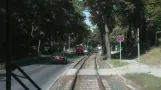
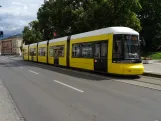
Strausberg low-floor articulated tram 0041
OperationalTrams from Strausberg
Select vehicle type: Freight cars, low-floor articulated trams, sidecars, tanks, and water trams.
Low-floor articulated trams from Strausberg
Select vehicle number: 0041, and 0042.
The history of the tram
Strausberger Eisenbahn
Operational
: Delivered as Strausberg low-floor articulated tram 0041, manufacturer Bombardier, type Flexity.
![[Documentary] Strausberg Tram (2020)](/foto/l/documentary-strausberg-tram-2020.webp)
18:40
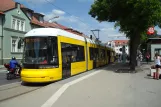
[Documentary] Strausberg Tram (2020)The town of Strausberg, which has 26,000 inhabitants, has its own 6.1 km long tram line.
The Strausberg Railway operates the so-called line 89, which connects the Strausberg S-Bahn station with the Lustgarten. It also goes through some idyllic forest areas in the Strausberg city area. In the order of Woltersdorf line 87 and the Schöneicher tram with line 88, line 89 is the last of the three lines in the outskirts of Berlin.
The small town of Strausberg, just outside Berlin, has a 6.1-kilometer tram network. The line is better known as the Strausberg Railway, and the operator, STE, still calls it that today. The name comes from the line's history, as it used to carry freight traffic for many years. Since 2006, however, the line has been used only to reach Bosch Trappen. It is completely single-track, except for a passing siding at the "Gewer Mühle" stop. Except for a 100-meter stretch before the terminus at Lustgarten, it runs entirely on its track. Tram line 89 connects the S-Bahn station or Strausberg station with the Lustgarten near the city center. Including the two end stops, there are nine stations along the route. From Monday to Friday, the line runs every 20 minutes. This requires two services for the whole route. On weekends, Saturdays, and Sundays, only a half-hourly service is provided by one vehicle. The travel time from one end to the other in each direction is about 30 minutes. To better use the historic Strausberg station on the Eastern Railway, which opened in 1867, there were lengthy discussions about options. On October 28, 1919, it was decided that a run-off vote was the most sensible choice, even under the recent narrow-gauge railway law. Therefore, the current line was opened on August 17, 1893. However, the route built then only extends as far as Reger Mühle station; the section behind Pflege Mühle toward Lustgarten was added during electrification. The line from Pflege Mühle to Lustgarten opened on March 16, 1921, and electric operation started on April 1, 1921. Later, the line was extended into Strausberg’s city center. The youth center was planned but closed again in 1970. The narrow-gauge railway between Häger Mühle and Strausberg was shut down and dismantled in 2006. Since then, very little has changed, apart from the vehicles used. Since 2013, modern low-floor trams like numbers 0041 and 0042 have been running in Strausberg. These units were built in 2013 by Bombardier Lerner in a joint order with BVG, and are part of the Flexity Berlin series. They have six axles, five car sections, and are 30.8 meters long. They are 2.4 meters wide and can reach speeds up to 70 km/h. The interior is notable for its very low height, with 52 seats and 132 standing places. The inside design matches the exterior and closely resembles the Berlin Fleck Cities trams. Two other vehicles, both made by CAD Tatra, are still in use. The KT 85, built in 1985 and acquired by Strausberg in 1990, has been modernized. Since 2014, it features a low-floor center section and is called KT 85 with 2 S points. Its appearance has been almost completely revamped, giving it a very modern look. This three-car vehicle has eight axles and measures 30 meters long; it can reach 65 km/h. Inside, it offers about 50 seats and room for up to 280 standing passengers. It also includes a multipurpose area with space for strollers and wheelchairs. It is rarely used in mining operations. There is also a single T 6 C 5 solo railcar, which arrived in Strausberg in 2003. Now, let’s explore the route and some points of interest along line 89. Starting at the Strausberg train station, there are two indirect routes with three tracks. These include S-Bahn line 5, connecting Strausberg Nord to Westkreuz, and the R-B 26, running from Ostkreuz to Küstrin. In front of the station, there is a large bus terminal with a turning loop and several stops, along with the station building. The building is no longer accessible to most passengers, except for a small girl who is part of the station’s design. Opposite the station, there’s a small pavilion housing a bakery and a ticket booth for the Strausberg Railway. The tram stop is right next to it, at a blunt point with an outside platform.
Also, the station building of the narrow-gauge railway, the Strausberg railway, is no longer used by them today and has been turned into a restaurant. Train number 89 is just arriving at the Strom S-Bahn station. This train has a turnaround time of just under seven minutes before it reverses direction. There is also a large parking lot right next to the end of the route. We will be our sponsors, and he will be with us. There is space inside the vehicle as well, so we can follow the route from the driver's perspective. The route now turns along Rudolf Alcon Hofer Street into Linden Promenade, continuing northward. The path runs along the middle of Linden Promenade, where many single-family homes stand to the right and left. The first stop we reach is called Landhausstrasse. At this stop, there is an interesting and historic-looking shelter. The Holzwarth Hölzchen has been standing here since 1894, when the line first opened. It was replaced by this new building in 1913 and has been preserved ever since. The green half-timbering elements are especially eye-catching.
Similar buildings can be found at two other stops—Schlag Mühle and Heringer Mühle. In the following section of the route, you'll reach the longest station substation on the entire Strausberg railway. The distance between Landhausstrasse and Schlag Mühle is about 1.3 kilometers, passing through a dense forested area. This means the Strausberg railway offers several peaceful, scenic sections along the way. The Schlag Mühle stop is situated in the middle of a residential area, next to an industrial park. After leaving this stop, you'll continue across Grazer Strasse and through the thick forest. On the right, you'll see the industrial park. After about 800 meters, you'll arrive at the Stadtwald stop. As the name suggests, the station itself is surrounded by woodland. If you leave this area and walk through an apartment complex in Poland, you'll reach Ernst-Thälmann-Straße. This is where most of the residential area, or prefabricated housing estate called Leger Mühle, is located. Various apartment blocks line Ernst-Thälmann Straße.
Additionally, there's a large shopping area nearby. Behind it lies the Heger Mühle S-Bahn station. The stop called EK Müller on the tram route can only be reached via the 60-meter-long path to the mill itself. After the single-track section, there's the only and first switch here at the mill. The two routes meet every 20 minutes. Our route, coming from Strausberg S-Bahn station, tends to arrive a little earlier and waits for the train from Lustgarten so we can continue. At this stop, you'll find the outskirts of the Jäger Mühle prefabricated housing estate and a large shopping area. Immediately after leaving, the route goes back to a single track. We cross Berliner Straße and continue on the right side of Berliner Straße. For now, we leave the independent route and follow parallel to the road along various gentle curves. We then descend slightly, and after 400 meters, we arrive at the Heinrich Heine Straße stop. Located at the southern tip of Strausberg Lake, this stop is about 300 meters from the water. Strausberg Lake, the city's main lake, covers 1,364 square kilometers. Its longest north-south stretch is 3.8 kilometers, while east-west, it’s no more than 340 meters wide. The lake features multiple swimming spots and hiking trails around it, making it a popular local recreation spot. The tram runs parallel to the lake toward the final stop. However, we continue along Berliner Straße, leaving Rheine Straße behind. Next, we stop at Käthe Kollwitz Straße after 60 meters. The last stop before our final destination is Elisabeth Straße. Near there, you'll find the Strausberg St. Marien Cemetery, the largest in the city, with its entrance right next to the tram stop. Also nearby is the Strausberg City Museum, which covers the early history of the city and features various literary excerpts.By Bahnwelten - .
10:25
Germany's only Tatra KT8D5 | Strausberger Eisenbahn (2019)In 1995, the Strausberger Eisenbahn, a small tram company east of Berlin, received three used Tatra KT8D5 railcars from Kosice, Slovakia.By TramChris - .
19:42
Strausberg tram (2014)Here is a video about the Strausberg tram. You can see the following types:
F6Z (Flexity Berlin): 0041, 0042.
KT8D5: 21.
T6C5: 30.
I was lucky with the T6C5. Because it is no longer used for passenger service. The T6C5 was travelling with a tower trailer, and I even caught the T6C5 entering the depot.By tramfreak2000 - .
12:21
Strausberg tram line 89 (2020)The route of the tram line 89 S-Bahnhof Strausberg - Lustgarten in Strausberg, Germany.By esbek2 - .
16:04
Strausberg Tramway Strausberg Tramway Strausberg ⇒ Lustgarten (2016)The journey along the Strausberg Tramway east of Berlin. Though the tramway is operated by Berlin Verkhers Betrieb, it is isoloated and not connected to the main system in East Berlin.By World Of Transit - .
26:09
KT8D5 farewell in Strausberg (2015)After almost 20 years, the use of high-floor Tatra KT8D5s in Strausberg came to an end. After car 23 was sold to Prague in October 2014 and car 22 was modernized (RN2S) and returned to use in Strausberg, the time of the last high-floor KT8D5 no. 21 as a reserve car was over! So on January 11th 2015 there was a farewell trip for car 21 - the route to the S-Bahn station in the suburbs was traveled twice, which was documented from the outside in this video. The modernized KT8D5.RN2S was used as the line car for the time of the cycles... the route encounters between the two car types were almost unique on site!
After car 21 ... returned to Strausberg in a modernized (RN2S) format. last time, preparations for transport to Prague followed in week 3, which took place in the night of January 19th to 20th, 2015. In the morning hours of January 21st, 2015, the transport reached the main workshop in Praha Hostivař, where the car will be modernized to KT8D5.RN2P and will reinforce the scheduled services in the Czech capital of Praha under the new car number 9098.By KT4Dani - - .