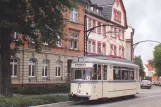
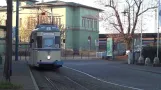
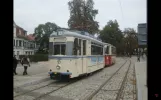
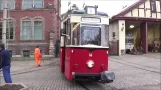
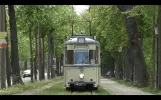
: Taken over by the company as Naumburg (Saale) railcar 37 (ex Stralsund railcar 15), manufacturer VEB Waggonbau Gotha, type T57.
12:22
"Wilde Zicke": Germany's smallest tram in Naumburg, Saale (2019)The Naumburg tram was opened in 1892 as a steam tram between the train station and the city center. After electrification in 1902, the line was expanded in several steps to become a ring line. Due to the poor condition of the infrastructure and a sharp drop in passenger numbers, operations were discontinued in 1991. Thanks to the commitment of some tram enthusiasts, part of the former ring line has been open to traffic again since 1994. Line 4, also known by residents as the "wild bitch," has now become an integral part of the cityscape.
In this video, we follow the route from the main station, past the tram depot and along the city wall to the final stop at Salztor. Due to an event, two cars were used on the day of the recording, while one route is sufficient for the normal timetable.By TramChris - .
29:26
A joyful drive through Naumburg (2017)Immediately after the fall of the Berlin Wall, the Naumburg tram was sidelined: it was too worn out, too old-fashioned, and too ineffective. However, many citizens refused to accept the end of "their" tram and managed to get it running again. For ten years now, the trams have been traveling through the cathedral city every day, just like they used to. And what trams!
Each one is a historic treasure in its own right. For instance, there are old Gotha trams from the 1960s and so-called Reko trams from the 1970s. Recently, passengers could even ride in a Lindner tram from 1928! Corina Pfrenzinger and Robby Mörre are not going to miss out on this nostalgic experience in the new edition of "On a narrow gauge".
They also explore the history of the BR 143 electric locomotive. Developed in East Germany in the early 1980s, it was used for both passenger and freight trains. The locomotive was so dependable that it continued running in the West after the fall of the Berlin Wall and remains in service today as the "Trabilok".
For model train enthusiasts, there’s a behind-the-scenes look at a private facility in the Ore Mountains. Here, two men from Ehrenfriedersdorf built a monument to the former local narrow-gauge railway, which in the past transported grit from a quarry. Now, it’s all on display again—fully automatic, of course, and on a 1:87 scale.
A warm welcome from Naumburg. The cathedral is here in the city. Many people are aware of it, but Naumburg has even more to offer. For example, the smallest tram service in Germany is just 2 2.5 kilometers long, running from the station into the city. Fortunately, this tram is still operating. After reunification, it was only here that trams began running daily. It's been only 10 years since the Nauenburg trams restarted daily service, so to speak, and with that, this tram faced a similar fate to the narrow-gauge railways in Briegnitz. There was a long stop in Briegnitz, too, but it is now back in operation. The Pollo, a diesel locomotive from Babelsberg, along with three carriages, is how the Pollo departs on a narrow-gauge track. In the driver's cab is Sven Lieberinz, the chairman of the Pregnitz Narrow-Gauge Railway Museum, Lindenberg e. V. When the association was founded 24 years ago, it was only meant to display a few relics from the railway's history. No one believed trains would ever run here again, but Lieberinz recalls that when the volunteers came together, a momentum of its own arose. We started here in '93- it all began with a power socket at the station under the open sky. Most of the vehicles were repaired here, regardless of the weather; the lock shed was only added in 2000. Before that, everything was rebuilt outdoors. We can take pride in the club. The Pregnitz is located in the northwest of Brandenburg. The Pollo now runs again on a 9 km route from Lindenberg station to Mesendorf station. Railway enthusiasts have come from Saxony. They are narrow-gauge railway fans themselves. In Jöstadt in the Ore Mountains, the Pressnitz Valley Railway is a beautiful place - a classic railway, a small train. We are trying to portray the museum railway in the style of the 1960s, which reflects the region's decline and slow development. It's not as low as in towns and cities; that's why it remains truly rural- very rural, just like in the old pictures. That's part of the charm. It's actually the beautiful former Tönning Junction of a 20-km-long narrow-gauge railway network. The railway used to run on steam. Today, there are no operational steam locomotives left, but friends from the Pressnitztalbahn bring one here every year on a low-loader for Thomas Brand.
The highlight of the year is when we have a steam locomotive from Höstadt. Of course, it's a significant challenge. It brings back memories of my childhood. I grew up with steam locomotives that ran regularly, so there's a bit of nostalgia involved. In May, there are steam locomotive days at Polllo. This is what it looked like last year. This year, Mario Wolf from the Pressnitztalbahn is already planning for this event. We will bring a steam locomotive here again on loan. We’re also happy it has been so well received. We learn from each other about refurbishing carriages, operating locomotives, or SAS, and that definitely helps. I believe it’s a massive win for both sides. Saxony and Brandenburg support each other — it’s as simple as that. But where does the name Polllo actually come from? Who knows? At the opening, Lieberenz was there with his dog Polllo. When the train approached, the dog got scared and ran away, or probably after it. No one knows for sure anymore. The forester called the dog Polllo, and everyone thought that was the train’s name, so it has stuck in widespread usage ever since.
Pollo, that is. The people of Prnitzer are happy that many want to get to know their Po. It is on the road for about 25 days until the end of December. On the last two weekends in May and on Ascension Day, steam can be heard in the Pregnitz. We are still traveling through Naumburg on the retro tram, and everything here has been restored to its original state. The people of Naumburg affectionately refer to their tram as the "Wild Bitch," and there are two theories about why. One reason is that the steam-powered tram always hissed back then, and the other, more likely, is that the poor rails caused the passengers to be jolted back and forth constantly. Whatever the case, one thing is sure: Naumburg once had the largest model railway in the GDR, and you can still see it from Michael. Anyone who plays with this model railway has plenty of options. There are over 40 different trains here. Twelve of them can run on the tracks simultaneously. Michael Schulze from Naumburg is especially proud of this. Four decades ago, the kasermeister started building his masterpiece, and at the same time, he found time to start a family. I built the others.By Thueringer-Bahn Initiative - .
13:40
Naumburg (2025)On Saturday, 07.06.2025, we visited Naumburg. Tram traffic started in Naumburg in 1892, at that time still with steam traction. The network was electrified in 1907.
Naumburg's tram network consisted of a tram ring built around the city center, which was intended to connect the train station with the city. In the 1970s, due to a track correction, the short downtown section was abandoned, but its remains can still be seen (pictures in the introduction to the video). In 1991, tram traffic stopped due to the extremely poor track conditions. Starting in 2005, the track between the Hauptbahnhof and the Salztor was rebuilt in several sections, and LOWA (ET54), Gotha (T57Z) and Reko (BZ70) motor cars suitable for bidirectional traffic were purchased for the operation.
When we were there, the 37 Gotha and the 51 Reko were in traffic, but to our surprise, we sometimes saw a few two-stroke vehicles, besides the trams.
#Naumburg #NDK #DDR #Tram #tram #Straßenbahn #Gotha #LOWA #Reko
0:00 Introduction
0:30 Life pictures
8:56 Travel on the Reko tram
12:35 Departure from the HauptbahnhofBy Kocso84 - .
Tram & Music: Thank you to all donors! Restoration of sidecar 1 (2018)The last surviving EB 50, built in 1951 from Werdau in meter gauge. A piece of GDR tram history that we as a club want to preserve. And you are welcome to support us in doing so. Built as a two-judge, it served in Halberstadt. In 1970 it was converted to a one-judge. Later it came to Naumburg to earn its retirement. It was saved and will be back in service as a two-judge.By Straßen Bahn unterwegs mit dem Schienenonkel - .
Tram Naumburg HD (2011)A short visit to the Naumburg tram with the ex-Stralsund two axle tram in service.
Since a while the Naumburg tram is again in service and runs every 30 minutes the day, however it does not cover the whole circle line again and it is questionable if this will be the case because the old rails were removed and roads and buildings are now at their former place.By Klingl3r - .