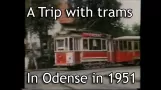
Odense railcar 14
DismantledTrams from Odense
Select vehicle type: Low-floor articulated trams, open sidecars, railcars, service vehicles, sidecars, and snowplows.
The history of the tram
Odense Tramway (OS)
Closed
: Delivered as Odense railcar 14, manufacturer Allmänna Svenska Elektriska Aktiebolaget (ASEA).
13:51
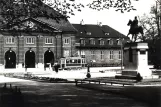
A trip with Odense's trams (1951)Old houses in a historic neighborhood are known for one particular name. People from around the world visited Odense to see H.C. Andersen's home in Helsingør. Although it wasn't the most visited spot back then, occasionally a tour bus would pull up near the house, unloading a group of passengers. Visitors were often intrigued by the old house and surprised to see the chimney sweep, as featured in one of H.C. Andersen's famous stories. Maybe it wasn't just the atmosphere, but there was something adventurous about the place. To add to the sense of adventure, visitors could see the chimney sweep walking barefoot on the roof. Clearly, it was a place with something special to offer. But it wasn't always H.C. Andersen's house that drew people from near and far; sometimes, there was something else that attracted them.
You see, Odense was a great city, much like other major Danish cities such as Copenhagen, with features that those cities typically had. The red trams, a color they adopted in the 1920s when they replaced the darker green models. Odense's main tram line opened in 1911. It started in Forsbury, passed through the city center, and ended at Hulopko. At each end of the line, there was a loop where the tram could turn around. The tram would arrive at the loop, make a high-pitched screech, and turn around to head back. On hot spring and summer days, the zoo and the surrounding trolley attracted many visitors, and the tram ride was just part of the experience. From Forsbury, the line ran along the green belt of Sonobat toward the city center. The next stop was the hospital, which saw many passengers during visiting hours. After a quick halt, the tram continued toward the next stop at Cassan, just a few hundred meters before Son Boulevard, in an effort to head down Sonale. Going through Vestigal, the tram entered busy city traffic, merging with other routes. Here, the tram line diverged onto double tracks, with a boulevard to continue toward the city center and Odense's main station. On summer days, it was common to see the regular tram replaced by open-air excursion wagons used for school trips, allowing children to enjoy the sights and sounds of the city from the comfort of a tram. Usually, these trips ended at the central station, with plans to continue the day, probably behind a real steam engine.
Like everything else, Odense’s tram system required maintenance. The overhead wires at the old Central Station were being repaired, featuring the building's majestic style in the background. The tracks were greased, and occasionally, a welding crew came to fix the worn rails. After welding, the rails were ground to a smooth finish.
The tram system was also a place where passengers were treated well and served with care. People would wave hats and greet friends and family before boarding. In America, there was another quick stop, passing the Hunob Scout tram, before continuing past Fisk and Finan's largest newspaper, the Fan Times. Then, it crossed between Nar and Vista, where traffic was so heavy it needed controls with lights. At Albani Torv, the tram was seen passing by, then turning past the city hall, which had been under construction for several years. From there, you entered the heart of the city.
From this central area, people could switch to local buses or go shopping. One popular spot was the old market, where traditional practices thrived. For instance, you could taste the cucumber before buying it—nobody wanted a bad one. Markets were typically held at Albani Torv and Klingan Bear, where vendors sold flowers, vegetables, and fruits, creating a vibrant and authentic market atmosphere. All of this could be seen from the tram as it traveled past, with views behind the church and towering rooftops. The old gas tower was visible, and someday, this part of it would become history, along with a little red tram passing down Sus Kra, past Philosoph, and crossing over below onto Leel. This crossing required extreme caution. There was one final crossing with the tram at Munobsko before reaching the destination—Hunsko—where the tram ended in a loop in the forest.
For a brief moment, passengers could enjoy the peaceful atmosphere. But then they arrived, and the journey came to an end. Here was Honors Go, welcoming the city's citizens with its green surroundings. Though most of Odense's rolling stock was scrapped in 1952 when the tram lines closed, one tram found a new lease on life. Number 12 was sold to the U.S. tramways in Sweden in 1945 along with a sister tram, number six. This particular tram survived after being purchased and was discovered in 1973 in a backyard in Sweden. A Swedish equivalent to the Danish Tramway Society was sent back to Denmark, and it was restored in 1997. The tram has been reintroduced to service and can now be seen alongside many other trams at the Danish Tramway Museum.By SJB Media 1996 - .Odense Tramway (OS)
Closed
: Dismantled.