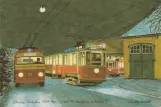
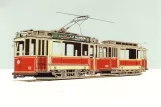
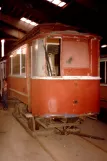
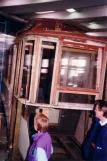
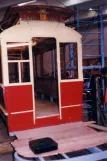
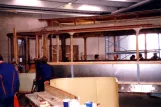
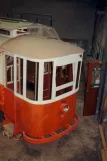
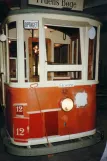
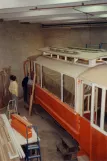
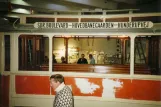
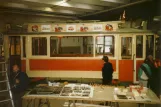
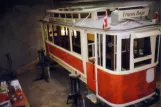
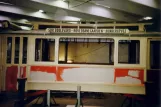
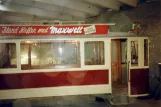
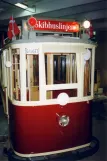
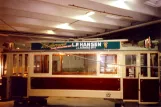
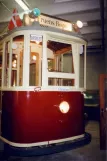
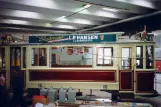
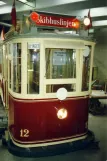
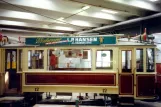
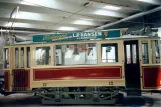
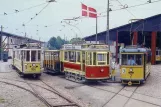
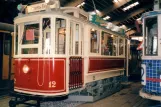
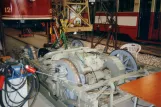
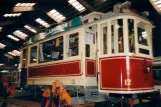
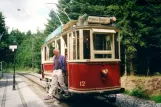
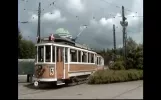
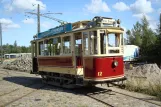
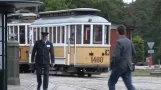
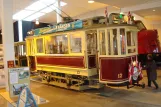
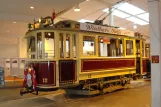
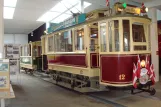
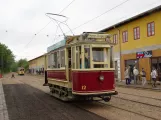
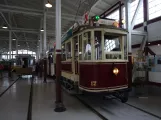
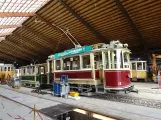
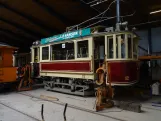
: Delivered as Odense railcar 12, manufacturer Allmänna Svenska Elektriska Aktiebolaget (ASEA).
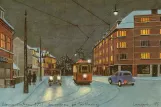
Postcard: Odense railcar 12 (1989)Svenskbygget sporvognstog fra Allmänna Svenska Aktiebolaget - ASEA - i Vesterås med motorvogn leveret i 1911 og bivogn leveret i 1913By Henrik Boye, John Lundgren, Sporvejshistorisk Selskab (SHS) - .
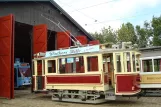
: Arrived at the museum as Skjoldenæsholm railcar 12 (ex Odense railcar 12), manufacturer Allmänna Svenska Elektriska Aktiebolaget (ASEA).
13:51
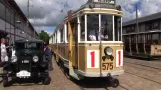
A trip with Odense's trams (1951)Old houses in a historic neighborhood are known for one particular name. People from around the world visited Odense to see H.C. Andersen's home in Helsingør. Although it wasn't the most visited spot back then, occasionally a tour bus would pull up near the house, unloading a group of passengers. Visitors were often intrigued by the old house and surprised to see the chimney sweep, as featured in one of H.C. Andersen's famous stories. Maybe it wasn't just the atmosphere, but there was something adventurous about the place. To add to the sense of adventure, visitors could see the chimney sweep walking barefoot on the roof. Clearly, it was a place with something special to offer. But it wasn't always H.C. Andersen's house that drew people from near and far; sometimes, there was something else that attracted them.
You see, Odense was a great city, much like other major Danish cities such as Copenhagen, with features that those cities typically had. The red trams, a color they adopted in the 1920s when they replaced the darker green models. Odense's main tram line opened in 1911. It started in Forsbury, passed through the city center, and ended at Hulopko. At each end of the line, there was a loop where the tram could turn around. The tram would arrive at the loop, make a high-pitched screech, and turn around to head back. On hot spring and summer days, the zoo and the surrounding trolley attracted many visitors, and the tram ride was just part of the experience. From Forsbury, the line ran along the green belt of Sonobat toward the city center. The next stop was the hospital, which saw many passengers during visiting hours. After a quick halt, the tram continued toward the next stop at Cassan, just a few hundred meters before Son Boulevard, in an effort to head down Sonale. Going through Vestigal, the tram entered busy city traffic, merging with other routes. Here, the tram line diverged onto double tracks, with a boulevard to continue toward the city center and Odense's main station. On summer days, it was common to see the regular tram replaced by open-air excursion wagons used for school trips, allowing children to enjoy the sights and sounds of the city from the comfort of a tram. Usually, these trips ended at the central station, with plans to continue the day, probably behind a real steam engine.
Like everything else, Odense’s tram system required maintenance. The overhead wires at the old Central Station were being repaired, featuring the building's majestic style in the background. The tracks were greased, and occasionally, a welding crew came to fix the worn rails. After welding, the rails were ground to a smooth finish.
The tram system was also a place where passengers were treated well and served with care. People would wave hats and greet friends and family before boarding. In America, there was another quick stop, passing the Hunob Scout tram, before continuing past Fisk and Finan's largest newspaper, the Fan Times. Then, it crossed between Nar and Vista, where traffic was so heavy it needed controls with lights. At Albani Torv, the tram was seen passing by, then turning past the city hall, which had been under construction for several years. From there, you entered the heart of the city.
From this central area, people could switch to local buses or go shopping. One popular spot was the old market, where traditional practices thrived. For instance, you could taste the cucumber before buying it—nobody wanted a bad one. Markets were typically held at Albani Torv and Klingan Bear, where vendors sold flowers, vegetables, and fruits, creating a vibrant and authentic market atmosphere. All of this could be seen from the tram as it traveled past, with views behind the church and towering rooftops. The old gas tower was visible, and someday, this part of it would become history, along with a little red tram passing down Sus Kra, past Philosoph, and crossing over below onto Leel. This crossing required extreme caution. There was one final crossing with the tram at Munobsko before reaching the destination—Hunsko—where the tram ended in a loop in the forest.
For a brief moment, passengers could enjoy the peaceful atmosphere. But then they arrived, and the journey came to an end. Here was Honors Go, welcoming the city's citizens with its green surroundings. Though most of Odense's rolling stock was scrapped in 1952 when the tram lines closed, one tram found a new lease on life. Number 12 was sold to the U.S. tramways in Sweden in 1945 along with a sister tram, number six. This particular tram survived after being purchased and was discovered in 1973 in a backyard in Sweden. A Swedish equivalent to the Danish Tramway Society was sent back to Denmark, and it was restored in 1997. The tram has been reintroduced to service and can now be seen alongside many other trams at the Danish Tramway Museum.By SJB Media 1996 - .
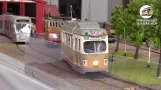
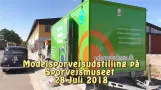
Model railway exhibition at the Tramway Museum (2018)In the 2018 season, Sporvejsmuseet Skjoldenæsholm marked its 40th anniversary with a number of events throughout the year. One of them was a large model railway exhibition with several foreign guests. The film here shows an extract from the exhibition on 28 July.By SJB Media 1996 - .
12:26
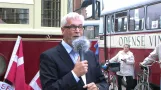
Odense Tramway - Flakhaven (2011)100 years for A/S Odense Sporvej. Mayor Anker Boye, Odense Municipality, and museum curator Mikael Lund, Sporvejsmuseet Skjoldenæsholm, speaking at the exhibition on the game Odense tram at Flakhaven in front of Odense City Hall.
I want to welcome you to Flaghaven. Precisely 100 years ago today, Odense Sporvej officially began operating this tram along the track through Odense. There was a sneak start a few weeks earlier, but the official opening day was October 5. We are pleased that the Skjønensholm Tram Museum has returned to Flaghaven today. We visited here in 1997 with the tram, which Claus Abo Christensen and the now-deceased Arne Vedsted Hansen had completely restored. The two dedicated a tremendous amount of work restoring this beautiful tram, which ran in Odense until at least 1952. Over 16,000 volunteer hours have been spent working on this tram. After it was displayed here at Flaghaven in 1997, it continued to promote Odense by being in operation at the Spormuseet Skjønnesholm, along with the two buses, numbers 10 and 30, which served as the tram's replacements, and the stunning waiting room building from Fruens Bøge. They are pleased to be back at Flaghaven, presenting the tram, and are also glad that Odense is now seriously considering starting a modern tram system. Based on my experience abroad, I am confident you will be pleased with it. But today is a special occasion. It’s the 100th anniversary, and I’d be honored to give the floor to Mayor Anker Bøje. Thank you for that, and everyone here. Welcome, and thank you for being here. It’s wonderful to see the old tram back in the city. It’s located in the city square, cared for by Skjoldnesholm, which we take pride in. We are happy to have a museum that showcases our past in this way, something we’ve greatly enjoyed in our city. It’s fitting that today, on the 100th anniversary, we gather at Flaghaven to see this long history exemplified by the old tram, as well as what came after — the buses, which became the successors of the tram. Even back when we established our first tram route to Fruens Bøge, Odense was at the forefront of developing good public transportation. The three major cities—Copenhagen, Aarhus, and Odense—have been the primary drivers in shaping this, and they continue to be so. It’s a point of pride to remember those times. The tram was put into operation by Odense Sporveje, and I have a little note from the day they first took the tram out for a ride from Fruens Bøge into the city. The city council members of Odense were proud passengers on that first trip. One of them reportedly said that when they arrived here at Flaghaven, they now had modern public transportation. It’s safe to say they were proud of that, and understandably so. Thankfully, today’s city council members are a bit more modest. Well, maybe they are. We take pride in making thoughtful decisions and accepting responsibility. That was true back then, and it's true now. Back in the day, there was a special event — Saint Knud's Market — when they also traveled to Fruens Bøge. On that day, about 17,700 passengers took the tram in Odense—that’s nearly half the city's population. That's no small number. Back then, it cost 10 øre for adults and 5 øre for children. That sounds cheap, but considering that a skilled worker earned 60 øre an hour, it wasn't really that affordable. Today, you can ride the ring bus for free, so transportation has undoubtedly improved. However, not all buses were affected, as city buses took over and the trams were discontinued. They ended service on July 1, 1952. The tram could no longer keep up, as the city's population had grown significantly and cars were becoming increasingly common. The streets remained narrow, and the trams weren't large enough to handle everyone. So, diesel buses replaced them. A newspaper at the time wrote that these buses were much stronger, almost like being at the Speedway. People were amazed at how much more these buses could do compared to the rattling tram. This change also reflected a broader cultural image. The tram, along with Fruens Bøge, was a beautiful spot where many people went out, especially during Pentecost, when you could take the tram to Fruens Bøge. The girls would put on their nicest clothes...By SporvognDK - .
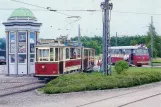
Postcard: Skjoldenæsholm standard gauge with railcar 12 by The Tram Museum (1998)Odense carriages at the Tram Museum forecourt. On the left, motor carriage no. 12 and open sidecar no. 51 from Odense Sporvej. Both were built by ASEA in Sweden in 1913 and 1911, respectively. The motor carriage was restored between 1987 and 1997 by members of the Tram Historical Society in Odense. On the right, bus no. 10 from Odense Bytrafik. The bus is a 1952 Volvo, the first model with an engine located under the floor.By Henrik Boye, Sporvejshistorisk Selskab (SHS) - .
The Straßenbahn Museum (2018)Visit to the Sporvejsmuseet Skjoldenæsholm June 2018.
Don't forget to "Like" the video if you liked what you saw and Subscribe to the channel for more of my videos.
Don't forget to "Like" the video if you liked it, and subscribe for more videos.By Mikkel Graugaard Hansen - .
Odense Sporveje 100 years (1911-2011)On October 5, 1911, A/S Odense Elektriske Sporvej began operations. On the same day, the old Odense tram will leave from the Sporvejsmuseet to Flakhaven in Odense and will be on display at Denmark's Railway Museum for the rest of October.
The fifth of October — is it exactly 100 years since the Odense Electric Tramway Company began operating its first track? And on this centennial, October 5th, can you see the old Odense track, now at the Gedsholm Tramway Museum in front of Odense City Hall, just as it appeared when first shown to the public on September 12, 1997, after being fully renovated from October 6 through the rest of the month? Can you view the track at the Danish Railway Museum, which currently hosts an exhibition about modern trams and light rail, now making their way back to Denmark's three historic tramway cities: Odense, Copenhagen, and Aarhus? If anyone knows the history of the Odense Tramway, it's Ole Iskov. His father worked for the Odense Tramway Company, and his deep interest in tramways stems from a lifelong fascination. Ole Esgaard authored a book about the Odense Tramway, published by the Tramway Historical Society in 1986. You're mentioned in the foreword of that book.
The American author Ray Bradbury’s book, "Dandelion Wine," features a main character, Douglas, who at 12 years old experiences something about the tramway in his hometown in the USA. Why did you mention that book? I can't help but compare it to myself. I was also me—I was 14 when they closed the Odense tramway—and I feel the same way as Douglas in "Dandelion Wine," which isn’t a science fiction book, unlike Bradbury’s usual style. He says something like, "The nice carriage driver comes and drives his tram and says, Hey kids, hop in—it's free today. It’s the last day," Douglas says, "the last day." They can't do that forever—he’d driven the tram his whole life, knew its sounds, its smell, and so on. And I think the same thing happened to me, too. When I arrived in Odense in 1950 and worked with the tramway for two and a half years, I always knew it was going to close—a beautiful day. But it wasn’t until July 1, 1952, when I saw all the carriages idle in Sønderborg, that it really hit me—no more trams. It was serious. Never again. And what strikes me is that the same thing happens again in R. Bredberg’s book.
I moved from Svendborg to Odense in January 1950 because my father, a machinist at Svendborg Municipal Electricity Company, was hired as a foreman at Odense Tramway. He was trained as a machinist and apprenticed with Thomas B. Trige before attending the Mechanical Engineering School. He knew Thomas B. Trige, and apprentices usually received a few kind words from him when they became "Svenne." So, my father attended the Mechanical Engineering School and became a machinist, working alongside an electrical installer. He also worked with AP Møller for a few years in the 1930s, including on the tanker Jan Mærk. Mærk came ashore before the war and was employed by the Copenhagen Lighting Service, working at HC Ørstedsværket and the good damage repair shop. My father also chose his predecessor, the old post foreman Andersen, a trained machinist. That’s why it felt right for me to come to Odense, just like Odense's tracks. Even though I knew from the newspapers that it was going to shut down, I already had a slight interest in the trams of Copenhagen. I was born in Copenhagen and lived on line five, which was the last tram line there, so I had it in my blood. The first time I was with my father in the depot, I saw all the trams—it was truly exciting. They were mostly out and running, but some remained in the depot. Strangely, I even got a greeting from the depot director that day. He thought it was fun to walk around and see what kind of kids were in the depot. He was always kind. I’d previously gone for a ride in Odense and was very excited. The trams I saw were red and blue. I was used to the yellow ones in Copenhagen. It was fortunate that my father's face meant we kids got free passes—though only on school days or weekdays, not on weekends, holidays, or evenings. But when the trams finally ran, I gradually learned all the motor cars—and I remember every single one. Number 12 was one of them, sold to Uppsala in 1945, along with number six. I knew many drivers—I eagerly stood close to them—and even many conductors, though I'm not sure they all knew me. I was a shy boy, after all. But the conductors were nice, and I always enjoyed my rides.By SporvognDK - - .