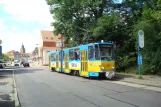
Gotha articulated tram 303
ScrappedTrams from Gotha
Select vehicle type: Articulated trams, freight cars, open freight cars, railcars, and sidecars.
Articulated trams from Gotha
Select vehicle number: 201, 202, 206, 207, 209, 211, 212, 215, 216, 301, 302, 303, 306, and 316.
The history of the tram
Thüringerwaldbahn und Straßenbahn Gotha
Operational
: Delivered as Gotha articulated tram 303, manufacturer Tatra, type KT4D, length 18.20 m, weight 22.0 t, power output 160 kW.

12:36
Documentary Thuringian Forest Railway and Gotha Tram - Part 1 (2020)An excellent documentary about the Gotha tram and the Thuringian Forest Railway. The documentary was very well-structured, engaging, and informative, especially since the Gotha tram is exciting both in terms of vehicle operation and the routes. The quality of the documentary was also excellent. Thumbs up, stay healthy, and LG Beni.
The tram is the most important means of transportation in Thuringia's fifth-largest city and connects it via the Thuringian Forest Railway to the Thuringian Forest. In this documentation, you will learn more about the route network and its more than 100-year history. We hope you enjoy it. As early as 1800, the idea of establishing a horse-drawn tram was considered. However, these plans did not gain support, so it wasn’t until 1893 that the city council decided to build an electric tram. The route runs from the central station to the election—now the road. The Gotha tram is 127 kilometers long and has been electric from the start. After the tram was sold to Index ITC AG in 1897, which now belongs to RWE, there were major plans to expand the route network to a railway via rural roads. Of the six routes considered, only today's line 4 was ultimately built. Bad Tölz was developed in 1812. The depot on Waltershäuser Straße was opened and is still in use today. Two years later, construction began on the line via Waltershausen to Tabarz. However, due to World War I and its aftermath, construction was suspended between 1915 and 1928, and it was only completed in 1929.
Similar to World War II, traffic was regulated between 9:45 and 9:47, then was nationalized and placed under municipal utilities. In 1954, the tram received new vehicles from the Gothaer Wagon Factory, the only tram manufacturer in the GDR. As a result, this freight car remains a household name for many today. In 1971, the inner-city line in Waltershausen was opened. After Gotha’s tram production stopped in 1967 in favor of importing Tatra trams from Czechoslovakia, Gotha received its first KTV railcar, which was a war trophy. Some of these were still running in 1981. Interestingly, freight traffic on the interurban routes occurred between 1982 and 1988. After reunification, the state-owned company was transformed into a limited liability company operated by municipalities along the route. To modernize the vehicle fleet, used trains began operating in the following years. The six trains from Mannheim were introduced in the 1990s, and routes were gradually modernized. Simultaneously, it was necessary to improve connections to the city, so 62 six-axle Bogestra trains were purchased for line 1 from the central station to Sunthausen. This also enabled direct turnarounds at the Gleisdreieck in Waltershausen. However, aside from one example, these vehicles are no longer in service today. In 2002, line 1 was extended from 2000 to the new terminus at the hospital—the first and last extension of this route.
Regarding the vehicles, the fleet includes three preserved original units: cars numbered three, four, and six. Additionally, cars 3, 107, 117, and 319 were acquired from the Herforder Straße coal plant in the early 2000s. Vehicles 207, 308, and Traut 11 still have their accelerator controls. Tett 1617 vehicles also feature accelerator controls on both side doors as they are used on line 6, which ends at the Gleisdreieck cinemas.
In 2012, the first low-floor vehicles, Bottas 4 g/t Achten, were acquired from Mannheim, with three still operating today, representing the only low-floor units in the fleet. To replace the Tatras, which were delivered directly according to quota, six B4 models from the Basel tram system were also added in 2009–2010, and they are still in operation. Besides planned vehicles, a few preserved historic tram lines mark the beginning of this network's ongoing history. For example, line 71 RB 20 runs on a two-hourly schedule from Dresden via Leipzig, Frankfurt, to Wiesbaden, with stops as noted in 2007.
Now, let's look at line 2, which runs up to Rote Straße and shares the same route as lines 1 and 4 up to that point. It operates Monday through Friday from 8 a.m. to 5 p.m. every 20 minutes, then until 10 p.m., and runs all day on weekends approximately every 30 minutes. The 3-kilometer route takes about 12 minutes. Shortly after leaving the central station, it passes through Bahnhofstraße to the same stop. West of this is the over-500-year-old Cutter Castle Park, covering 37 hectares, leading up to the next stop, the Orangery, which continues onward. The landmark that gives the hotel its name was built in 1700 and is planned to be the German Orangery Museum in the future. Also, here is Friedenstein Castle, built in the 17th century, serving as a gateway to the city center.By Regionalzugverband - .Thüringerwaldbahn und Straßenbahn Gotha
Operational
: Rebuilt to Gotha articulated tram 303, manufacturer Kiepe/Talbot, type KT4D-MOD 8 Gotha.
12:36
Documentary Thuringian Forest Railway and Gotha Tram - Part 1 (2020)An excellent documentary about the Gotha tram and the Thuringian Forest Railway. The documentary was very well-structured, engaging, and informative, especially since the Gotha tram is exciting both in terms of vehicle operation and the routes. The quality of the documentary was also excellent. Thumbs up, stay healthy, and LG Beni.
The tram is the most important means of transportation in Thuringia's fifth-largest city and connects it via the Thuringian Forest Railway to the Thuringian Forest. In this documentation, you will learn more about the route network and its more than 100-year history. We hope you enjoy it. As early as 1800, the idea of establishing a horse-drawn tram was considered. However, these plans did not gain support, so it wasn’t until 1893 that the city council decided to build an electric tram. The route runs from the central station to the election—now the road. The Gotha tram is 127 kilometers long and has been electric from the start. After the tram was sold to Index ITC AG in 1897, which now belongs to RWE, there were major plans to expand the route network to a railway via rural roads. Of the six routes considered, only today's line 4 was ultimately built. Bad Tölz was developed in 1812. The depot on Waltershäuser Straße was opened and is still in use today. Two years later, construction began on the line via Waltershausen to Tabarz. However, due to World War I and its aftermath, construction was suspended between 1915 and 1928, and it was only completed in 1929.
Similar to World War II, traffic was regulated between 9:45 and 9:47, then was nationalized and placed under municipal utilities. In 1954, the tram received new vehicles from the Gothaer Wagon Factory, the only tram manufacturer in the GDR. As a result, this freight car remains a household name for many today. In 1971, the inner-city line in Waltershausen was opened. After Gotha’s tram production stopped in 1967 in favor of importing Tatra trams from Czechoslovakia, Gotha received its first KTV railcar, which was a war trophy. Some of these were still running in 1981. Interestingly, freight traffic on the interurban routes occurred between 1982 and 1988. After reunification, the state-owned company was transformed into a limited liability company operated by municipalities along the route. To modernize the vehicle fleet, used trains began operating in the following years. The six trains from Mannheim were introduced in the 1990s, and routes were gradually modernized. Simultaneously, it was necessary to improve connections to the city, so 62 six-axle Bogestra trains were purchased for line 1 from the central station to Sunthausen. This also enabled direct turnarounds at the Gleisdreieck in Waltershausen. However, aside from one example, these vehicles are no longer in service today. In 2002, line 1 was extended from 2000 to the new terminus at the hospital—the first and last extension of this route.
Regarding the vehicles, the fleet includes three preserved original units: cars numbered three, four, and six. Additionally, cars 3, 107, 117, and 319 were acquired from the Herforder Straße coal plant in the early 2000s. Vehicles 207, 308, and Traut 11 still have their accelerator controls. Tett 1617 vehicles also feature accelerator controls on both side doors as they are used on line 6, which ends at the Gleisdreieck cinemas.
In 2012, the first low-floor vehicles, Bottas 4 g/t Achten, were acquired from Mannheim, with three still operating today, representing the only low-floor units in the fleet. To replace the Tatras, which were delivered directly according to quota, six B4 models from the Basel tram system were also added in 2009–2010, and they are still in operation. Besides planned vehicles, a few preserved historic tram lines mark the beginning of this network's ongoing history. For example, line 71 RB 20 runs on a two-hourly schedule from Dresden via Leipzig, Frankfurt, to Wiesbaden, with stops as noted in 2007.
Now, let's look at line 2, which runs up to Rote Straße and shares the same route as lines 1 and 4 up to that point. It operates Monday through Friday from 8 a.m. to 5 p.m. every 20 minutes, then until 10 p.m., and runs all day on weekends approximately every 30 minutes. The 3-kilometer route takes about 12 minutes. Shortly after leaving the central station, it passes through Bahnhofstraße to the same stop. West of this is the over-500-year-old Cutter Castle Park, covering 37 hectares, leading up to the next stop, the Orangery, which continues onward. The landmark that gives the hotel its name was built in 1700 and is planned to be the German Orangery Museum in the future. Also, here is Friedenstein Castle, built in the 17th century, serving as a gateway to the city center.By Regionalzugverband - .
7:09
Seven minutes of winter enjoyment on the Thuringian Forest Railway (2018)Just in time for the start of the winter holidays, there was a load of snow for the children in the Thuringian Forest. Reason enough to visit the Thuringian Forest and Gotha Tramway.By Straßen Bahn unterwegs mit dem Schienenonkel - .
5:41
Tram in Gotha and the Thuringian Forest Railway (2021)Today, there is a new video from the tram in Gotha and the Thuringian Forest Railway.By Spiegelwagen - .
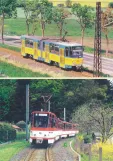
Postcard: Gotha regional line 4 Thüringerwaldbahn with articulated tram 303 near Friedrichroda (1999-2003)Top: KT4D 303 (built in 1981)
at Wahlwinkel on May 24, 1999
Below: KT4D traction 310-312 (built in 1990)
Friedrichroda curve before the stop on May 3, 2003
www.waldbahn-gotha.deBy Henrik Boye, Kirchberger, Thüringerwaldbahn und Straßenbahn Gotha - - .
9:34
Gotha Tram city line (2018)The Gotha tram is one of the smallest German tram companies. Tatra KT4D trams still dominate the operation. They could soon be replaced by used trams from Switzerland.
At the time the photos were taken, the section of the line to the main station was out of service due to renovation work.By worldtradesurfer - - .Thüringerwaldbahn und Straßenbahn Gotha
Operational
: Scrapped.