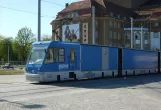
Dresden motor freight car 2002
Out of serviceTrams from Dresden
Select vehicle type: Auto lubrication vehicles, auto tower wagons, cable cars, freight cars, grinder cars, horse-drawn trams, low-floor articulated trams, motor freight cars, rail cleaning cars, railcars, service vehicles, and sidecars.
The history of the tram
Dresdner Verkehrsbetriebe (DVB)
Operational
: Delivered as Dresden motor freight car 2002, manufacturer Schalker Locomotives, type CarGoTram, width 2.20 m, length 59.00 m, manufactured 2001, power output 45 kW, max speed 50 km/h.

7:37
Dresden Cargotram (2013)The role of railway romanticism in introducing the Cargotram in Dresden.
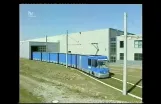
Our next stop is Dresden, home to the Volkswagen Transparent Factory. The luxury cars produced there don't receive their parts by truck, but by tram. This is the new VW freight tram in the company's livery, and it has been operating in Dresden since March 2001. Its purpose is to supply Volkswagen's newly built transparent car factory with materials. Currently, two of the five-car bidirectional freight trams are in use. Built by Schalker Eisenhütte Maschinenfabrik GmbH in Gelsenkirchen, the tram's design differs from the typical Dresden light rail model. At 59.4 meters, it is nearly twice as long, requiring the driver to be especially attentive. At certain intersections, it's advisable to stay alert and possibly avoid following the scheduled train to prevent closing off the entire intersection. Dresden has many traffic lights that change unpredictably or give priority to private vehicles, putting the tram to the test. The blue tram, in particular, is affected by this, running daily through the heart of Dresden's historic city center. The city's traffic is chaotic, cold, and unwelcoming, though the two trams are actually colleagues. The Dresden public transportation company operates the tram serving Volkswagen under a 15-year contract. After just 20 minutes of travel, the Transparent Factory comes into view. Behind 27,500 square meters of soundproofed windows, luxury-class cars are being assembled. A total investment of 186 million euros was made in this glass construction giant.
Compared to that, the price for a complete freight tram seems almost absurd. One train costs 1.75 million euros. When the production facility was built near the city center, a new logistics system was also set up outside Dresden. A goods distribution center was established, from which car parts are transported by train directly to the Transparent Factory site, creating a direct link to the Dresden tram network. This was actually a key argument in favor of the Transparent Factory location in local politics: it was said, okay, if delivery is done via an environmentally friendly tram, which is also more cost-effective because it only needs one driver instead of three, is fully integrated, causes no disruption, and makes better use of the track network, then it's an ideal solution that benefits everyone, not to mention the advertising and attention it draws.
Let’s take a quick step back: On November 14, 2000, the moment arrived. On a sleet night with a shiny, icy road surface, the first CarGoTram was brought to Dresden by heavy-duty transport. It was hard work for the people and machines involved. The unloaded transport train weighs 90 tons. A technical challenge also had to be overcome. Since Germany typically uses rails with a gauge of 1,435 mm, Dresden is an exception. Besides narrow-gauge railways, only Dresden and Leipzig in Germany don’t follow this standard. Dresden’s gauge is 15 mm wider. These extra 15 mm are on a standard track bed, which would have required significant wedging and additional safety measures for trucks, leading to extra costs.
Our challenge was to find vehicles with the Dresden gauge. It took us several days of phone calls, but then we had them. Where do they originate? They come from Eisenhüttenstadt. Another unique feature is the trolleybus station, which has been around for several decades. True to the motto "make old new," this fully motorized trolleybus station has an all-wheel drive train sourced from scrap Tatra vehicles. These trolleybuses were refurbished, and we installed a primary suspension system. We also replaced the DC motors with asynchronous machines from VEM, giving us a modern three-phase drive. As a result, we were able to significantly lower costs.
We are located in the Dresden-Friedrichstadt goods distribution center, situated on the outskirts of Dresden, where the Schnellecke Group, a supplier company, has taken over the storage and loading of the CarGoTram. The only downside is that the center is not yet connected to a DB track; however, this is expected to be completed by the end of July. Until then, car parts are still transported to the goods distribution center by truck. From here, the CarGoTram runs every 40 minutes to the manufacturing facility, operating 21 hours a day. By the way, due to its appearance, the train is also known as the Blue Wonder, much like the famous Dresden Bridge. This is fitting, as the train, like the historical Dresden, has now become an attraction. However, transporting goods by tram is nothing new to us—we have a long tradition of doing so.By Sebastian Lehmann - .Dresdner Verkehrsbetriebe (DVB)
Operational
: Out of service.