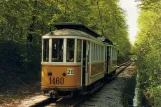
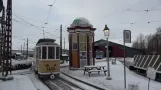
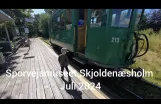
- : Vehicle number changed to Copenhagen sidecar 1460 (ex Copenhagen sidecar 916), manufacturer Scandia, series 412-436, width 2.00 m, length 10.00 m, manufactured 1912, 2 axles.
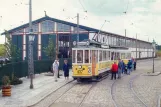
: Arrived at the museum as Skjoldenæsholm sidecar 1460 (ex Copenhagen sidecar 916), manufacturer Scandia, series 412-436, width 2.00 m, length 10.00 m, manufactured 1912, 2 axles.
3:07
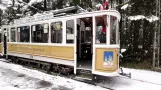
Christmas at the Sporvejsmuseet Skjoldenæsholm (2021)For the 31st time, the traditional Christmas event featuring mulled wine, apple slices, a visit from Santa Claus, and the sale of Christmas trees took place at Sporvejsmuseet Skjoldenæsholm on the weekend of December 11 and 12.By SporvognDK - .
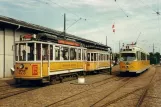
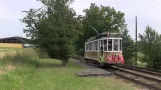
Postcard: Skjoldenæsholm standard gauge with railcar 275 at The tram museum (2001)In 2001, the Tram Museum succeeded in bringing home two of the Copenhagen articulated trams that had been running in Alexandria, Egypt for about 30 years. In the street between the museum's two depots, no. 890 (DÜWAG/Copenhagen Trams 1966) is photographed together with motor car no. 275 (Scandia 1907) and sidecar no. 1460 (Scandia 1920) from Copenhagen Trams.By Henrik Boye, Sporvejshistorisk Selskab (SHS) - .
Postcard: Skjoldenæsholm standard gauge with railcar 437 at Valby Gamle Remise (1998)The old Valby Remise from 1901 was rebuilt at the Tram Museum in the years 1995-98. In front of the depot is a train from Copenhagen Trams with motor car no. 437 and sidecar no. 1460. Both were built by Scandia in 1918 and 1920 respectively.By Henrik Boye, Sporvejshistorisk Selskab (SHS) - .
The Tram Museum Christmas Part 3 (2021)This video is part 3 of 3
Clips in the video are recorded using the Oppo Find X3 Pro and the Vivo X60 Pro+By Dinglehopper - .
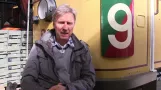
The Tramway Museum - Visit by Jørgen de Mylius (2013)The well-known radio personality and DJ Jørgen de Mylius visited Sporvejsmuseet with his family on Sunday, 28 April 2013.
In addition to trying his hand as a coach driver, he also talks briefly about the memoir "Thanks for all the music."
In January, Jørgen de Mylius celebrated his 50th anniversary at Danmarks Radio. To mark the occasion, he wrote a memoir titled "Thank You for Everything." In his musical journey, he reflects on over 50 years of experience with music. However, he also discusses his interest in the track, as he describes it himself. I had a chat with Jørgen de Mylius about his fascination with the track, but first, we're going out for a ride on the track with Jørgen de Mylius as the driver. You should be allowed to take control sometimes, so I am sure that... Have you turned it on? Have you turned it off? Now Ling Bu is coming like this? Do you give it one, two, three, four, five? Yes, okay, like this? Have you seen Ling Bu's girls? It was the one that only drove past the animal school, and then they were marked up. I teach my girls a little bit. Yes, of course, high. Yes, you definitely need that. I say yes, give two rams, thank you. Yes, we are looking at the signal. No, I. Then you give a contact to increase the number up to three until you reach the switching track, like this. No, I. I drove it so often, especially to Aarhusgade depot, because he often got off there and then back in zero years; his name is Larsen. It was so sweet of a father; I was always allowed what I could stand. Now, now we give it Pl again. Ah, how nice it is, Jørgen de Mylius. You have just been driving a car with the number 437. When we look at the annual report from the FR Tram Museum from 1984, you were also out driving in the same car. How did you feel about the reunion? What? Yes, nice reunion. I love both the sound of the tram and the general spirit of a tram. I still feel that way. I think it was terrible that those mayors—and the mayor and his apprentices—when they decided to abolish the trams, did not realize that closing some lines was not the way forward; they should have at least kept 10 or 8 of the lines. It was much, much better than those buses; rather than throwing all that away. You describe your interest in the track in the book you wrote about your 50th anniversary in Denmark, "Thank You for Everything." The music there describes your interest in the track, which dates back to childhood. Yes, it was kind of like that. It was because the music came in and took over a bit. There was an overlap, I would say, but it took over that interest. Before that, I spent most of my free time riding the tram. Many other healthy boys stood there, writing license plates on cars and doing strange things. However, I became interested in trams and categorized them with a good friend, Leif Sundby, who was then known as Leif Larsen, with whom I was in class. We drove around and then kept a note at home for every single tram we discovered. Oh, and our hobby was driving around, seeing if they were signposted from line nine to line 15 because that's what they did every now and then. If you suddenly saw a train of cars broken down, they would take one left over on line 15 and re-signpost it to line n9, and similar actions would be taken. That was our hobby, and through it, I also got to know Copenhagen in a really fantastic way. We cycled around every year; for my birthday, I got a tram network card—my biggest wish each year. It was at the top of my wish list, and I received a network card. You also describe your interest in the sport in your book as a special interest, but it developed a little later in life, when you started doing pokis on DR. There, a participant named Claus Petersen appears. Yes, and what's funny about him was that he came in, and I finally found a mate who was just as interested in rock music and pop music as I was, and with whom I could talk. I always felt a bit alone in the '60s; on the radio, there was only me interested in pop and rock music. I was also the only one who played it and talked about it with SP. I didn't really have anyone to talk to. When I sat with colleagues, some weren't really interested—they actually had other priorities. So, suddenly, I met someone who was really into it with life and soul, just like me. One day, he said to me, 'By the way, I've read some interviews with you,' and we discovered that we shared a different interest. It turned out that, although he was four years younger, he was also hugely interested in trams. I think that was fantastic. We both had two slightly different interests—partly and partly. But many people interested in music took it so seriously that we went into detail, and we did the same with the track. Our shared interests and work also led us to go to the Tram Museum in 1979 to record some sessions with the Lollipops. He was also exceptionally skilled in music, and I hired him to assist me with various programs.By SporvognDK - .
18:55
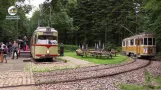
The Tramway Museum Skjoldenæsholm video (2024)A short video from the Tramway Museum Skjoldenæsholm.
A look at their workshop and exhibitions.
Nice exhibitions of trams and buses. And there is the possibility of driving with several trams in the area.By VærdAtSe - .
The Tramway Museum - Traffic Weekend (2015)On Saturday, July 25, and Sunday, July 26, 2015, the Skjoldenæsholm Tram Museum hosted its annual traffic weekend.
Around 2:00 p.m., on the way back to the museum, we passed the newly built Depot 3, where the first two tracks are now complete — a scene even passengers on horse-drawn omnibuses can enjoy. Museum manager Michael Lund was busy, as guests from Germany arrived and needed guidance to their parking spots at the maritime university, which is one and a half kilometers from the Tramway Museum. Several vintage car owners waited eagerly for the tour to continue at the museum. The tour first circled Valsø's smaller lake, with Copenhagen's Royal Tiger tracks guiding the way. Upon arriving at the museum, the vintage cars were greeted by the organizer, Veterans, who distributed informational materials to the participants. Despite a heavy daily rainstorm, the Tramway Museum managed to avoid heavy rain on Saturday morning. After a few hours of visiting, the German guests prepared to continue to Sweden. Leaving the museum was orderly, with horns and lights used to signal.
At 2 p.m., the awards ceremony for the vintage cars took place. One of the winners was Erling Roland Petersen, with his 1957 M 1000, of which I am the fifth owner. It originally ran on Funen, and when I bought it, I picked it up in Jutland. I first visited it in 2000, and it was an exciting experience; I was fortunate as well. My lady and I previously won prizes for best costume, and today I was lucky enough to receive an award for the best-looking car of the year. The guests had an unexpectedly extraordinary experience—a good old-fashioned punch from the Bostok truck train. The truck train couldn't drive back to the museum under its own power, so assistance was requested to pull it. Is anyone available to signal after the Bostok truck train has been moved? Can the other trucks start their trip back to the museum? The museum closed at 5 p.m. and reopened at 5:16 p.m. The café truck, as the last vehicle to leave, was also part of the return journey. On the way back, Melb's cart, although on the road, still operated smoothly under Eif Petersen's expert supervision. There was plenty of space, and the café truck was able to drive into the shed after a long day in the forest.By SporvognDK - - .