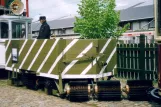
Copenhagen service vehicle S2
Exhibited in a museumTrams from Copenhagen
Select vehicle type: Articulated trams, bilevel rail cars, horse-drawn trams, low-floor articulated trams, model railcars, model sidecars, open model sidecars, open sidecars, railcars, service vehicles, sidecars, tower wagons, and track cleaning trams.
The history of the tram
Copenhagen Tramway (KS)
Closed
: Delivered as Copenhagen service vehicle S2, manufacturer Københavns Sporveje (KS), type Snefejevogn.
Tram Museum Skjoldenæsholm
Open regularly
: Arrived at the museum as Skjoldenæsholm service vehicle S2 (ex Copenhagen service vehicle S2), manufacturer Københavns Sporveje (KS), type Snefejevogn.
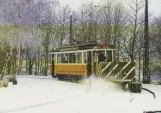
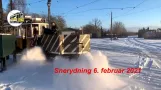
Postcard: Skjoldenæsholm standard gauge with service vehicle S2 in front of The tram museum (2005)The museum's snow gear during testingBy Henrik Boye, Sporvejshistorisk Selskab (SHS) - .
7:45
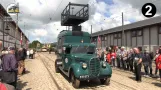
The Tramway Museum - Great Cavalcade Day, II (2015)On the occasion of the Tram Historical Society's 50th anniversary on February 8, 2015, the Tram Museum Skjoldenæsholm held a cavalcade on Saturday, June 20, 2015, with all ready-to-run museum vehicles arranged in order by date of acquisition
Content:
00:00 Start
00:17 Copenhagen Trams KS 587
01:10 NESA tower car 501-02
03:20 About the establishment of a tram museum
04:30 Copenhagen Trams grinding car S1
04:40 Snow sweeper
04:50 Tower for line maintenance
05:35 Copenhagen Trams KS 22
07:00 Copenhagen Trams 389/1172
When the trams in Copenhagen were retired, they acquired a larger collection of trams, which were given to them by the trams themselves. One of these, 587 line 8, is standing in front of us. It was built in 1940 and was in service until the very end. From the trams, they received four Buggy carriages, two engines, two sidecars, and two trailers, one of which we will see in a moment. The carriages were stored in the Svanemøllen depot, where our members could work on them. 587 has recently been refurbished here at the museum, so it now appears in a beautiful and nearly new condition. The next carriage that arrives may perhaps show more versatility, as it wasn't just trams and buses; work vehicles are also part of the collection. And here comes our bus with our beautiful 1938 Ford V8, Nesa F 50102, an automobile tower carriage used for wiring repairs. This is done from the platform on the roof. The carriage is ejected by a hydraulic pump, allowing it to be used. The handle, the small wheel at the top of the tower, can lift the tower to quite a height, and as you might notice, the carriage is not equipped with support legs, so when the tower is fully raised, it’s quite an experience to stand up there. The last time the carriage was used was, among other things, during the establishment of street lighting at Lyngbyvejen to enhance the street's profile, where the carriage could be utilized. Since then, it was brought here for maintenance and then taken to Dong to be restored. The carriage has been refurbished at Nesa and Dong's workshops. I can tell you that when the carriage was poorly repaired, it had to be presented to the members of the Association, which happened at our annual Members' Day, where all members are invited. And there we were, about to demonstrate the carriage and talk about it when it started running. Yes, there was actually damage, so the carriage is usually exhibited inside the Valby Remise, with an opportunity to look into the box at the back, where a small workshop has been set up for on-site repairs.
I mentioned earlier that they were working on establishing a tram museum. The association's management saw that the project in Brøndby was unlikely to be feasible, so they decided instead to advertise in various newspapers, including local papers on Zealand, both to find space for a sports museum and to store trams because they expected that after the closure of track operations in Copenhagen, it would no longer be possible to store trams there. They contacted a nearby farmer, who recommended the landowner, Vilen Brundin Nergaard, at Skørn Desholm Estate. This was done on December 23, 1971, and communication was immediate and positive. He was farsighted and thought it was a good idea to have a sports museum at Skørn Holm. In 1972, they took over a barn, and this is the carriage that arrives. Here, Copenhagen's tram S1 has a snow wagon mounted in front, used to clear snow from the streets.
Similar wagons featured a salt grinder, allowing for the addition of salt as well. A tower is mounted at the back to keep it on the track. S1 was built in 1900 as a two-story traffic control vehicle. Two years later, it was converted for overhead line operation, and in 1924, it was modified into a single-story tram. In 1952, S1, also known as number 23, was converted along with a sister vehicle and operated as a rail-based tram until its closure in 1972. The SS took over both wagons and began converting S2 into a traffic control vehicle in the form of a double-decker, as it appeared after its 1924 conversion. However, one of our members, the man behind our department on Bornholm, believed that a double-decker was too dull, so he initiated a project to restore S2 to its original 1915 version, featuring a closed front and rear by the driver and the addition of a first floor to provide cover and style. Now, it’s back in regular operation here at the museum and will be able to run in traffic today. At the back is the open sidecar 389, built in 1909 and retired as a museum piece in 1936. It later belonged to the HT Museum, and in 2003, it was acquired by the museum. Open sidecars were common in Copenhagen until 1936, when they were taken out of service; most were then sold to tram operators in Helsinki.By SporvognDK - .
12:33
The tramway museum in Skjoldenæsholm (2023)Intensive traffic day with trams every 5 minutes, as well as vintage cars and buses. Not all trams ran with passengers, but ran for the photographers.By jvltog - .
5:01
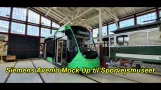
Tram Museum Skjoldenæsholm - MockUp by Siemens Avenio (2020)On June 17, 2020, the mock-up of the Siemens Aveni that will run on Ring III from 2025 arrivedBy SporvognDK - .