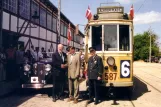
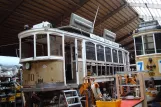
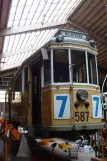
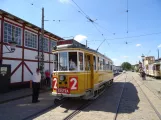
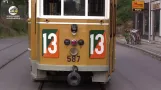
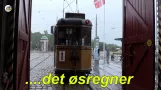
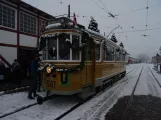
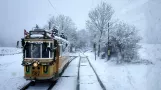
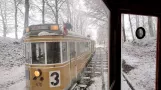
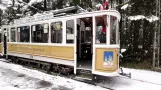
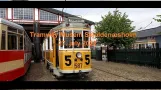
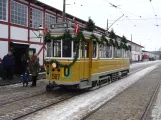
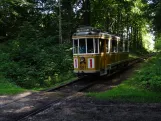
: Delivered as Copenhagen railcar 587, manufacturer Københavns Sporveje (KS), type Bogiemotorvogn, series 501-618, width 2.02 m, length 12.30 m, manufactured 1930-1941, with 28 seats and 39 standing places.
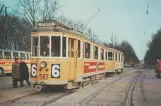
: Rebuilt to Copenhagen railcar 587, manufacturer Københavns Sporveje (KS), type Bogiemotorvogn, series 501-618, width 2.02 m, length 12.30 m, manufactured 1930-1941, with 28 seats and 39 standing places.
Postcard: Copenhagen tram line 6 with railcar 587 at Vibenshus Runddel (1969)Tram Museum, Skjoldenæsholm
Copenhagen Tramways, Bogiemotorcar no. 587 (KS main workshop 1939) with corresponding sidecar as line 6 on Øster Allé at Vibenshus Runddel on March 27, 1969. This and another motorcar and two bogie sidecars are now owned by the Tramway Historical Society.By Henrik Boye, Sporvejshistorisk Selskab (SHS) - .
: Arrived at the museum as Skjoldenæsholm railcar 587 (ex Copenhagen railcar 587), manufacturer Københavns Sporveje (KS), type Bogiemotorvogn, series 501-618, width 2.02 m, length 12.30 m, manufactured 1930-1941, with 28 seats and 39 standing places.
3:07
Christmas at the Sporvejsmuseet Skjoldenæsholm (2021)For the 31st time, the traditional Christmas event featuring mulled wine, apple slices, a visit from Santa Claus, and the sale of Christmas trees took place at Sporvejsmuseet Skjoldenæsholm on the weekend of December 11 and 12.By SporvognDK - .
Lucca drives a tram (2016)Lucca tries to drive a tram at Sporvejsmuseet Skjoldenæsholm.
Please turn on the power and ring the bell before we start moving. Hard step like this, then it comes here toward me, and you take one more step. Stay right here with a high B on zero while we review this sporty section. Queue up here toward me and take another step. If there are two, it doesn't matter; we have K SK, not too much. Take one more step. Yes, then we’ll soon come to a stop. You need to drive back to zero, ready to brake. Pull it toward yourself to start with one. Hit one more, then again, again, and again. One more time, then the last one. You’ll see a signal with an 'S' indicating 'Stop'. Change the signal so we can get ready. Please ring the bell once before we drive. Queue up here again, then stay right until you hit the switch. Drive it back to zero, then you can do that now. Drive toward me—one, two, three, four, five. More, now more. One more here, then again. See how it goes. Okay, now we stop here. Return to zero. Be ready to brake—you take one, then one more, again, again, and again. Quietly and calmly, brake softly; it’s nice here. Back to zero. As soon as we stop, we drive again—ring the bell. Drive toward me with one more, then again. One more. Last one. We’ll come to a switch soon, where we’ll drive slowly in, then back to zero. Start braking with the Brake Switch—one more now. Stay at the switch until we get closer to the stop, then brake further down—no further, and again, again. The last one, then back to zero. Stop gently. Drive toward me again—one more. Nice, then back to zero. We’ll do one-two here toward me—no, the other way, the other way—toward me, then back to zero. There’s a crossing now, so ring the bell a few times. Come in. Great, then drive back toward me—one more, and again. One more, then again. There’s a stop down here on the right, so soon you'll go back to zero. Do that now, then start braking and continue without me saying anything—brake a little more, then back to zero when we stop. Ring the bell, then drive back. Drive toward me—one more, then again. One more, then back to zero. Approach with the switch in—good. Then back to zero again. Now, throw the switch toward me. Then it drives. Yes, you hit exactly where you need to, like that, and then back to zero. Now we'd better wait until he's filled up a little—that green one with the signal that says 'S' over there. Now we're going out and telling the signal system that we'd like to run when it's free. So now you're going out to work outside. I'm going to have to go all the way over there in the rain. No, it's not that much right now. Look here, here. Look, you hang it so that it hangs down there, then you turn it one way or another. Look, now the light came on in there. Then we've told the signal system we'd like to run it when it's free. So, we can get into the tram and get ready on that side toward me. R, R, you hit it fine; when you hit the switch, you drive it back to zero. That's enough. Who wants to own it? One more. And one more. And one more. Then it just runs. If you turn, then you drive back to zero. Right when you're underneath the bridge, you take a quick brake check. I'm all the way up to number five for Yes. We need to maintain the right speed. We're speeding up, then back to zero, and then you have to start braking with a Brake Switch one more time. Now, and one more there. Next, and one more thing. And the last one too. Okay, we can drive first, says the horse. Back to zero. Yes, then you ring the bell, and then you drive here toward me with a switch. Yes, nice, and one more. And then it returns to zero due to the next switch. We come to the very board switch, so there. Shall we drive quietly in? So, you can take two. The brake control signal says, 'What can we drive?' Yes. Then you give it a quick beat. Yes, FL. Then you drive back. Lucca tries to drive a tram at Sporvejsmuseet Skjoldenæsholm, K to NE. Then we drive one, two, three, four, five—here toward me. Yes, here toward me. And one more, one more, and then back to zero, because we will soon reach SK. What is the name of this stop here? Now you start to brake with a Brake Switch, and one more. And one more. By Jeppex - .
5:10
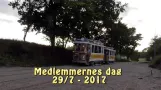
Members' Day (2017)On 29/7 - 2017, Sporvejsmuseet Skjoldenæsholm held their annual "members' day", which ended with a diploma run.
This year's "surprise" was KS 567 and 226.By SJB Media 1996 - .
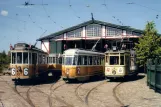
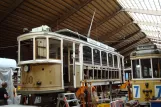
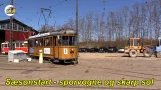
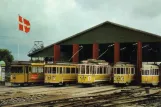
Postcard: Skjoldenæsholm railcar 1 by Depot 1 (1978)Some of the Tram Museum's trams in front of the depot. From left: Aarhus Trams' motor car no. 1 (Copenhagen Trams 1945), Copenhagen Trams no. 470 (KS 1945), Copenhagen Trams no. 275 (Scandia 1907), Copenhagen Trams no. 587 (KS 1939) and Copenhagen Trams no. 701 (KS 1949).By Henrik Boye, Sporvejshistorisk Selskab (SHS) - .
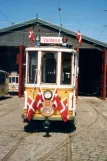
Postcard: Skjoldenæsholm railcar 587 by Remise 2 "Valby Gamle Remise" (1999)Valby Old Depot from 1901 was rebuilt in 1995-98 at the Skjoldenæsholm Tram Museum, where it now forms the framework for the museum's exhibition.
In front of the depot, line 6 bogie train KS 587 and 1552 Ks' main workshop 1940 and 1934 respectively) and line 2 KS 701 (KS' main workshop 1949). On the right, Haag wagon HTM 824 (La Brugeoise 1929).By Henrik Boye, Sporvejshistorisk Selskab (SHS) - .
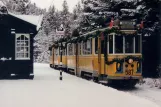
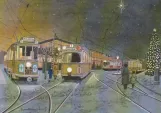
Postcard: Skjoldenæsholm railcar 587 by Remise 2 "Valby Gamle Remise" (2005)The Skjoldenæsholm Tram Museum in Christmas and winter clothes: The late co-founder and honorary member John Lundgren, who would have turned 80 on December 20, 2010, managed to make a total of more than 550 hand-colored drawings with trams and buses as motifs.By Henrik Boye, John Lundgren, Sporvejshistorisk Selskab (SHS) - .
Postcard: Skjoldenæsholm standard gauge with railcar 587 at Eilers Eg (2000)At the Tram Museum's Christmas event, it is a tradition for line 0 to be put into service. In the years 1953-56, the line ran for a single day in December as a collection vehicle for the daily newspaper Social-Demokraten.
At the museum's terminus Eilers Eg, KS motor car no. 587 (KS' main workshop 1940) and sidecar no. 1552 (KS' main workshop 1934) can be seen.By Henrik Boye, Sporvejshistorisk Selskab (SHS) - .
Postcard: Skjoldenæsholm standard gauge with railcar 587 at Valby Gamle Remise (2003)The Skjoldenæsholm Tram Museum celebrated its 25th anniversary in the summer of 2003. The anniversary was celebrated with a large cavalcade, in which 28 trams and 6 buses participated.
The cavalcade was initiated by Minister of Culture Brian Mikkelsen.
On the left, King Christian X's Cadilac, belonging to the Jystrup Car Museum.By Henrik Boye, Sporvejshistorisk Selskab (SHS) - .
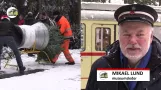
The Railway Museum - Great Cavalcade Day I (2015)On the occasion of the Railway Historical Society's 50th anniversary in February, the Railway Museum held a cavalcade with 68 of the museum's vehicles on 20 June 2015.
In the first episode, you can see the speeches by museum manager Mikael Lund and Ringsted's mayor Henrik Hvidesten (V).By SporvognDK - .
11:39
The Tram Museum Christmas Part 3 (2021)This video is part 3 of 3
Clips in the video are recorded using the Oppo Find X3 Pro and the Vivo X60 Pro+By Dinglehopper - .
The Tramway Museum - From the archives 8 (2012)June 2012: KS 587 is test-driven after having the bogies renovated in Gera.
A film company has hired the "railway crossing" to film a trailer for the Zulu Comedy Awards.By SporvognDK - .
7:45
The Tramway Museum - Great Cavalcade Day, II (2015)On the occasion of the Tram Historical Society's 50th anniversary on February 8, 2015, the Tram Museum Skjoldenæsholm held a cavalcade on Saturday, June 20, 2015, with all ready-to-run museum vehicles arranged in order by date of acquisition
Content:
00:00 Start
00:17 Copenhagen Trams KS 587
01:10 NESA tower car 501-02
03:20 About the establishment of a tram museum
04:30 Copenhagen Trams grinding car S1
04:40 Snow sweeper
04:50 Tower for line maintenance
05:35 Copenhagen Trams KS 22
07:00 Copenhagen Trams 389/1172
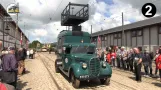
When the trams in Copenhagen were retired, they acquired a larger collection of trams, which were given to them by the trams themselves. One of these, 587 line 8, is standing in front of us. It was built in 1940 and was in service until the very end. From the trams, they received four Buggy carriages, two engines, two sidecars, and two trailers, one of which we will see in a moment. The carriages were stored in the Svanemøllen depot, where our members could work on them. 587 has recently been refurbished here at the museum, so it now appears in a beautiful and nearly new condition. The next carriage that arrives may perhaps show more versatility, as it wasn't just trams and buses; work vehicles are also part of the collection. And here comes our bus with our beautiful 1938 Ford V8, Nesa F 50102, an automobile tower carriage used for wiring repairs. This is done from the platform on the roof. The carriage is ejected by a hydraulic pump, allowing it to be used. The handle, the small wheel at the top of the tower, can lift the tower to quite a height, and as you might notice, the carriage is not equipped with support legs, so when the tower is fully raised, it’s quite an experience to stand up there. The last time the carriage was used was, among other things, during the establishment of street lighting at Lyngbyvejen to enhance the street's profile, where the carriage could be utilized. Since then, it was brought here for maintenance and then taken to Dong to be restored. The carriage has been refurbished at Nesa and Dong's workshops. I can tell you that when the carriage was poorly repaired, it had to be presented to the members of the Association, which happened at our annual Members' Day, where all members are invited. And there we were, about to demonstrate the carriage and talk about it when it started running. Yes, there was actually damage, so the carriage is usually exhibited inside the Valby Remise, with an opportunity to look into the box at the back, where a small workshop has been set up for on-site repairs.
I mentioned earlier that they were working on establishing a tram museum. The association's management saw that the project in Brøndby was unlikely to be feasible, so they decided instead to advertise in various newspapers, including local papers on Zealand, both to find space for a sports museum and to store trams because they expected that after the closure of track operations in Copenhagen, it would no longer be possible to store trams there. They contacted a nearby farmer, who recommended the landowner, Vilen Brundin Nergaard, at Skørn Desholm Estate. This was done on December 23, 1971, and communication was immediate and positive. He was farsighted and thought it was a good idea to have a sports museum at Skørn Holm. In 1972, they took over a barn, and this is the carriage that arrives. Here, Copenhagen's tram S1 has a snow wagon mounted in front, used to clear snow from the streets.
Similar wagons featured a salt grinder, allowing for the addition of salt as well. A tower is mounted at the back to keep it on the track. S1 was built in 1900 as a two-story traffic control vehicle. Two years later, it was converted for overhead line operation, and in 1924, it was modified into a single-story tram. In 1952, S1, also known as number 23, was converted along with a sister vehicle and operated as a rail-based tram until its closure in 1972. The SS took over both wagons and began converting S2 into a traffic control vehicle in the form of a double-decker, as it appeared after its 1924 conversion. However, one of our members, the man behind our department on Bornholm, believed that a double-decker was too dull, so he initiated a project to restore S2 to its original 1915 version, featuring a closed front and rear by the driver and the addition of a first floor to provide cover and style. Now, it’s back in regular operation here at the museum and will be able to run in traffic today. At the back is the open sidecar 389, built in 1909 and retired as a museum piece in 1936. It later belonged to the HT Museum, and in 2003, it was acquired by the museum. Open sidecars were common in Copenhagen until 1936, when they were taken out of service; most were then sold to tram operators in Helsinki.By SporvognDK - .
The Tramway Museum Skjoldenæsholm video (2024)A short video from the Tramway Museum Skjoldenæsholm.
A look at their workshop and exhibitions.
Nice exhibitions of trams and buses. And there is the possibility of driving with several trams in the area.By VærdAtSe - .
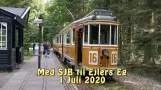
With SJB to Ejlers Eg - Sporvejsmuseet Skjoldenæsholm (2020)In July 2020, SJB took a ride behind the wheel on KS 587 to Eilers Eg, at Sporvejsmuseet Skjoldenæsholm's usual track section. Along the way, some information is shared about the stretch, both with text and with one of the museum's knowledgeable conductors in the background.
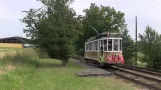
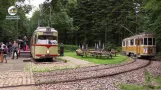
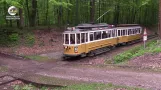
With SJB heading to Eilers Eg (Eilers Oak), the forecourt is where the trams leave for the forest. Welcome aboard Line 16 from Copenhagen. I won't say too much yet, except that you might find this an unusual place for city trams to run through the forest or the gold court. So, we’ve tried to make this first section feel a bit more city-like by adding scenery meant to look like shops; however, they aren't real shops, just 1.5 meters deep. They're decorated with various items I'd like you to enjoy. I'll be quiet for a moment. The museum street Tobakmarken (Tobacco field), opened in 1985 and closed in 2017, marks where the line becomes single-tracked, with signals controlling traffic. On the left, the signals are marked with "S" for stop and "I" for go. I also want to tell you about the trams you're riding in. They originate from the Copenhagen Tramways and are part of a class that includes 118 motor cars and 83 trailers built in the 1930s. By this time, the first electric trams from 1901 to 1910 were showing their age. The fact that they ran until 1966 is a story in itself, but that’s why this class was built. Design-wise, they turned out well, with both motor cars and trailers now identical, unlike at the start of the 20th century. This class lasted until Copenhagen's last tramline closed in 1972. Tram 587 was built in 1940, making it one of the later ones in the class. Flemmingsminde (in memory of Flemming), opened in 1987, is where we are now, at a stop called 'Flemmingsminde." On our right, there's a small shed serving as a waiting room, initially placed at Vestre Kirkegårds Allé when the tram line was served by horse trams in 1893. It is 127 years old. When electric trams were introduced, they continued to serve. After buses took over, the area became obsolete as a waiting space, because buses could now go directly to the graveyard. The stop is named after a society member who fell over a mast for the overhead wires in 1985—the remains of the toppled mast can still be seen next to the first mast on the left. After the tram service ended here, the waiting room was used as a tool shed by graveyard workers, allegedly made out of old gravestones. Inside, there's a small exhibit about the railway the tramway was built on—the Midland Railway, which only operated for 11 years before closing. We’re now approaching "Skovkanten" (Forest's Edge), signaling we're entering the forest. Here, we'll pass another tram from today—a double-decker from 1900. Fun fact: Copenhagen was the only Scandinavian capital to have this tram type. Your tickets are valid on all trams, so if you want to ride the double-decker, feel free. Skovkanten opened in 1990. The tram passes Gammel Sparegodtvej (Old Sparegodt Road), where the driver rings the bell to alert pedestrians. On the left, you can see the stop of the same name. Broen (The Bridge), opened in 1993 with a new platform added in 2018, is the next stop. It’s named "Broen" because of the nearby bridge about 50 meters ahead, built where a railway once ran, and a road crossing was needed. The bridge is still owned by BaneDanmark (rail infrastructure), who occasionally check its condition rather than replacing it. It's also a popular photo spot for tram enthusiasts. We'll soon reach the terminus, Eilers Eg (Eilers Oak), and after a short break, we'll head back to the museum. You're welcome to stay on or get off and walk in the forest. Eilers Eg opened in 1999. Here, the tram enters a loop and passes the museum's café, with a tram from Düsseldorf to the right. The tram attendant is just reminding passengers that trams run at 10-minute intervals. The tram on the left is a mockup used on a Copenhagen school’s playground, replacing an old trailer. You can enjoy food that's been brought along, even if the weather’s bad. The waiting room to the right, located initially at Fruens Bøge (the lady's beech), is now part of the museum, donated by Odense City Council. More info about the museum: www.Sporvejsmuseet.dk. Thanks for riding with us!By SJB Media 1996 - .
4:45
The Tramway Museum - Traffic Weekend (2015)On Saturday, July 25, and Sunday, July 26, 2015, the Skjoldenæsholm Tram Museum hosted its annual traffic weekend.
Around 2:00 p.m., on the way back to the museum, we passed the newly built Depot 3, where the first two tracks are now complete — a scene even passengers on horse-drawn omnibuses can enjoy. Museum manager Michael Lund was busy, as guests from Germany arrived and needed guidance to their parking spots at the maritime university, which is one and a half kilometers from the Tramway Museum. Several vintage car owners waited eagerly for the tour to continue at the museum. The tour first circled Valsø's smaller lake, with Copenhagen's Royal Tiger tracks guiding the way. Upon arriving at the museum, the vintage cars were greeted by the organizer, Veterans, who distributed informational materials to the participants. Despite a heavy daily rainstorm, the Tramway Museum managed to avoid heavy rain on Saturday morning. After a few hours of visiting, the German guests prepared to continue to Sweden. Leaving the museum was orderly, with horns and lights used to signal.
At 2 p.m., the awards ceremony for the vintage cars took place. One of the winners was Erling Roland Petersen, with his 1957 M 1000, of which I am the fifth owner. It originally ran on Funen, and when I bought it, I picked it up in Jutland. I first visited it in 2000, and it was an exciting experience; I was fortunate as well. My lady and I previously won prizes for best costume, and today I was lucky enough to receive an award for the best-looking car of the year. The guests had an unexpectedly extraordinary experience—a good old-fashioned punch from the Bostok truck train. The truck train couldn't drive back to the museum under its own power, so assistance was requested to pull it. Is anyone available to signal after the Bostok truck train has been moved? Can the other trucks start their trip back to the museum? The museum closed at 5 p.m. and reopened at 5:16 p.m. The café truck, as the last vehicle to leave, was also part of the return journey. On the way back, Melb's cart, although on the road, still operated smoothly under Eif Petersen's expert supervision. There was plenty of space, and the café truck was able to drive into the shed after a long day in the forest.By SporvognDK - - .