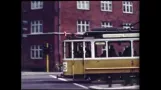
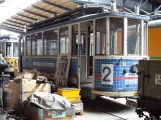
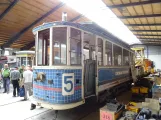
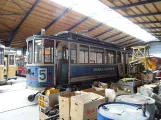
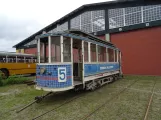
: Delivered as Copenhagen railcar 557, manufacturer Falkenried/N. Larsen/Scandia, type Hovedtype, series 105-234, width 2.10 m, length 8.90 m, manufactured 1901-1910, with 20 seats and 26 standing places, 2 axles.
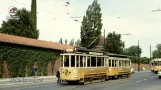
- : Vehicle number changed to Copenhagen railcar 257 (ex Copenhagen railcar 557), manufacturer Falkenried/N. Larsen/Scandia, type Hovedtype, series 105-234, width 2.10 m, length 8.90 m, manufactured 1901-1910, with 20 seats and 26 standing places, 2 axles.
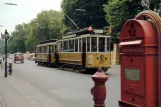
5:00
Farewell to the old carriages - On a trip with line 16 (1966)50 years ago - on 1 May 1966 - Copenhagen's Sporveje decommissioned the last old two-axle carriages. The Tram History Society organized a number of trips on different tram lines - in this film you can see a look back at the trip on 5 June 1966, which took place on line 16.By SporvognDK - .
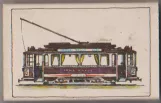
Matchbox: Copenhagen railcar 257 (1978)Modernized Copenhagen railcar from 1925. Ran in 1967 as an advertisement for IRMA KAFFE which was served during the journey.
Drawn by Bo Bonfils for Irma '78By Bo Bonfils, Henrik Boye, Irma - .
Postcard: Copenhagen railcar 257 at Sjællandsgade (1966)Tram Museum Skjoldenæsholm
Copenhagen Tramway motor car no. 257 (DKS' main workshop 1907) on Nørrebrogade on Sjællandsgade during SHS excursion on June 5, 1966.
Line 16's service to Søborg ceased in 1962.By Henrik Boye, Sporvejshistorisk Selskab (SHS) - .
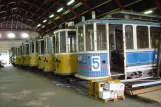
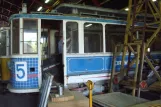
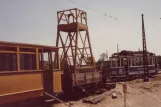
: Arrived at the museum as Skjoldenæsholm railcar 257 (ex Copenhagen railcar 557), manufacturer Falkenried/N. Larsen/Scandia, type Hovedtype, series 105-234, width 2.10 m, length 8.90 m, manufactured 1901-1910, with 20 seats and 26 standing places, 2 axles.
18:09
A visit to Bornholm with SHS (2016)On September 4, 2016, Sporvejshistorisk Selskab (SHS) took a trip to Bornholm, where, among other things, the road was laid past the workshops in Østermarie and Trio, as well as the railway museum in Nexø.
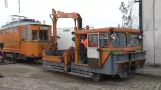
On Saturday, April 9, members of the Tramway Historical Society gathered on Bornholm to inspect several locations, including the tram workshop in Østermarie, which appears in the first clips here. The carriage we will first examine is one of the many projects about to be put into service by the Danish Tramway Authority on Bornholm, namely KS 567. The carriage, previously owned by the Transfer Club with Skelskør, is now being restored to its original form, known as the Skørven, named after the distinctive fenders added to the cars to reduce sick days for the driver. The carriage, acquired by the Tramway Museum in 2011, dates back to 1907. Its restoration began in 2012 and is expected to be completed within another year, after which it will be able to operate under its own power. During the museum's visit to the workshop, the carriage was primarily designated as line OT. However, at one end, it served more than just one line—lines 13 and 15—inside the carriage itself, which is beginning to look really lovely. As I mentioned, within the next year, we can expect a significant amount of work to be done on this carriage in terms of operation. You can likely infer from its short wheelbase that the carriage will be pretty lively, but besides KS 567, there are other projects in progress. On the far right, we see FS31, which belonged to the Frederiksberg Tramway and is expected to resemble Frederiksberg's bog number 50, which the museum already has running. In addition to Bog 31 in Frederiksberg, there is also FS22, located in Frederiksberg, which is expected to be restored. From the 1899 version, with an open upper floor and no shield for the carriage's steering wheel, there are three motorcars, along with a sidecar—specifically KS 226. This sidecar descends from many others, some of which were the last built, originating as horse-drawn carriages that were later converted into sidecars for electric trams. The sidecar is expected to be finished somewhat later than the railcar it will be paired with, KS 567, but it will at least be just as beautiful after the visit to the railway workshop in Østermarie. The trip continued towards one of SPM's partners on Bornholm, Trio Neksø.
Trio Neksø works with metal, and the company has been helpful to the museum on several occasions, including duplicating the undercarriage for the Frederiksberg railcars, which only have their car bodies armored. The company is also expected to participate in several of the museum's upcoming projects, such as some sidecars from Odense. One of these is the undercarriage for the first Odense sidecar, shown here, and another is expected to be sent to Neksø soon. The Odense sidecar is an open model, number 51, while the museum also plans to send sidecar number 59, which is a closed model. Both sidecars have been partially restored in Odense, and with the undercarriage being restored in Neksø, it represents a joint project between the two locations. Parts of the country agree with you. At the end of the museum's trip to Bornholm, there was time for a short visit to the Railway Museum in Neksø.
Here, the Bornholm Railways Association has attempted to create a station theme based on Bornholm, recreating some lost locomotives and carriage types from the Bornholm ironworks, as documented in the Gazette, among the museum's collection of carriages. There are two passenger carriages, a mail carriage, and a freight carriage. One of the passenger carriages here is of Swedish origin. The whistle heard in the background belonged to the association's chairman, Sten Møller, who, during the visit from the Tram Museum, shared some information about the various objects with us. Here, he talks about a signal apparatus from Røn H station. At Rønnes Havn, ladies and gentlemen, I would like to introduce the arrival of modern times at the Bornholm Railways. A central apparatus was installed in 1950 at Rønne H, and it was very contemporary. If you look up, you can see an island. What is the name of that signal? An orange signal. Up there, and if we could get someone to look there and confirm that there's an orange signal, we agree with that. Yes, I agree very much. And for the police, there is no signal at the moment indicating that something was arranged at Rønne H, so the person in charge was sitting here. Perhaps he was sleeping lightly, or I'm not sure if he was deeply absorbed in something, but he could still hear this sound very quietly. It was like a trace indicating that the train was in the area, as they say in Bornholm. It’s getting close, so he had to do something. So he did this, and now, if you look in front of you...By SJB Media 1996 - .