TRAM TRAVELS

Copenhagen railcar 275

In operation as a museum vehicle
Trams from Copenhagen

Select vehicle type: Articulated trams, bilevel rail cars, horse-drawn trams, low-floor articulated trams, model railcars, model sidecars, open model sidecars, open sidecars, railcars, service vehicles, sidecars, tower wagons, and track cleaning trams.

Railcars from Copenhagen

Select vehicle number: 6, 11, 17, 23, 39, 40, 52, 56, 77, 84, 90, 98, 99, 100, 107, 141, 153, 157, 159, 181, 186, 190, 195, 252, 263, 266, 275, 293, 447, 448, 449, 450, 456, 462, 463, 465, 467, 470, 472, 479, 484, 487, 490, 501, 501 (201), 502, 503, 504, 505, 506, 507, 511, 512, 515, 516, 518, 519, 522, 528, 534 (234), 543, 547, 549, 550, 551, 552, 554, 555, 557, 561, 564, 567 (gl), 567, 568, 572, 575, 578, 580, 587, 588, 589, 595, 596, 598, 600, 602, 608, 608 (gl), 610, 611, 614, 617, 620, 625, 627, 638, 653, 655, 659, 661, 674, 685, 689, 690, 701, 704, 705, 706, and 929.

The history of the tram

Copenhagen Tramway (KS)
Closed

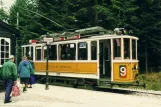
: Delivered as Copenhagen railcar 275, manufacturer Scandia, type Hovedtype, width 2.10 m, length 8.90 m, manufactured 1901-1910, with 20 seats and 26 standing places, 2 axles.
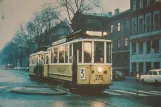
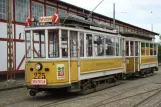
Postcard: Copenhagen tram line 3 with railcar 275 on Blegdamsvej (1966)Postcard: Copenhagen tram line 3 with railcar 275 on Blegdamsvej (1966)Skjoldenæsholm Tram Museum Copenhagen's tramways. Motorcar no. 275 (Scandia 1907) with a cross-seat sidecar as line 3 on Blegdamsvej on March 8, 1966. The motorcar and a similar sidecar are now owned by the Tram History Society.By Henrik Boye, Sporvejshistorisk Selskab (SHS) - .
Sticker: Copenhagen railcar 52  (1977)Sticker: Copenhagen railcar 52 (1977)Museum Fund 1 kr. Tram Historical Society Museum Fund 2 kr. Tram Historical Society Museum Fund 5 kr. Tram Historical SocietyBy Henrik Boye, Sporvejshistorisk Selskab (SHS) - .

Tram Museum Skjoldenæsholm
Open regularly

: Arrived at the museum as Skjoldenæsholm railcar 275 (ex Copenhagen railcar 275), manufacturer Scandia, type Hovedtype, width 2.10 m, length 8.90 m, manufactured 1901-1910, with 20 seats and 26 standing places, 2 axles.
A visit to the Tram museum at Skjoldenæsholm in Denmark (2010)
4:58
A visit to the Tram museum at Skjoldenæsholm in Denmark (2010)A visit to the Tram museum at Skjoldenæsholm in Denmark.By Niels Hoffmeyer - .
Alexander and the family at Skjoldenæsholm (2010)
7:02
Alexander and the family at Skjoldenæsholm (2010)By Kim Schwalbe.
.
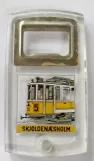
Bottle opener: Skjoldenæsholm railcar 275 (2010)Bottle opener: Skjoldenæsholm railcar 275 (2010)SkjoldenæsholmBy Henrik Boye, Sporvejshistorisk Selskab (SHS) - .
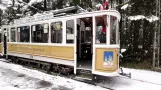
Christmas at the Sporvejsmuseet Skjoldenæsholm (2021)
3:07
Christmas at the Sporvejsmuseet Skjoldenæsholm (2021)For the 31st time, the traditional Christmas event featuring mulled wine, apple slices, a visit from Santa Claus, and the sale of Christmas trees took place at Sporvejsmuseet Skjoldenæsholm on the weekend of December 11 and 12.By SporvognDK - .
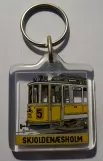
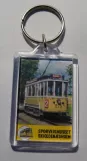
Keyring from Tram Museum Skjoldenæsholm (1993)Keyring from Tram Museum Skjoldenæsholm (1993)By Henrik Boye, Sporvejshistorisk Selskab (SHS).
.
Keyring from Tram Museum Skjoldenæsholm (2001)Keyring from Tram Museum Skjoldenæsholm (2001)By Henrik Boye, Sporvejshistorisk Selskab (SHS).
.
Keyring from Tram Museum Skjoldenæsholm (2018)Keyring from Tram Museum Skjoldenæsholm (2018)By Henrik Boye, Sporvejshistorisk Selskab (SHS).
.
Members' Day (2017)
5:10
Members' Day (2017)On 29/7 - 2017, Sporvejsmuseet Skjoldenæsholm held their annual "members' day", which ended with a diploma run. This year's "surprise" was KS 567 and 226.By SJB Media 1996 - .
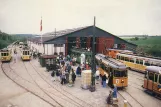
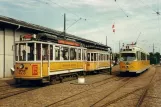
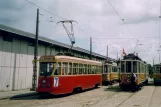
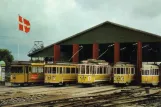
Postcard: Skjoldenæsholm railcar 1 by Depot 1 (1978)Postcard: Skjoldenæsholm railcar 1 by Depot 1 (1978)Some of the Tram Museum's trams in front of the depot. From left: Aarhus Trams' motor car no. 1 (Copenhagen Trams 1945), Copenhagen Trams no. 470 (KS 1945), Copenhagen Trams no. 275 (Scandia 1907), Copenhagen Trams no. 587 (KS 1939) and Copenhagen Trams no. 701 (KS 1949).By Henrik Boye, Sporvejshistorisk Selskab (SHS) - .
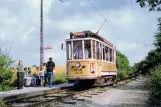
Postcard: Skjoldenæsholm standard gauge with railcar 275  (1995)Postcard: Skjoldenæsholm standard gauge with railcar 275 (1995)Greetings from Skovly Camping Skovly Camping. Ortved. 4100 Ringsted. Tel. 53 62 82 61.By Henrik Boye, Skovly Camping - .
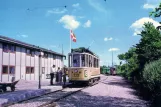
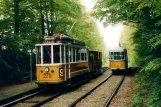
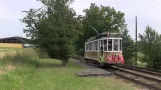
Postcard: Skjoldenæsholm standard gauge with railcar 275 at Eilers Eg (1999)Postcard: Skjoldenæsholm standard gauge with railcar 275 at Eilers Eg (1999)In 1999, the Tram Museum was able to put the loop at "Eilers Eg" into use, and thus the museum's 1.7 km long standard gauge section was completed. Motor car no. 275 Scandia 1907) is standing in the loop. The waiting room on the left in the picture comes from the Fruens Bøge terminus in Odense.By Henrik Boye, Sporvejshistorisk Selskab (SHS) - .
Postcard: Skjoldenæsholm standard gauge with railcar 275 at The tram museum (2001)Postcard: Skjoldenæsholm standard gauge with railcar 275 at The tram museum (2001)In 2001, the Tram Museum succeeded in bringing home two of the Copenhagen articulated trams that had been running in Alexandria, Egypt for about 30 years. In the street between the museum's two depots, no. 890 (DÜWAG/Copenhagen Trams 1966) is photographed together with motor car no. 275 (Scandia 1907) and sidecar no. 1460 (Scandia 1920) from Copenhagen Trams.By Henrik Boye, Sporvejshistorisk Selskab (SHS) - .
Postcard: Skjoldenæsholm standard gauge with railcar 275 at Tobaksmarken (1985)Postcard: Skjoldenæsholm standard gauge with railcar 275 at Tobaksmarken (1985)First stop on the Tram Museum's new line for the Copenhagen trams. The stop, located approx. 350 m from the depot, is the temporary terminus on the line, which when fully extended will be approx. 1.5 km long. Copenhagen Trams' motor car no. 275 was built by Scandia in 1907 and rebuilt at the trams' main workshop in 1928.By Henrik Boye, Sporvejshistorisk Selskab (SHS) - .
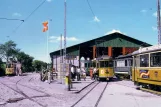
Postcard: Skjoldenæsholm standard gauge with railcar 275 by The Tram Museum (1985)Postcard: Skjoldenæsholm standard gauge with railcar 275 by The Tram Museum (1985)At the platform in front of and along the Tram Museum's depot, there is a transfer between the museum's two lines, one heading towards Højbjerg Skov and the other to the parking lot at Skjoldenæsvej. The trams shown in the picture are Copenhagen no. 275 (1907/1928), Basel no. 213 (1933), Aarhus no. 1 (1945), Copenhagen grinding trolley S 1 (1900/1952), and Aarhus sidecar no. 54 (1947).By Henrik Boye, Sporvejshistorisk Selskab (SHS) - .
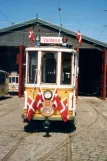
Postcard: Skjoldenæsholm standard gauge with railcar 275 on The Tram Museum (1985)Postcard: Skjoldenæsholm standard gauge with railcar 275 on The Tram Museum (1985)At the stop along the Tram Museum's depot, there is a departure for the museum's newest route, which is primarily served by carriages from Copenhagen. Copenhagen Trams' motor car no. 275 was built by Scandia in 1907 and rebuilt at the tramways' main workshop in 1928.By Henrik Boye, Sporvejshistorisk Selskab (SHS) - .
Postcard: Skjoldenæsholm standard gauge with railcar 470 The Tram Museum (1985)Postcard: Skjoldenæsholm standard gauge with railcar 470 The Tram Museum (1985)Tram museum forecourt with, among others, Copenhagen no. 470 (KS 1945), Copenhagen no. 275 (Scandia 1907), Basel no. 213 (SIG 1933), Aarhus no. 1 (KS 1945), Wuppertal no. 3241 (van der Zypen 1925) and Copenhagen no. 701 (KS 1949).By Henrik Boye, Sporvejshistorisk Selskab (SHS) - .
Rainy day at the Tramway Museum (2011)
6:16
Rainy day at the Tramway Museum (2011)Rainy weather atmosphere at the Tramway Museum on 11 August 2011By SporvognDK - .
Skjoldenæsholm railcar 587 by Depot 1 (2003)Skjoldenæsholm railcar 587 by Depot 1 (2003)With decorations Trolley Museum Skjoldenæsholm 25th anniversary.By Henrik Boye - .
Skjoldenæsholm Tram Museum Christmas Part 2 (2021)
10:17
Skjoldenæsholm Tram Museum Christmas Part 2 (2021)This video is part 2 of 3 Clips in the video are recorded using the Oppo Find X3 Pro and the Vivo X60 Pro+By Dinglehopper - .
Skjoldenæsholm tramway museum (2009)
9:57
Most viewed -
Skjoldenæsholm tramway museum (2009)Enjoy the sounds and sights from Denmarks' Tram Museum "Skjoldnaesholm".
Sporvejsmuseet - Summer atmosphere (2014)
1:46
Sporvejsmuseet - Summer atmosphere (2014)By SporvognDK.
.
Sporvejsmuseet - The new café car handed over (2014)
6:31
Sporvejsmuseet - The new café car handed over (2014)On 2 April 2014, the new café cart was handed over to the Café Cart team. I am now at a point where Team 100 can hand over 2410 to the Café wagon staff, not because we are finished with it, but because it is now in use. The wagon is essentially complete, but some exterior installations still need to be finished. Of course, future changes will be made as we gain more experience with the wagon's operation. In 2002, Per Tingman suggested that we should have a café wagon. The wagon train was designed for this purpose. Test runs were conducted to ensure the track was suitable, preventing coffee from overflowing into the cups. Ultimately, the wagon train had to stand in the loop. I made a salad; otherwise, everything would lie and float on the floor. At that time, there were seven girls—the seven cool ones—who operated the wagon, and the general opinion was that the Café wagon had two sals from the kiosk. Gradually, funds were allocated for purchases and chests of drawers. They are actually the same as the ones we use today, and most of them have been sold. The Café wagon provided a sales island, so the RS AG 924 k is now a Café wagon. In 12 years, it will return to its original purpose of being a biv. It was a spy several times in history, but in 2011, it was finally adopted by rebuilding. The first thing that happened was that J cleaned the inside in one day. Perhaps most noticeable was the exterior painting, which J also completed. Per and Claus took care of the electrical installations, while Køren handled the underground work. I mention just a few details, but overall, 10 hours have been spent on this project. Now, we leave the Café wagon to the network and the Café wagon staff, and I hope you will be happy with it. Take good care of it now, as it was initially costly. Of course, some things need to be changed, but let's see how it performs in daily use. Then I would say, 'Let's celebrate its use with three cheers and long live the Café!' I also think it's great that we can celebrate today, so let’s make this an official handover of the wagon. It has been a project that took longer than expected. We initially thought it would be operational last year, but it takes more time. On the other hand, I believe that we’ve covered many details about the wagon, and there has been excellent sparring with the café wagon team to ensure the interior meets your wishes. I think it’s a wagon we will be delighted with. I am also pleased that the Rostok side wagon can now return as a side wagon for the newly renovated 97. Now that we have 2410, I think it has been very nice to have equipped it for this purpose, and I believe it will be a great success. Finally, I want to thank everyone involved in the project. There are quite a few more than Team 100—those who were most involved—but many others contributed as well, and I think we owe them a thank you. Also, thanks to the treasurer for approving your overruns. Yes, cheers! It will be a valuable asset for us, just as we envisioned when we started this project. This has been a full-time effort on behalf of the café team. Thank you very much for the excellent café cart. I am pretty confident it will meet our expectations, both now and in the future. I am really looking forward to beginning use with the first trial run. I will see if any adjustments are needed after the first day, but I am confident that, together, we’ll figure out how to make it work really well. Thanks also to everyone who did quality work.By SporvognDK - .
The Railway Museum - "Führerstandsmitfahrt" with KS 575 (2011)
13:44
The Railway Museum - "Führerstandsmitfahrt" with KS 575 (2011)On 11 August 2011, Kurt Berg is the driver of the Lunding bogie car KS 575. On the trip from the Railway Museum to Ejler Eg and back again, he has the video camera with him - see the result here :-)By SporvognDK - .
The Tram Museum Christmas Part 3 (2021)
11:39
The Tram Museum Christmas Part 3 (2021)This video is part 3 of 3 Clips in the video are recorded using the Oppo Find X3 Pro and the Vivo X60 Pro+By Dinglehopper - .
The Tramway Museum - From the archives 2 (2014)
2:01
The Tramway Museum - From the archives 2 (2014)In the second episode, we show something from the film archives from spring 2014By SporvognDK - .
The Tramway Museum - Great Cavalcade Day, II (2015)
7:45
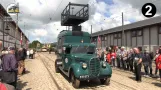
The Tramway Museum - Great Cavalcade Day, II (2015)On the occasion of the Tram Historical Society's 50th anniversary on February 8, 2015, the Tram Museum Skjoldenæsholm held a cavalcade on Saturday, June 20, 2015, with all ready-to-run museum vehicles arranged in order by date of acquisition Content: 00:00 Start 00:17 Copenhagen Trams KS 587 01:10 NESA tower car 501-02 03:20 About the establishment of a tram museum 04:30 Copenhagen Trams grinding car S1 04:40 Snow sweeper 04:50 Tower for line maintenance 05:35 Copenhagen Trams KS 22 07:00 Copenhagen Trams 389/1172 When the trams in Copenhagen were retired, they acquired a larger collection of trams, which were given to them by the trams themselves. One of these, 587 line 8, is standing in front of us. It was built in 1940 and was in service until the very end. From the trams, they received four Buggy carriages, two engines, two sidecars, and two trailers, one of which we will see in a moment. The carriages were stored in the Svanemøllen depot, where our members could work on them. 587 has recently been refurbished here at the museum, so it now appears in a beautiful and nearly new condition. The next carriage that arrives may perhaps show more versatility, as it wasn't just trams and buses; work vehicles are also part of the collection. And here comes our bus with our beautiful 1938 Ford V8, Nesa F 50102, an automobile tower carriage used for wiring repairs. This is done from the platform on the roof. The carriage is ejected by a hydraulic pump, allowing it to be used. The handle, the small wheel at the top of the tower, can lift the tower to quite a height, and as you might notice, the carriage is not equipped with support legs, so when the tower is fully raised, it’s quite an experience to stand up there. The last time the carriage was used was, among other things, during the establishment of street lighting at Lyngbyvejen to enhance the street's profile, where the carriage could be utilized. Since then, it was brought here for maintenance and then taken to Dong to be restored. The carriage has been refurbished at Nesa and Dong's workshops. I can tell you that when the carriage was poorly repaired, it had to be presented to the members of the Association, which happened at our annual Members' Day, where all members are invited. And there we were, about to demonstrate the carriage and talk about it when it started running. Yes, there was actually damage, so the carriage is usually exhibited inside the Valby Remise, with an opportunity to look into the box at the back, where a small workshop has been set up for on-site repairs. I mentioned earlier that they were working on establishing a tram museum. The association's management saw that the project in Brøndby was unlikely to be feasible, so they decided instead to advertise in various newspapers, including local papers on Zealand, both to find space for a sports museum and to store trams because they expected that after the closure of track operations in Copenhagen, it would no longer be possible to store trams there. They contacted a nearby farmer, who recommended the landowner, Vilen Brundin Nergaard, at Skørn Desholm Estate. This was done on December 23, 1971, and communication was immediate and positive. He was farsighted and thought it was a good idea to have a sports museum at Skørn Holm. In 1972, they took over a barn, and this is the carriage that arrives. Here, Copenhagen's tram S1 has a snow wagon mounted in front, used to clear snow from the streets. Similar wagons featured a salt grinder, allowing for the addition of salt as well. A tower is mounted at the back to keep it on the track. S1 was built in 1900 as a two-story traffic control vehicle. Two years later, it was converted for overhead line operation, and in 1924, it was modified into a single-story tram. In 1952, S1, also known as number 23, was converted along with a sister vehicle and operated as a rail-based tram until its closure in 1972. The SS took over both wagons and began converting S2 into a traffic control vehicle in the form of a double-decker, as it appeared after its 1924 conversion. However, one of our members, the man behind our department on Bornholm, believed that a double-decker was too dull, so he initiated a project to restore S2 to its original 1915 version, featuring a closed front and rear by the driver and the addition of a first floor to provide cover and style. Now, it’s back in regular operation here at the museum and will be able to run in traffic today. At the back is the open sidecar 389, built in 1909 and retired as a museum piece in 1936. It later belonged to the HT Museum, and in 2003, it was acquired by the museum. Open sidecars were common in Copenhagen until 1936, when they were taken out of service; most were then sold to tram operators in Helsinki.By SporvognDK - .
The tramway museum marks the 50th anniversary of Denmark's last tram (2022)
1:01
The tramway museum marks the 50th anniversary of Denmark's last tram (2022)Sporvejsmuseet marks 50 years of Denmark's last tram with a cavalcade of line 5 trams and buses on Saturday 23 April 2022 10-17By SporvognDK - .
Tramway Museum Skjoldenæsholm (2023)
8:02
Tramway Museum Skjoldenæsholm (2023)By jacob holm trainspotting.
.
The Tramway Museum - Traffic Weekend (2015)
4:45
The Tramway Museum - Traffic Weekend (2015)On Saturday, July 25, and Sunday, July 26, 2015, the Skjoldenæsholm Tram Museum hosted its annual traffic weekend. Around 2:00 p.m., on the way back to the museum, we passed the newly built Depot 3, where the first two tracks are now complete — a scene even passengers on horse-drawn omnibuses can enjoy. Museum manager Michael Lund was busy, as guests from Germany arrived and needed guidance to their parking spots at the maritime university, which is one and a half kilometers from the Tramway Museum. Several vintage car owners waited eagerly for the tour to continue at the museum. The tour first circled Valsø's smaller lake, with Copenhagen's Royal Tiger tracks guiding the way. Upon arriving at the museum, the vintage cars were greeted by the organizer, Veterans, who distributed informational materials to the participants. Despite a heavy daily rainstorm, the Tramway Museum managed to avoid heavy rain on Saturday morning. After a few hours of visiting, the German guests prepared to continue to Sweden. Leaving the museum was orderly, with horns and lights used to signal. At 2 p.m., the awards ceremony for the vintage cars took place. One of the winners was Erling Roland Petersen, with his 1957 M 1000, of which I am the fifth owner. It originally ran on Funen, and when I bought it, I picked it up in Jutland. I first visited it in 2000, and it was an exciting experience; I was fortunate as well. My lady and I previously won prizes for best costume, and today I was lucky enough to receive an award for the best-looking car of the year. The guests had an unexpectedly extraordinary experience—a good old-fashioned punch from the Bostok truck train. The truck train couldn't drive back to the museum under its own power, so assistance was requested to pull it. Is anyone available to signal after the Bostok truck train has been moved? Can the other trucks start their trip back to the museum? The museum closed at 5 p.m. and reopened at 5:16 p.m. The café truck, as the last vehicle to leave, was also part of the return journey. On the way back, Melb's cart, although on the road, still operated smoothly under Eif Petersen's expert supervision. There was plenty of space, and the café truck was able to drive into the shed after a long day in the forest.By SporvognDK - - .

Add a comment

Last updated: .