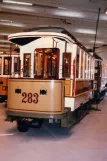
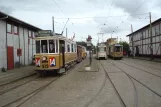
: Rebuilt to Copenhagen sidecar 283 (ex Copenhagen horse tram 283), manufacturer Scandia, series 412-436, width 2.00 m, length 10.00 m, manufactured 1912, 2 axles.
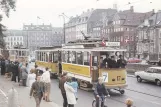
: Vehicle number changed to Copenhagen sidecar 1046 (ex Copenhagen horse tram 283), manufacturer Scandia, series 412-436, width 2.00 m, length 10.00 m, manufactured 1912, 2 axles.
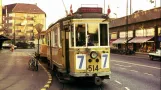
: Arrived at the museum as Copenhagen sidecar 283 (ex Copenhagen horse tram 283), manufacturer Scandia, series 412-436, width 2.00 m, length 10.00 m, manufactured 1912, 2 axles.
Postcard: Copenhagen railcar 17 near Thorvaldsens Museum (1969)Former accumulator tram from 1897 with converted horse tram as a sidecar on Slotsholmen on October 19, 1969. The tram train can be seen at the museum.By Henrik Boye, HT museum, Per Bech Petersen - .
2:14
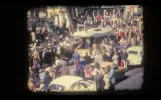
The last day with trams in Copenhagen (1972)On 22 April 1972, the last trams ran in Copenhagen, and on 23 April a procession of historic trams and buses drove through the city to mark the farewell to the trams in Copenhagen.By Jakob Skovgaard Koed - - .
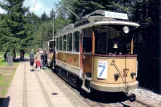
: Taken over by the museum as Skjoldenæsholm sidecar 283 (ex Copenhagen horse tram 283), manufacturer Scandia, series 412-436, width 2.00 m, length 10.00 m, manufactured 1912, 2 axles.
7:22
40 years ago - line 7 switches to bus operation (1971)What a great film, great pictures, but it always gives me a little stab in the heart when I see trams. Just think if they had preserved this form of transport and modernized the network, it wouldn't have been necessary to reinvent the wheel, as our current talk about light rail goes on a lot.By SporvognDK - .
Postcard: Skjoldenæsholm standard gauge with railcar 17 at Eilers Eg (2004)Motorcar no. 17 from De Københavnske Sporveie is the oldest electric motorcar in the Tram Museum. It was built as an accumulator car by Falkenried in Hamburg in 1897. In 1902 it was converted to overhead line operation, and it was used as a public transport car until 1927. After a few years as a work car, it has been a museum car since 1936.
The auxiliary car DKS no. 283 was built as a two-story horse tram around 1870 and was converted to an auxiliary car for electric operation in 1902. It ran as such until 1933.By Henrik Boye, Sporvejshistorisk Selskab (SHS) - .
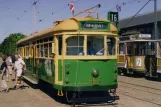
Postcard: Skjoldenæsholm standard gauge with railcar 965 at Valby Gamle Remise (2006)Melbourne no. 965 (M&MTB 1950) is a gift from the state of Victoria in Australia to the Crown Prince Couple and Prince Christian on the occasion of the latter's baptism.
The carriage is deposited at the Skjoldenæsholm Tram Museum, where it can be seen in traffic together with the museum's oldest electric carriages, DKS motor carriage no. 17 (Falkeried 1897) and sidecar no. 283 (built as a horse-drawn tram circa 1888 and converted to an electric sidecar in 1902).By Henrik Boye, Sporvejshistorisk Selskab (SHS) - .
The tramway museum in Skjoldenæsholm (2023)Intensive traffic day with trams every 5 minutes, as well as vintage cars and buses. Not all trams ran with passengers, but ran for the photographers.By jvltog - .
18:55
The Tramway Museum Skjoldenæsholm video (2024)A short video from the Tramway Museum Skjoldenæsholm.
A look at their workshop and exhibitions.
Nice exhibitions of trams and buses. And there is the possibility of driving with several trams in the area.By VærdAtSe - .
10:54
Traffic day at the Sporvejsmuseet Skjoldenæsholm (2024)On Saturday 11 May there was an intensive traffic day at the Skjoldenæsholm Railway Museum. So a large number of the museum's various trams, buses and a number of vintage cars were also on display.By SimonTog - .
10:07
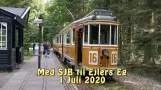
With SJB to Ejlers Eg - Sporvejsmuseet Skjoldenæsholm (2020)In July 2020, SJB took a ride behind the wheel on KS 587 to Eilers Eg, at Sporvejsmuseet Skjoldenæsholm's usual track section. Along the way, some information is shared about the stretch, both with text and with one of the museum's knowledgeable conductors in the background.
With SJB heading to Eilers Eg (Eilers Oak), the forecourt is where the trams leave for the forest. Welcome aboard Line 16 from Copenhagen. I won't say too much yet, except that you might find this an unusual place for city trams to run through the forest or the gold court. So, we’ve tried to make this first section feel a bit more city-like by adding scenery meant to look like shops; however, they aren't real shops, just 1.5 meters deep. They're decorated with various items I'd like you to enjoy. I'll be quiet for a moment. The museum street Tobakmarken (Tobacco field), opened in 1985 and closed in 2017, marks where the line becomes single-tracked, with signals controlling traffic. On the left, the signals are marked with "S" for stop and "I" for go. I also want to tell you about the trams you're riding in. They originate from the Copenhagen Tramways and are part of a class that includes 118 motor cars and 83 trailers built in the 1930s. By this time, the first electric trams from 1901 to 1910 were showing their age. The fact that they ran until 1966 is a story in itself, but that’s why this class was built. Design-wise, they turned out well, with both motor cars and trailers now identical, unlike at the start of the 20th century. This class lasted until Copenhagen's last tramline closed in 1972. Tram 587 was built in 1940, making it one of the later ones in the class. Flemmingsminde (in memory of Flemming), opened in 1987, is where we are now, at a stop called 'Flemmingsminde." On our right, there's a small shed serving as a waiting room, initially placed at Vestre Kirkegårds Allé when the tram line was served by horse trams in 1893. It is 127 years old. When electric trams were introduced, they continued to serve. After buses took over, the area became obsolete as a waiting space, because buses could now go directly to the graveyard. The stop is named after a society member who fell over a mast for the overhead wires in 1985—the remains of the toppled mast can still be seen next to the first mast on the left. After the tram service ended here, the waiting room was used as a tool shed by graveyard workers, allegedly made out of old gravestones. Inside, there's a small exhibit about the railway the tramway was built on—the Midland Railway, which only operated for 11 years before closing. We’re now approaching "Skovkanten" (Forest's Edge), signaling we're entering the forest. Here, we'll pass another tram from today—a double-decker from 1900. Fun fact: Copenhagen was the only Scandinavian capital to have this tram type. Your tickets are valid on all trams, so if you want to ride the double-decker, feel free. Skovkanten opened in 1990. The tram passes Gammel Sparegodtvej (Old Sparegodt Road), where the driver rings the bell to alert pedestrians. On the left, you can see the stop of the same name. Broen (The Bridge), opened in 1993 with a new platform added in 2018, is the next stop. It’s named "Broen" because of the nearby bridge about 50 meters ahead, built where a railway once ran, and a road crossing was needed. The bridge is still owned by BaneDanmark (rail infrastructure), who occasionally check its condition rather than replacing it. It's also a popular photo spot for tram enthusiasts. We'll soon reach the terminus, Eilers Eg (Eilers Oak), and after a short break, we'll head back to the museum. You're welcome to stay on or get off and walk in the forest. Eilers Eg opened in 1999. Here, the tram enters a loop and passes the museum's café, with a tram from Düsseldorf to the right. The tram attendant is just reminding passengers that trams run at 10-minute intervals. The tram on the left is a mockup used on a Copenhagen school’s playground, replacing an old trailer. You can enjoy food that's been brought along, even if the weather’s bad. The waiting room to the right, located initially at Fruens Bøge (the lady's beech), is now part of the museum, donated by Odense City Council. More info about the museum: www.Sporvejsmuseet.dk. Thanks for riding with us!By SJB Media 1996 - .