TRAM TRAVELS

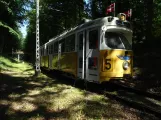
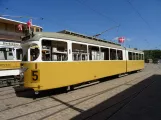
Copenhagen articulated tram 890

Exhibited in a museum
Trams from Copenhagen

Select vehicle type: Articulated trams, bilevel rail cars, horse-drawn trams, low-floor articulated trams, model railcars, model sidecars, open model sidecars, open sidecars, railcars, service vehicles, sidecars, tower wagons, and track cleaning trams.

Articulated trams from Copenhagen

Select vehicle number: 801, 802, 803, 805, 806, 808, 815, 816, 818, 832, 833, 836, 837, 850, 851, 853, 856, 860, 862, 875, 876, 877, 879, 880, 881, 884, 886, 888, 889, 890, 891, 892, 896, 898, and 900.

The history of the tram

Copenhagen Tramway (KS)
Closed

: Delivered as Copenhagen articulated tram 890, manufacturer Düwag (Düsseldorfer Waggonfabrik AG), series 801-900, width 2.20 m, length 19.10 m, manufactured 1960-1968, with 36 seats and 119 standing places, 6 axles.

40 years ago - line 7 switches to bus operation (1971)
7:22
40 years ago - line 7 switches to bus operation (1971)What a great film, great pictures, but it always gives me a little stab in the heart when I see trams. Just think if they had preserved this form of transport and modernized the network, it wouldn't have been necessary to reinvent the wheel, as our current talk about light rail goes on a lot.By SporvognDK - .
Prescription envelope: Copenhagen tram line 5 with articulated tram 890  (1993)Prescription envelope: Copenhagen tram line 5 with articulated tram 890 (1993)Line 5 was both the first and the last tram line with the new articulated vehicles in operation. The line was established on 24 April 1903 with a route from Brønshøj to Christianshavn. Line 5 was Copenhagen's last tram line and the last day of operation was 23 April 1972. Linde Apotek Frederikssundsvej 152 2700 Brønshøj Tel. 31 60 61 11 - Fax 31 60 11 30By Henrik Boye, John Lundgren, Linde Apotek - .

Alexandria Passengers Transport Authority (APTA)
Operational

: Taken over by the company as Alexandria articulated tram 890 (ex Copenhagen articulated tram 890), manufacturer Düwag (Düsseldorfer Waggonfabrik AG), series 801-900, width 2.20 m, length 19.10 m, manufactured 1960-1968, with 36 seats and 119 standing places, 6 axles.
Tram Museum Skjoldenæsholm
Open regularly

: Arrived at the museum as Skjoldenæsholm articulated tram 890 (ex Copenhagen articulated tram 890), manufacturer Düwag (Düsseldorfer Waggonfabrik AG), series 801-900, width 2.20 m, length 19.10 m, manufactured 1960-1968, with 36 seats and 119 standing places, 6 axles.

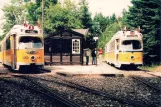
Postcard: Skjoldenæsholm standard gauge with articulated tram 890 at Eilers Eg (2001)Postcard: Skjoldenæsholm standard gauge with articulated tram 890 at Eilers Eg (2001)In 2001, the Tram Museum succeeded in bringing back two of the Copenhagen articulated trams that had been running in Alexandria, Egypt for about 30 years. No. 890 (DÜWAG/Copenhagen Trams 1966) and 815 (DÜWAG 1960) are photographed in their Alexandria appearance in the loop at "Eilers Eg"By Henrik Boye, Sporvejshistorisk Selskab (SHS) - .
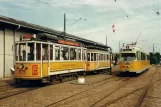
Postcard: Skjoldenæsholm standard gauge with railcar 275 at The tram museum (2001)Postcard: Skjoldenæsholm standard gauge with railcar 275 at The tram museum (2001)In 2001, the Tram Museum succeeded in bringing home two of the Copenhagen articulated trams that had been running in Alexandria, Egypt for about 30 years. In the street between the museum's two depots, no. 890 (DÜWAG/Copenhagen Trams 1966) is photographed together with motor car no. 275 (Scandia 1907) and sidecar no. 1460 (Scandia 1920) from Copenhagen Trams.By Henrik Boye, Sporvejshistorisk Selskab (SHS) - .
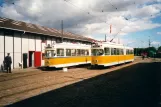
Skjoldenæsholm articulated tram 890 inside Depot 1 (2024)Skjoldenæsholm articulated tram 890 inside Depot 1 (2024)By John Bodholdt Nielsen.
.
Skjoldenæsholm articulated tram 890 inside Holbæk Privatbaner (2003)Skjoldenæsholm articulated tram 890 inside Holbæk Privatbaner (2003)The interior of the benefit seen from the front, everything innards are taken out.By Henrik Boye - .
The B section of KS 890 to the Tramway Museum (2011)
7:06
The B section of KS 890 to the Tramway Museum (2011)By SporvognDK.
.
The tramway museum in Skjoldenæsholm (2023)
12:33
The tramway museum in Skjoldenæsholm (2023)Intensive traffic day with trams every 5 minutes, as well as vintage cars and buses. Not all trams ran with passengers, but ran for the photographers.By jvltog - .
The tramway museum marks the 50th anniversary of Denmark's last tram (2022)
1:01
The tramway museum marks the 50th anniversary of Denmark's last tram (2022)Sporvejsmuseet marks 50 years of Denmark's last tram with a cavalcade of line 5 trams and buses on Saturday 23 April 2022 10-17By SporvognDK - .
The two trams from Alexandria return - TV-Lorry (2001)
2:40
The two trams from Alexandria return - TV-Lorry (2001)It was a shame that Washington, DC's streetcars were eliminated from September 1958 to January 1962. Had the Washington streetcars been kept, the 99 Copenhagen Duwag streetcars could have been bought by the Washington Metropolitan Area Transit Authority in 1969 and served from 1970 to 2015. Then, two former Copenhagen Streetcars could have been transported back from Washington, DC, to Copenhagen via the Antonov 225, the world's largest freight plane. I recall the streetcars in Copenhagen from my visit to the city in 1969-1970 when I was 7 years old. I am too young to remember the Washington, D.C., streetcars in their first guise. Very ambitious. I'm sure D.C. would've ordered trams/streetcars a bit closer to home. The problem, I reckon, was that, like the railroads, there was an increasing interest in cars, which unfortunately killed most of the streetcar lines around the US. I think it was Detroit where General Motors bought the entire network, only to close it and eventually force people into cars. But it's not a big shame. Watching, I see the Düsseldorf cars were abandoned at the same period. In Brazil, Rio de Janeiro has a significant number of parked vehicles that are left stopped and abandoned in the weather after work. This is a real big shame! Egypt was a strong presence in this field, as it began operating the Alexandria tram in 1863 AD and started using electricity in 1902 AD. It operates in the tram network of the city of Alexandria, including the sand line known as the Blue Tram, the city center line, and is an icon that starts from the branch lines, such as the line west of the city, called the Yellow Tram. The government's e-mail continued the development of the city's tram network. More information and pictures: https://alymousa.blogspot.com/2019/11/blog-post_26.htmlBy Peter Andersen - .

Add a comment

Last updated: .