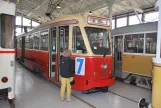
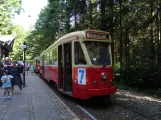
Brussels railcar 7000
In operation as a museum vehicleTrams from Brussels
Select vehicle type: Articulated trams, freight cars, horse-drawn trams, low-floor articulated trams, open horse-drawn trams, open sidecars, railcars, service vehicles, sidecars, snowplows, steam powered railcars, and tower wagons.
Railcars from Brussels
Select vehicle number: ART.69 "Francais", ART. 123, AR 133 "Francais", AR168, AR.89, A.9963, AR266, ART.50, A 9314, AR.193, A.9515, AR159, A 948, AR.86, A.9073, 19, 34, 72, 138, 201, 255, 346 "California", 410, 415, 428, 830, 1002, 1041, 1175, 1245, 1259, 1281, 1291, 1295, 1305, 1376, 1400, 1763, 4550, 5001, 5008, 5016, 5021, 7000, 7026, 7027, 7053, 7079, 7091, 7093, 7096, 7126, 7139, 7140, 7142, 7160, 7207, 9004, 9020, 9069, 9161, 9537 (SNCV), 9685, 9727, 9735, 9762, 9774, 9871, 9888, 9924, 9977, 10054, 10065, 10112, 10166, 10243, 10284, 10392, 10409, 10422, 10429, 10485, 10494, and 19544.
Description
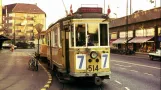
Trolley in Copenhagen in 1958 in line 7.
The history of the tram
Brussels Intercommunal Transport Company (MIVB/STIB)
Operational
1951: Delivered as Brussels railcar 7000, type PCC, series 7000-7171, width 2.20 m, length 14.21 m, weight 16.5 t, manufactured 1951-1971, with 32 seats and 68 standing places, 4 engines, power output 41 kW, max speed 70 km/t.
Hamburger Hochbahn (HHA)
Closed
January 21, 1952: Taken over by the company as Hamburg railcar 3060 (ex Brussels railcar 7000), type PCC, series 7000-7171, width 2.20 m, length 14.21 m, weight 16.5 t, manufactured 1951-1971, with 32 seats and 68 standing places, 4 engines, power output 41 kW, max speed 70 km/t.
Københavns Sporveje (KS)
Closed
February 21, 1958: Taken over by the company as Copenhagen railcar 3060 (ex Brussels railcar 7000), type PCC, series 7000-7171, width 2.20 m, length 14.21 m, weight 16.5 t, manufactured 1951-1971, with 32 seats and 68 standing places, 4 engines, power output 41 kW, max speed 70 km/t.
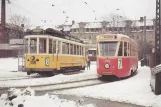 Postcard: Copenhagen tram line 8 with railcar 308 at Degnemose Allé (1958)By Henrik Boye, Sporvejshistorisk Selskab (SHS).
February 1958.
Brussels Intercommunal Transport Company (MIVB/STIB)
Operational
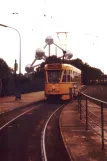
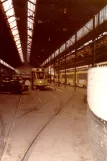
March 19, 1958: Taken over by the company as Brussels railcar 7000, type PCC, series 7000-7171, width 2.20 m, length 14.21 m, weight 16.5 t, manufactured 1951-1971, with 32 seats and 68 standing places, 4 engines, power output 41 kW, max speed 70 km/t.
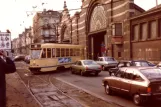
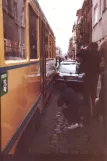
Museumsbahnen Schönberger Strand
Open regularly
July 1995: Arrived at the museum as Schönberger Strand railcar 3060 (ex Brussels railcar 7000), type PCC, series 7000-7171, width 2.20 m, length 14.21 m, weight 16.5 t, manufactured 1951-1971, with 32 seats and 68 standing places, 4 engines, power output 41 kW, max speed 70 km/t.
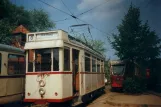
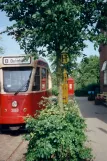
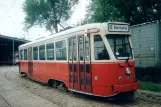
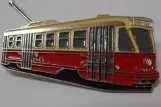 Pin: Schönberger Strand railcar 3060 (2005)By Henrik Boye, Verein Verkehrsamateure und Museumsbahn (VVM).
2005.
Tram Museum Skjoldenæsholm
Open regularly
1999: Taken over by the museum as Skjoldenæsholm railcar 3060 (ex Brussels railcar 7000), type PCC, series 7000-7171, width 2.20 m, length 14.21 m, weight 16.5 t, manufactured 1951-1971, with 32 seats and 68 standing places, 4 engines, power output 41 kW, max speed 70 km/t.
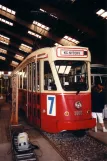
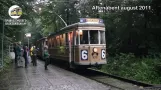
 Skjoldenæsholm 1435 mm with railcar 3060 at Gammel Sparegodtvej (2001)By Henrik Boye.
August 11, 2001.
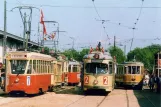 Postcard: Skjoldenæsholm standard gauge with railcar 3060 at The tram museum (2003)By Henrik Boye, Sporvejshistorisk Selskab (SHS).
May 31, 2003.

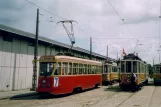
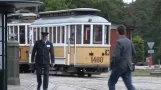 Most viewed video - August 2023