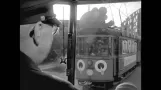
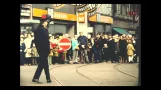
: Delivered as Aarhus sidecar 48, manufacturer Københavns Sporveje (KS)/Scandia, type AAS, series 41-59, width 2.10 m, length 8.50 m, manufactured 1945-1947, with 14 seats and 30 standing places.
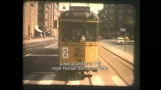
Aarhus' last tram (1971)Aarhus is saying goodbye to the city's last tram today. Journalist Preben Heide interviews driver Jens Nielsen.
A farewell was said at a tram parade with music and many guests. We have been able to ride the electric trams since 1904, and they have been well used. They have run a short distance through the whole city, benefiting both those who wanted to see something and those who wanted to be seen. However, it has been quite a few years since they discovered that having such iron-clad trains running between cars, cyclists, and pedestrians was not a very good idea. And today they are worn out, the old line ones and twos. Are they sad that the trams are stopping running? Yes, in a way. It takes away a bit of the big city atmosphere, I think. It's as if a bit of the big city disappears when the trams are gone. How many years have they been running the trams? 40 years. Car traffic is getting too heavy, and the streets are too narrow. There is no room for trams anymore. Where trams once filled the picture, there is now more quiet.
The Strøget, or at least the majority of it, will be converted into a pedestrian street. Pedestrians will have it all to themselves. In return, they will be given access to a new street bus that has been cut through part of the old town. It is a parallel street to the Strøget. Here, the buses will be allowed to pass through. They will take over the tram passengers and will connect the north and south of the city. The bus street is reserved exclusively for buses, in conjunction with the reorganization of public transport. If a new system of one-way streets has been implemented, it should also be extended to private drivers in Aarhus.By P3 Essensen - .
12:03
Aarhus runs in tram tracks (1904-2015)Århus Sporveje (abbreviated ÅS) was a traffic company owned by Aarhus Municipality, which was established on 1 January 1928 and merged into Midttrafik on 1 January 2007. The company took over the tram operation in Aarhus when it was established, which had been started by the private company Aarhus Elektriske Sporvej 7 July 1904. In 1929 the tram network was expanded by extending it up through Tordenskjoldsgade to Marienlund by Riis Skov; one more line was built from Banegårdspladsen over Frederiksbjerg to Harald Jensens Plads, a line that was later extended to Kongsvang. The original line from Dalgas Avenue to Trøjborg was extended to double track; originally it was only single-track, with many sidings on the stretch.
When the municipality took over the company in 1928, 46 people were employed. In 1940, the company had 225 employees, and a stock consisting of 23 trams, 22 sidecars and 43 buses. [1]
Tramway operations were discontinued on 7 November 1971. Before then, however, the company had opened several bus lines, and even more were added after the municipal reform in 1970, when Aarhus Municipality grew significantly. The Aarhus city buses were called trambuses for many years, but that name has long since fallen out of use. For many years, contrary to other Danish cities, boarding took place at the back and exiting at the front, but from 1 January 2012 this was abolished, and it is now permitted to enter and exit from all doors in the buses. As one of the only places in the country, there is still self-ticketing on the buses to this day.
On 1 January 2005, Århus Sporveje was split into Trafikselskabet Århus Sporveje (administration and planning) and Busselskabet Aarhus Sporveje (driving). Both were owned by Aarhus Municipality until 1 January 2007.
Trams were operated in Aarhus in the period 1904-71. It happened under the same company that still runs the city's bus traffic, Århus Sporveje, as it has been called since 1928. Nowadays, Århus Sporveje is part of the regional transport company Midttrafik.
Catering & companies
To EAT WELL, no wish is too big. With contact with the most quality conscious suppliers of raw materials, we ensure that the customer ALWAYS gets the best gastronomic experience.
We make all the food from scratch based on the season and trade items on the various Aarhus squares.
Our gastronomic style is inspired by everything from the Asian wok pan towards the southern European cuisines and up to the Danish country kitchen.By FAMILIEN OSSELV - - .
: Placed as Aarhus sidecar 48, manufacturer Københavns Sporveje (KS)/Scandia, type AAS, series 41-59, width 2.10 m, length 8.50 m, manufactured 1945-1947, with 14 seats and 30 standing places.