Zentralhaltestelle (Chemnitz)
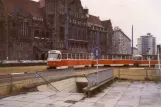
There are 9 photos from Zentralhaltestelle (Chemnitz) and 1 trams in the direction of Zentralhaltestelle (Chemnitz) on Tram Travels.
Chemnitzer Verkehr (CVAG) stops
Altchemnitz, Annenstraße, Bahnhofstraße, Bernsdorf, Brückenstraße/Freie Presse, Erzbergerstraße, Falkeplatz, Falkeplatz, Gablenz, Hauptbahnhof, Hutholz, Industrie-museum, Rottluff, Schönau, Schönau, Popowstraße, Straßenbahnhof Kappel, Technopark, Theaterplatz, Treffurthstraße, Weststraße/Kochstraße, Wladimir-Sagorski-Straße, and Zentralhaltestelle.
City-Bahn Chemnitz (CB) stops
Altchemnitz, Hauptbahnhof, Stollberg, Theaterplatz, Treffurthstraße, and Zentralhaltestelle.
Photos and videos from Zentralhaltestelle (Chemnitz)
27:40
Tram traffic in the city of Chemnitz (2012)Video taken on May 15, 2012, in the German city of Chemnitz. Footage shows regular tram traffic through the town with test runs of Škoda 15T vehicles, registration number 9238, with passengers on line 5. From 5:01 to 8:34, footage captures an emergency incident when a passenger hit her head while starting and waited for the ambulance. Because of this, a temporary single-track operation was established to prevent traffic disruption on the line to Gablenz. From 13:03 to 20:30, footage shows the single-track intercity line from Chemnitz to Stollberg. From 22:00 to 27:00, footage is from the rear window of a Škoda 15T vehicle.By tom88CZ - .
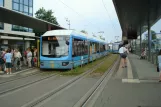
Chemnitz tram line 5 with low-floor articulated tram 611 at Zentralhaltestelle (2008)By Henrik Boye..

43:06
Driver's cab ride on Chemnitz tram (CVAG), Gablenz - Hutholz (2001)Ride in the driver's cab on tram line 5 in Chemnitz (Gablenz - Hutholz) on May 22, 2001, on a Variobahn. Found on my dad's videos.By Stofffuchs - .
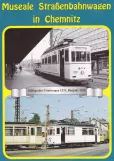
Postcard: Chemnitz service vehicle 1331 at Zentralhaltestelle (1988)Museum trams
in Chemnitz
Auxiliary equipment railcar 1331, built in 1928
1331 bidirectional railcar / narrow gauge Chemnitz, built around 1928
Series Nos. 218 - 239, data sheet T 20
Vehicle number 231, 1975: No. 331
1980: converted to Hillsgeräte railcar No. 1331
1988: to museum car No. 1331
Manufacturer: Waggon- und Maschinenfabrik AG, formerly Waggonfabrik W. C. F. Busch, Bautzen
Electrical equipment: Allgemeine Elektricitäts-Gesellscalt (AEG), Berlin
Motor / Power: 2 x 47.8 kW (Uk 523a, AEG)
Length over crash barrier: 10294 mmBy Henrik Boye, Maik Wagner, Straßenbahnfreunde Chemnitz, Thomas Böttger - .
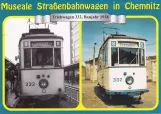
Postcard: Chemnitz tram line 8 with railcar 332 at Zentralhaltestelle (1977)Museum trams in Chemnitz
Motor car 332, built in 1928
332 bidirectional motor car / narrow gauge Chemnitz, built around 1928
Series nos. 218 - 239, data sheet T 20
Vehicle number 232, 1975: as no. 332,
1988: as museum car no. 332.
Manufacturer: Waggon- und Maschinenfabrik AG, formerly Waggonfabrik W. C. F. Busch, Bautzen
Electrical equipment: Allgemeine Elektricitäts-Gesellscalt (AEG), Berlin
Motor / power: 2 x 47.8 kW (Uk 523a, AEG)
Length over crash barrier: 10294 mm
Seats: 22 (across) / Standing places: 38By Henrik Boye, Maik Wagner, Straßenbahnfreunde Chemnitz - .
2:28
Narrow-gauge trams in Karl-Marx-Stadt (1893-1988)It all started in 1880 with a horse-drawn tram on the unusual gauge of 915 mm (about three feet), which remained the standard until 1893, when electric operation began. From 1917 onward, plans were made to widen the gauge to 1000 mm. However, it wasn't until 1958 that VEB Verkehrsbetriebe Chemnitz launched a truly ambitious gauge conversion program. Due to numerous urban development challenges and austerity measures typical of the GDR, the latter VEB Nahverkehr Karl-Marx-Stadt was only able to complete this program in 1988.
Look back at the lively tram scene and scheduled service on the narrow gauge line with the legendary three-car trains. These railcars from the 1920s were kept operational through extensive maintenance and continued to run until the last Rottluff-Zentrumsring line was shut down on November 6, 1988. Footage from the 1920s, of course, is just as common as winter shots from the 1980s.
First Chemnitz, then Karl Marstadt, then Chemnitz again. The city's name changed as often as its tramway. Even the track width was unusual. In 1890, an English engineer based his work on British units and chose a track spacing of three feet, or approximately 915 mm. In 1917, the track was widened to just 925 mm. It stayed that way for decades. This measurement was unique in Germany. This chapter wasn't finished until 1988. Until then, only vehicles from the 1920s were in operation. The footage in this film dates from the 1980s, but the film also offers a glimpse into earlier times. The employees of this tramway company had a knack for improvisation. When they wanted to showcase a historic carriage for the centenary, they converted a much newer model. Entry into the carriages was relatively high, ranging from over 36 cm to the first step. The coupling system was also old and extremely rare. The footage was shot by Jörg Langfeld, who also filmed in winter. This 50-minute film is an incredible journey through time for tram enthusiasts.By tram-TV - - .Location on a map
Trams in the direction of Zentralhaltestelle (Chemnitz)
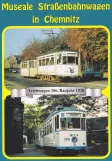
Postcard: Chemnitz tram line 3 with railcar 316 on Limbacher Straße (1988)Museum trams
in Chemnitz
Motor car 306, built in 1928
306 bidirectional motor car / narrow gauge Chemnitz, built around 1928
Series nos. 203-207, data sheet T 17
Vehicle number 206: 1975: renamed no. 306
1977: renamed no. 316
Converted to museum car no. 306 in the mid-1990s
Manufacturer: Waggon- und Maschinenfabrik AG, formerly Waggonfabrik W. C. F. Busch. Bautzen
Electrical equipment: Allgemeine Elektricitäts-Gesellschalt (AEG), Berlin
Motor/Power: 2 x 47.8 kW (AEG), 1976/77: equipped with the chassis of former railcar 346 (motor/power: 2 x 44.2 kW-Db 731, SSW) and until 1988: again equipped with AEG motors
Length over crash barrier: 10,216 mm
Seats: 22 (across) / Standing places: 38By Henrik Boye, Maik Wagner, Straßenbahnfreunde Chemnitz, Thomas Böttger - .