Photos and videos from Wallensteinstraße (Hannover)
8:52
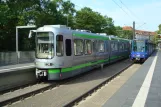
Driver's cab ride on the new Hemmingen section line 13 from Wallensteinstr (2023)Here you can see the TW2000 traveling from the Wallensteinstrasse stop to the Hemmingen terminus via Unter den Linden, Stfr. Ricklingen, H-Saarstrasse, H-Zentrum, and H-Berliner Strasse. Photographed on December 9, 2023 at noon.
Thanks to the driver who made this possible during regular service.
(Hannover, Üstra Aktiengesellschaft)
Joining @der_eisenbahnfotograf_lukas.
Enjoy watching!By Trainspotter Hannover - .
7:59
ÜSTRA Light Rail Shuttle Service Wallensteinstrasse - Tresckowstrasse (2018)From July 27 to July 29, 2018, the A-South section of lines 3 and 7 will be closed due to construction work. A replacement bus service will be provided during this time. A commuter tram service has been set up between Wallensteinstrasse and Tresckowstrasse.
Due to track construction and switch work along Ricklinger Stadtweg, as well as at the Allerweg track curve, the A-Süd line between Waterloo and Wallensteinstraße was closed for the weekend. Passengers on lines 3, 7, and 17 must use rail replacement services. At the "Wallensteinstraße" stop, passengers transfer between the bus and the aerial tram. Between Wallensteinstraße and Tresckowstraße, two three-car trains of the TW 3000 type will run back and forth, each on a single track. This means that service is offered approximately every ten minutes on this section of the route. Two additional TW 3000 cars are parked as reserves in the reversing lane. Because pedestrians, cyclists, and motorists do not expect trams traveling in the opposite direction, speed limits have been set up in front of the crossings.
The "Dormannstraße" crossing, in particular, is hard to see because of the train parked in the reversing lane. The crossing lights have been covered since they can't be activated by trains on the left track. Instead, signal panels are installed, and trains ring their bells to signal their approach. The crossing signals and signal lights have also been covered at other crossings along the light rail line, and speed limits are posted. Signal panels are located at the crossings. It's rare to see two light rail trains traveling on the left track at the same time. Since the commuter trains each run on a single track, they always travel on the left track in one direction, opposite the usual direction of travel. Passengers are informed about the shuttle service at stops via displays. Additionally, service staff are available to provide information. Signs indicate which platform the next departure will be from.
The unsignalized second stop entrance has been blocked off with barriers to simplify passenger information and enhance safety. The commuter tram service was introduced because there weren't enough buses available to provide SEV service on the entire route between Waterloo and Wettbergen for two tram lines. Two drivers staff each of the two commuter trams to ensure quick reversals at their terminals. Additionally, there is a "standby" driver at Wallensteinstraße who can relieve the commuter drivers for a break. The commuter trains terminate at "Tresckowstraße," one stop before the Wettbergen terminal, and then return from there. The trains cannot travel to the terminal because work is being done on the switches there. The drives and controls of the frequently used switches are being replaced.
Replacement service to the terminal is only available at night; during the day, it can only be reached on foot. During the commuter service, train protection in the tunnel section is turned off, the maximum speed is limited to 30 mph, and the track magnets are covered. The trains navigate the tunnel by sight; the tunnel lighting has been turned on for this purpose. When trams run on the left track, hazard lights must be turned on; this requirement has been extended to both directions for the entire duration of the commuter service. The short tunnel passes beneath the Mühlenberg district and has a station below Mühlenberger Markt (Mühlenberg Market). Staff are also present at the tunnel station to assist passengers. The trains return to the surface via the "Am Sauerwinkel" tunnel ramp. The 30 mph speed limit applies to the whole route, not just the tunnel section. Here, too, the signals and magnets have been covered. This type of commuter service is probably a first for the tram and unlikely to happen again soon. The final scene, set in front of St. Thomas Church, concludes the documentary about the commuter service.By IC-lokomotivfører - - .
3:44
ÜSTRA Hanover Transport Company (2017)The ÜSTRA with its 2000, 2500, 3000, and 6000 railcars in action.
There are also some advertising cars to see. But take a look for yourself.By SchienenZombie - .
56:17
Tram/Light Rail in Hannover (2015)On April 4, 2015, the train departed for Hanover with a permit. Participants were:
RheinbahnFan 2.0 / rheinbahnfan
ThunderSchraeg / thunderschraeg
The TW2000, TW2500, TW3000, and TW6000 models are on display.By tramfreak2000 - .
Hannover Tram - Impressions (2013)No matter which light rail video I watch, I keep noticing that many stops are still not barrier-free. This poses a particular challenge for people with walking difficulties. I understand that making stations barrier-free can be costly, but still, what if a person with a disability needs to board or get off at a stop where boarding and alighting are only possible via the light rail's folding steps? Or do the light rail vehicles have ramps that can be used if needed?By 777whitestone - .
2:47
Stadtbahnen Hannover TW 6000 Üstra. U-Bahn The Green Stadtbahn (2012)The green trams have been running in Hanover since 1974. The Hanover tram is a combination of underground and tram systems. With their striking color, "the Greens" have helped shape Hanover's cityscape. Today, 147 green TW 6000s are still in use. From the end of 2013, the brand-new TW 3000 series will be available in exterior colors of green, silver, and black.By Benjamin Schulz - .
10:12
[1/2] Trams in Hanover - a case study - ideal transport? (2012)Visit my blog http://filmykolejowe.pl/. Today, I'm taking you to Hannover, a city with a population of over 500,000. It has 12 tram lines and nearly 40 bus lines. It's also a city of bicycles. Yet, it boasts a level of public transportation that a town of similar size, Gdańsk, can only dream of. And it's not about the money but about the transfer options.
Hanover is not a large city, and contrary to what it says, it doesn't have a metro, but it does have a very efficient public transportation system based on fast trams. Here, we see the entrance to the underground tram station. Let's take a tram to the transfer hub located two stations above ground. To travel, we need to buy a ticket, so let's go to the ticket machine. This machine features a unique ticket-purchasing system. We can choose the language. Polish isn't available; surprisingly, Turkish is. Yes, we have many languages here. There's Russian, Turkish, and more. It's obvious why, but since we're poets, we'll manage. A single-zone ticket costs 230 EUR and is not very profitable, as we mentioned, because an all-day (24-hour) ticket costs only 4.50 EUR. This time, shopping went much better. She returned our ticket and change.
The ticket reads: 'Now we're heading to the viewing platform.' This tram, like the metro, is relatively shallow. The first interesting thing is that someone will appear at the bottom; those are stairs. Switch to the upward mode. Someone's coming. We'll see if it works as it should, in theory, for now. The stairs come from above. Now, the stairs have switched direction, meaning the escalators are now downward. A clever trick at less busy stops is to check the stairs themselves.
As you can see, compared to the Warsaw metro, these platforms are pretty small and not very spacious either. The metro and tram were built around 1975. From what I remember, according to the info board built into the central tram station, we'll see it later. Now, let's go above ground. The info boards about the next train are obvious—two units, the destination station. Usually, before the train arrives, info about the following three trains and departure times appears. We're at the last station of the underground metro, so we're just heading to the surface. Welcome to the surface. Let's look at this tram route. The first thing that catches your eye is the very high platforms, which means most stations have level floors. Our tram is here; as you can see, the platform is enormous, but there are ramps, so no problem. The tracks continue toward the districts. These aren't suburbs, but areas where running tracks off the road aren't possible. I'll show you something that highlights its simplicity. Let's go to the other bus stop. Buses traveling from that side run along this street, bypassing this tram island, and approach the stop on a slight slope. You can see that some drivers are also having trouble. Thanks to this design, we get excellent transfers because bus passengers can board directly onto the tram platform. The next tram here is also an older model. As you can see, the doors are very high, and there are other differences.
Below are the steps that open when the tram shares platforms with buses. I'm trying to show you such a platform and how these steps operate, but on high platforms, the floor is even. How long did the tram stand? Getting off? Getting on is easier. No one was threatening. Trams only stop briefly at designated stops. You'll see in some videos the speeds in the tunnel; around 60 km/h, similar to the maximum speed of the Warsaw metro until recently. Here, we have dedicated solutions, such as trams running at these speeds. Here's the timetable for this bus line.
As you can see, it runs every 10 minutes. It's a pretty good service, along with the peak line 133. This provides a perfect frequency. Buses probably run every 8-9 minutes. Here's a map of the entire bus and tram network. The white area in the middle is the first zone. We're practically on its border, right there, and we'll go to the other end near the stadium. We'll see from the window what it looks like where the underground exits. The trams run fast, and thanks to the innovative solution at the central station, there are information boards at all tram stops showing the next departures. Unlike Warsaw, this system works much better. It just works. In one minute, there’s a tram; soon, we'll see the TR line 379 operating here. Looking at the map again, or better yet, the tram line map, you’ll see that line 369 is 3. They start at different points but intersect and support each other throughout the section. So, we're practically on the border of the zone now, and on the other side too. These three lines complement each other along this entire stretch, then branch again into two different loops at the other end.By KolejTakPkpNie - .
8:07
Stadtbahn Hannover - Vehicles (2007)During a visit to Hanover in 2007, these pictures were taken at a few selected locations on the above-ground rail network. My main aim at the time was to capture the various vehicle types, TW 6000, 2000, and 2500. I also managed to capture some beautiful full-length advertisements on camera.By Horst Honig (Horst Honigs Bahnvideos) - .
Location on a map
Trams in the direction of Wallensteinstraße (Hannover)
3:44
ÜSTRA Hanover Transport Company (2017)The ÜSTRA with its 2000, 2500, 3000, and 6000 railcars in action.
There are also some advertising cars to see. But take a look for yourself.By SchienenZombie - .
2:47
Stadtbahnen Hannover TW 6000 Üstra. U-Bahn The Green Stadtbahn (2012)The green trams have been running in Hanover since 1974. The Hanover tram is a combination of underground and tram systems. With their striking color, "the Greens" have helped shape Hanover's cityscape. Today, 147 green TW 6000s are still in use. From the end of 2013, the brand-new TW 3000 series will be available in exterior colors of green, silver, and black.By Benjamin Schulz - .