TRAM TRAVELS

Straßenbahn-Haltestelle (Hannover)

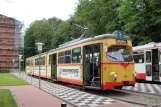
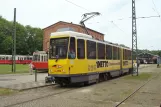
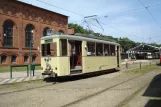
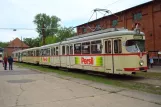
There are 18 photos from Straßenbahn-Haltestelle (Hannover) on Tram Travels.

Hannoversches Straßenbahn-Museum (HSM) stops

Field at Stichkanal Hildesheim, Omnibushalle, and Straßenbahn-Haltestelle.

Photos and videos from Straßenbahn-Haltestelle (Hannover)
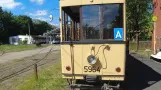
Tram Museum Hannover (2024)
2:12
Tram Museum Hannover (2024)By MauriceU79 Duisburg.
.
I also brake for rabbits! | DÜWAG GT 8 | Ride in the tram museum (2024)
10:10
I also brake for rabbits! | DÜWAG GT 8 | Ride in the tram museum (2024)On May 1, 2024, after nearly three years of interruption, the outer line of Hannover's tram museum in Wehmingen resumed operation. After the overhead line was stolen, electrical service with trams was no longer possible. Thanks to many generous donations and the dedication of the association members, the historic trams could once again run across the fields. My volunteer work at the Hannover Tram Museum is a nice change from my daily job as a driver. I can ride old trams in my free time—and you might want to, too! It’s worth becoming a member, as it greatly benefits the association: https://www.tram-museum.de/verin/mitarbeit-im-museum/. Check out the website if you're going to drive a historic tram yourself: https://www.tram-museum.de/besucher/strassenbahn-selbst-fahren/. The traffic signal system isn't operational, so I am allowed to drive through the intersection with extra caution. However, I would now like to welcome you to the tram museum and guide you on a tour of the reopened exterior route. To do this, I move from the storage area to the departure stop where visitors begin their journey to the museum. The Hanover Tram Museum in Wehmingen houses around 140 railway vehicles from 1895 to 1990, not only from Hanover but from all over Germany and Europe. The DÜWAG-GT8 features two DC traction motors, each rated at 115 kW, and is controlled by a cam switch with electrical contacts. Using the drive crank, I can gradually disconnect the starting resistors that supply DC to the traction motors in a controlled manner, which are also actuated during braking. The motors act as generators, converting kinetic energy into heat through brake resistors. At the switch, we turn left onto the outer road, and on the right, the route continues along the circuit through the museum. The outer road, on the other hand, leaves the museum area and goes through the fields to the nearby district road. Initially, this six-kilometer track served as a connection between the Hohenfels potash mine and the railway used for freight; steam locomotive-powered trains transported potassium salt away. In the 70s and 80s, the first trams arrived at the newly established Tram Museum via this track. You can support me a lot by liking or subscribing—thank you very much for your support :) We now leave the museum area through the gate and immediately cross the first railway crossing. I stop in front of the crossing, open the first door, and let my conductor exit. Then, I secure the crossing with a flag that is not visible in the camera view. As I slowly roll over the crossing, the conductor re-boards, and I can close the door. In 2013, overhead power lines were installed along the outer road, and the catenary was suspended. Since then, the trams have been able to run independently on this track, increasing the number of visitors. Previously, a diesel locomotive had to be positioned in front of the tram, or a battery-powered car had to be placed behind it. In September 2021, the museum faced a serious setback when a professional gang of thieves stole the line's contact wire to access the valuable copper in the catenary, which meant trams could no longer operate. Since then, operations on the scenic route through the fields have been suspended and can only resume thanks to many generous donations. Thanks to the hard work of all active club members, the newly purchased catenary was successfully re-tensioned quickly. The outer route can reach speeds of up to 25 km/h in certain sections, but is limited to 15 km/h before the curved track in the depression. With a ceremonial opening on May 1, 2024, the outer route is set to begin operation—a long-awaited milestone for visitors. We crossed Billerbach and stopped at the second crossing along the route. Here too, the conductor gets out again, secures the crossing with a red/white flag, and then re-boards the train. The Tram Museum in Hanover has its own presence on Instagram, so be sure to check out @tram_museum for updates and behind-the-scenes insights. The tram driver must always stay highly focused when driving through the city, paying close attention to other road users. Still, nothing can happen in a field where no children jump out between parked cars or cyclists cross the track just in front of the train. But even here, you need to stay alert when suddenly a brown hare hops faster than the tram to cross the track. It jumps behind a pillar, out of sight the whole time, and really wants to cross the track, so I slow down to make that possible. Now that I've started moving again, the drive wheels are slipping audibly, so I reset the crank to zero and try again. During the three years without traffic, the route has become somewhat overgrown, with small bushes growing alongside and within the track area. However, a very dedicated club member cut the route completely in time for the reopening and cleared it of bushes. Currently, we are allowed to drive to the district road, about 1.By IC-lokomotivfører - .
I drive a 55-year-old tram at the museum | DÜWAG GT 8 (2024)
13:30
I drive a 55-year-old tram at the museum | DÜWAG GT 8 (2024)A welcome change from my daily work as a train driver is volunteering at the Hanover Tram Museum. There, I can drive vintage trams in my free time—and maybe you can too! Becoming a member is worth it and greatly supports the organization: https://www.tram-museum.de/verein/mitarbeit-im-museum/ Check out the website if you'd like to drive a historic tram yourself: https://www.tram-museum.de/besucher/strassenbahn-selbst-fahren/ You can find more insights into the daily life of a train driver at DB Fernverkehr AG on my Instagram channel: https://www.instagram.com/ic_lokfuehrer/ Welcome to the driver's cab of a Duewag articulated tram (GT8) from 1969, now preserved as a museum tram. I want to take you on a tour of the Hanover Tram Museum in Wehmingen, where the vehicle has been based since 2020. The museum, situated just outside Hanover, houses approximately 140 railway vehicles and features two routes totaling around five kilometers. At the subsequent junction, the routes split into a circuit through the museum and an external route leading into the open fields. We switch to the circuit and take a lap around the historic museum area, which has a fascinating history. Separation points are regularly built into the overhead wire to segment it into sections that can be switched off individually. The external route branches off to the left and leaves the museum grounds shortly afterward. It has been electrified since 2013 and is usable by trams. Several stops are scattered throughout the museum grounds. Our first stop is at the Hohenfels Mitte station. While I can independently open and close the first door, all other doors can only be operated by passengers. However, I can open the doors to allow passengers to use the door buttons, after which the doors close automatically. From above, the track resembles a prominent figure 8; here, the two parts of the route intersect in a short, single-track section. We are in tram car 711, nicknamed "Helmut," which was delivered to Düsseldorf Rheinbahn in 1969 as car 2664. After 42 years of service on the Rhine, the vehicle arrived in Poznań, Poland, in 2011, where German cars were named after former Chancellor Kohl. A damaged section of track requires a temporary speed reduction to 5 km/h; this is communicated to the driver with the speed signals G 2 and G 3. The stop "Hohenfels Haus 20" is only served during major events and is also known as the cemetery on Reformation Day. The scary train with Halloween characters, which has been set up and popular for years, runs on the neighboring track. When all doors are closed and the vehicle is ready to depart, the green "Departure" indicator light turns on. In February 2020, due to hurricane "Sabine," a tree fell on car 2304 parked underneath, a Düsseldorf Duewag GT 6, which was destroyed beyond repair. By a fortunate coincidence, the Poznań GT 8 was scheduled to be parked almost simultaneously; just a few months later, the former Düsseldorf car, which had been painted green and yellow, was transferred to the Tram Museum. The vehicle was put into visitor service just in time for the start of the 2021 season and has been popular with both staff and visitors from the beginning. We have arrived in the southern area, which features a spacious, open space and an impressive collection of buildings. The building houses the worlds of technology, including the Telecommunications Museum and the North German Museum of HiFi and Studio Technology. During major events at the museum, the bus museum also opens its doors, with the Solaris bus, which is not part of the museum's collection, explicitly on display. On visiting days, the trams run according to the schedule so visitors can take the train to the worlds of technology and back. We have reached the southernmost point of the museum and are now traveling through the relatively narrow southern loop, heading back toward the northern area. The southern part of the museum, located in the forest, was initially built during World War II as a munitions factory and hospital. In the barracks and buildings, the Wehrmacht sewed parachutes and manufactured ammunition, which were also temporarily stored here. During the war, the area expanded significantly, becoming a hospital for wounded soldiers and civilians. The confusing intersection behind the corner of the house is marked with a bell sign; the speed limit sign is no longer relevant after the repair work on the superstructure. Most of the barracks today house trams, which may be refurbished someday or, more realistically, serve as spare parts suppliers, since the club lacks the volunteer workforce to restore all the vehicles, which are already involved in maintaining operational vehicles and are busy. The tram museum always welcomes volunteers; membership is inexpensive and provides significant support to the club. Depending on their interests, active members can participate in the workshop, the bistro, the driving service, track construction, etc.By IC-lokomotivfører - .
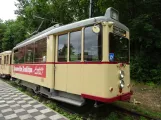
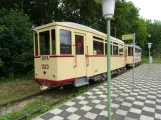
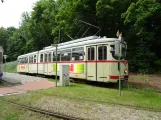
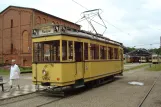
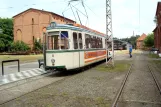
Hannover Hohenfelser Wald with railcar 236 at Straßenbahn-Haltestelle (2020)Hannover Hohenfelser Wald with railcar 236 at Straßenbahn-Haltestelle (2020)By Henrik Boye.
.
Hannover Hohenfelser Wald with sidecar 1023 at Straßenbahn-Haltestelle (2020)Hannover Hohenfelser Wald with sidecar 1023 at Straßenbahn-Haltestelle (2020)By Henrik Boye.
.
Tram Museum Wehmingen (2020)
7:15
Tram Museum Wehmingen (2020)One of the most prominent tram museums is in Wehmingen near Hanover. You can see exhibits from all over Europe. Highlights include rides on the operational vehicles. A modest sign points to one of Germany's most renowned tram museums. In just a few minutes near Hanover, trams from all over Europe run and stop. Choose the display for this railcar. The train numbered 35 33 came from Bremen. The short, articulated railcar, built in 1976, was manufactured by Wegmann. It runs on the museum's own track, with proper stops. Car 389 is much older; it was built in 1951 by de Bug for the Düsseldorf trams. This railcar is a so-called association type, still primarily based on pre-war designs. Here in Memmingen, the old car has a new home, and as you can see, 389 is even operational. Many of the tram exhibits have been beautifully restored. Number 2 comes from Neuenkirchen. Behind it is a pre-war tram from the Üstra in Hanover. In between, there’s everything that tram enthusiasts love, from textbooks to DVDs. The 1895 Budapest subway train is one of the most valuable exhibits. Budapest's metro is one of the oldest on the European continent. Number 7,156 ran in The Hague. Next to it is the 281 overland tram from the former Upper Rhine Railway, which needs restoration. Line 11 was also a country road tram that ran between Hildesheim and Hanover until 1958. Next to it is the 461 overland tram from Viertel in Switzerland. The museum exhibits are all touchable, and almost every tram can be entered. The dusty charm of the 50s and 60s invites visitors to linger. Next to the Freiburg tram is a three-axle tram from Bonn. Over 100 vehicles can be seen in just a few minutes, offering a journey through European tram history. The horse-drawn tram from Hamburg is one of the oldest exhibits, though its exact construction year is unknown. A special feature of the museum is that it offers rides on its own tracks, without a schedule. The old trains run along these tracks. The 389 from Düsseldorf is back on the road, with its next trip scheduled for 23-04, involving the nearly 60-year-old train from Düsseldorf. The Bremen tram, now designated as Line 1, was much more modern when it was relocated to Osterholz. A T24 from Berlin is also on display; this well-restored tram has been operational again since 2008. The tram museum in Memmingen is open every Sunday and public holiday from April to October. With a bit of luck, visitors can even ride a Kassel tram from 1936.By The Travelling Drone - .
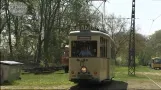
Hannover Hohenfelser Wald with articulated tram 2304 at Straßenbahn-Haltestelle (2018)Hannover Hohenfelser Wald with articulated tram 2304 at Straßenbahn-Haltestelle (2018)By Henrik Boye.
.
The Berlin tram 5964 on the outdoor track of the Hanover Tram Museum (2021)
1:34
The Berlin tram 5964 on the outdoor track of the Hanover Tram Museum (2021)Ride on June 26, 2016 with the T 24. The solid chassis is clearly noticeable!By Nordbahnmicha - .
Hannover Hohenfelser Wald with articulated tram 206 "Berlin" at Straßenbahn-Haltestelle (2016)Hannover Hohenfelser Wald with articulated tram 206 "Berlin" at Straßenbahn-Haltestelle (2016)By Henrik Boye.
.
Hannover Hohenfelser Wald with articulated tram 6016 at Straßenbahn-Haltestelle (2016)Hannover Hohenfelser Wald with articulated tram 6016 at Straßenbahn-Haltestelle (2016)By Henrik Boye.
.
Hannover Aaßenstrecke with railcar 389 at Straßenbahn-Haltestelle (2014)Hannover Aaßenstrecke with railcar 389 at Straßenbahn-Haltestelle (2014)By Henrik Boye.
.
Tram Museum Wehmingen (2013)
28:20
Tram Museum Wehmingen (2013)A film from the Wehmingen Tram Museum in August 2013.By Thomas Flebbe - .
The trams of the Hanover Tram Museum (2012)
17:02
The trams of the Hanover Tram Museum (2012)The T4D comes from Magdeburg. To the best of my knowledge, these are not loans. It and the Reko car belong to the museum. The museum also houses vehicles from Munich, The Hague, Berlin (Reko & T24), Amsterdam, Vienna, Kassel, and some others. Even a subway car from Budapest is part of the collection at the "Hannoversches Straßenbahnmuseum" (Hanover Tram Museum).By choppernachladung - .
Hannover Hohenfelser Wald with articulated tram 2304 at Straßenbahn-Haltestelle (2010)Hannover Hohenfelser Wald with articulated tram 2304 at Straßenbahn-Haltestelle (2010)By Henrik Boye.
.
Hannover Hohenfelser Wald with railcar 5964 at Straßenbahn-Haltestelle (2010)Hannover Hohenfelser Wald with railcar 5964 at Straßenbahn-Haltestelle (2010)By Henrik Boye.
.
Hannover Hohenfelser Wald with articulated tram 2 at Straßenbahn-Haltestelle (2008)Hannover Hohenfelser Wald with articulated tram 2 at Straßenbahn-Haltestelle (2008)By Henrik Boye.
.
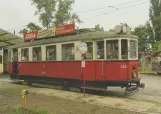
Postcard: Hannover Hohenfelser Wald with railcar 4037 at Straßenbahn-Haltestelle (2003)Postcard: Hannover Hohenfelser Wald with railcar 4037 at Straßenbahn-Haltestelle (2003)Tw 4037 (TYPE M. Simmering, 1928) ex Vienna on July 26, 2003, at the HSM departure stop www.wehmingen.deBy Hannoversches Straßenbahn-Museum (HSM), Henrik Boye, J. Schulz - .
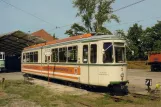
Postcard: Hannover Hohenfelser Wald with articulated tram 2 at Straßenbahn-Haltestelle (2003)Postcard: Hannover Hohenfelser Wald with articulated tram 2 at Straßenbahn-Haltestelle (2003)GT4 Tw2 (Esslingen, 1961 from Neunkirchen/Saar in the summer of 2003 at the HSM departure stop www.wehmingen.deBy Hannoversches Straßenbahn-Museum (HSM), Henrik Boye, J. Schulz - - .

Location on a map

Add a comment

Last updated: .