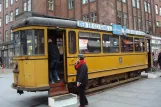
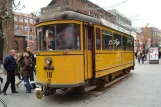
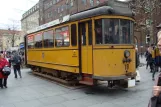
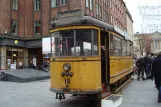
Ryesgade (Aarhus)
There are 6 photos from Ryesgade (Aarhus) on Tram Travels.
Aarhus Tramway (ÅS) stops
Banegårdspladsen, Dalgas Avenue, Kongsvang, Marienlund, Sct. Pauls Kirkeplads, Store Torv, and Trøjborgvej.
Aarhus Tramway (ÅS) depot
Depot Bryggervej, and Remise.
Photos and videos from Ryesgade (Aarhus)

7:19
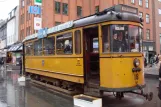
Strøget's 40th anniversary was celebrated with a tram in Ryesgade (2012)The street association Strøget in Aarhus, in collaboration with the museum Den Gamle By, has decided to display an Aarhusian tram on the street to celebrate the 40th birthday of the street, which was recently celebrated. We talked with former tram driver Ove Hansen. The former tram driver, Leif Bisbo, provided a vivid account of how trams operated in the old days in Aarhus.
The street association Strøgt in Aarhus, in collaboration with the museum Den Gamle By, has decided to put an Aarhusian tram on display in connection with Strøt's 40th birthday, which has just been celebrated. We talked to former tram driver Ove Hansen. Yes, it is the street association's 40th anniversary. They have chosen to mark it by finding the old spur because they couldn't build the pedestrian street before, as the spurs had been removed. The trams disappeared 41 years ago, and they spent a year restoring the pedestrian street and building it, which is why they have now recovered the spur rather than just marking it. The trams in Aarhus belong to a bygone era, unfortunately for those who worked on the trams and for those who preferred electric operation over diesel. Yes, I drove the tram for the last three years.
I started at the Tramway in 1968 and drove until it closed in 1971. They shut down on November 6, 1971. That was the last day the track was in operation. The day after, on the 7th, there was a big parade that you can see in various old movies and videos, but how do you actually feel about it now that you've ridden a tram? Do you feel sad that they no longer run, or is it something else? Yes, you could say I feel a little ambivalent about it because, back then, we thought it was something ancient. But you can see that maybe we should have had a bit more foresight. Of course, you couldn't have kept the tracks on the street, but perhaps you could have used some of this for something like in San Francisco—for example, something that could become a tourist attraction. Let's go back in time a little and stand on the first tram that ran through the street in 1948. The former tram driver, Leif Bisbo, vividly described how the trams operated in old Aarhus. There were ten contact points. When you arrived at a stop nearby, there would be some passengers. You pulled the handle back, which oppositely braked the dynamo, then you took the handbrake, making sure the tram stopped when people boarded.
After they finished boarding, you pushed the arm up here. You were a bit lazy, so you drove up like this, then moved it up there—it faced forward. It still says 'Here,' and at the back, you could pull the handle to drive the tram backward. It also had an emergency brake, which, when activated, engaged four magnetic brakes that clamped down, gripping the track at the same time as a sandbox in front. The sandbox was used to put sand on the rails to prevent slipping. The wheels were small, so sand was needed. I can tell you that the tram would come to a complete stop when the brakes were fully engaged. People would get off and greet the drivers, and those still on would wave.
Aarhus got its first tram line in 1884. It was horse-drawn and ran from the railway station to Store Torv, made possible by the construction of Klemens Bridge. Back then, merchants on Store Torv found the tram stop a big nuisance on market days and asked the city council to move it. They decided the tram should stop at Klemens Torv on market days. Now, people from Den Gamle By have plans to bring this tram and sidecar down and display them in the area being developed in the 1970s, which I've heard about. They want visitors to see it. Even the director, Thomas Block Ravn, has ideas about possibly running it there, but that's probably too expensive—something I can't imagine.
On a different note, there's a fantastic interest in riding the tram. It's fun to watch. We are three colleagues who have driven the tram, and we've been surprised by the significant interest that has developed over the past three days. We've met a lot of people, mostly in their 50s. They get on and say, 'Wow, wasn't it bigger?' It turns out they mean because it was the size that children and young people experienced back then. So, what was the biggest challenge in driving a tram? Honestly, I'm not entirely sure. It followed the tracks and essentially took care of itself. But you had to be careful, especially in areas like Søndergade and Sallings, where it drove right up to the curb. That meant you had to be cautious not to hit pedestrians walking with a bakery bag or something similar. Sometimes, accidents happened, but overall, the operation was manageable.By atvdenmark - .