Rottluff (Chemnitz)
There are 5 photos from Rottluff (Chemnitz) on Tram Travels.
Chemnitzer Verkehr (CVAG) stops
Altchemnitz, Annenstraße, Bahnhofstraße, Bernsdorf, Brückenstraße/Freie Presse, Erzbergerstraße, Falkeplatz, Falkeplatz, Gablenz, Hauptbahnhof, Hutholz, Industrie-museum, Rottluff, Schönau, Schönau, Popowstraße, Straßenbahnhof Kappel, Technopark, Theaterplatz, Treffurthstraße, Weststraße/Kochstraße, Wladimir-Sagorski-Straße, and Zentralhaltestelle.
Videos of trams at Rottluff (Chemnitz)

3:02
Karl-Marx-Sadt - Tram - Chemnitz Rottluff (1988)The year is 1988. The GDR still exists, and so does the 925 mm tram in Karl-Marx-Stadt. It was its last year of operation, and in the spring of 1989, we produced this short report. The tram in Karl-Marx-Stadt was a 925 mm narrow-gauge railway. For 108 years, it was the only such gauge in Germany. Line 3 ran from the central station to Rottluff. The trailers and caravans date back to 1929. In 1929, 35 railcars and 50 trailers were delivered to what was then known as the Chemnitz Transport Company. The railcars were built by Busch in Bautzen. AEG and Siemens Schuckertwerke supplied the electrical components. Twelve railcars and three original trailers were still in use during the last year of operation. Many lines have since been converted to standard gauge and are now served by modern Tatra trains. Tram service in Karl-Marx-Stadt was phased out, and the final closure, which involved the remaining operations on line 3, took place in November 1988.By pcneustadt - .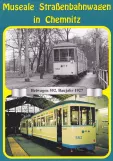 Postcard: Chemnitz tram line 3 with sidecar 552 at Rottluff (1988)Museum trams
in Chemnitz
Trailer car 552, built in 1927
552 bidirectional railcar / narrow gauge Chemnitz, built around 1927
Series nos. 551 - 560, data sheet B 16
Vehicle number 552: decommissioned in 1983.
1986 converted to a museum car, mid-1990s: converted to museum car no. 552
Manufacturer: Waggon-und Maschinenfabrik AG, formerly Waggonfabrik W. C. F. Busch, Bautzen
Length over crash barrier: 10026 mm
Seats: 22 (across) / Standing places: 44By Henrik Boye, Maik Wagner, Straßenbahnfreunde Chemnitz - .
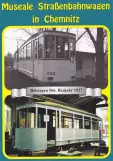 Postcard: Chemnitz tram line 3 with sidecar 566 at Rottluff (1988)Museum trams
in Chemnitz
Trailer car 566, built in 1927
566 bidirectional railcar / narrow gauge Chemnitz, built around 1927
Series nos. 566 - 568, 569, 570, data sheet B 18
Vehicle number 566: Decommissioned in 1986 (currently being refurbished)
Manufacturer: Vereinigte Westdeutsche Waggonfabriken, Düsseldorf-Oberbilk plant
Length over crash barrier: 10026 mm
Seats 22 (across) / Standing room 44By Henrik Boye, Maik Wagner, Straßenbahnfreunde Chemnitz - .
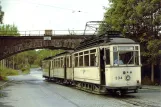 Postcard: Chemnitz tram line 3 with railcar 334 at Rottluff (1979)Chemnitzer Verkehrs-AG tramcar no. 334 of the former 925 mm narrow-gauge network at the Rottluff terminus in August 1979.
Waggonfabrik Busch, Bautzen/AEG 1928/29, 2 x 47 kW, top speed = 40 km/h
CVAG, electric narrow-gauge tramcar no. 334 in August 1979 at the Rottluff terminusBy Der Bahnladen, Henrik Boye, Wolfgang Walper - .

2:28
Narrow-gauge trams in Karl-Marx-Stadt (1893-1988)It all started in 1880 with a horse-drawn tram on the unusual gauge of 915 mm (about three feet), which remained the standard until 1893, when electric operation began. From 1917 onward, plans were made to widen the gauge to 1000 mm. However, it wasn't until 1958 that VEB Verkehrsbetriebe Chemnitz launched a truly ambitious gauge conversion program. Due to numerous urban development challenges and austerity measures typical of the GDR, the latter VEB Nahverkehr Karl-Marx-Stadt was only able to complete this program in 1988.
Look back at the lively tram scene and scheduled service on the narrow gauge line with the legendary three-car trains. These railcars from the 1920s were kept operational through extensive maintenance and continued to run until the last Rottluff-Zentrumsring line was shut down on November 6, 1988. Footage from the 1920s, of course, is just as common as winter shots from the 1980s.
First Chemnitz, then Karl Marstadt, then Chemnitz again. The city's name changed as often as its tramway. Even the track width was unusual. In 1890, an English engineer based his work on British units and chose a track spacing of three feet, or approximately 915 mm. In 1917, the track was widened to just 925 mm. It stayed that way for decades. This measurement was unique in Germany. This chapter wasn't finished until 1988. Until then, only vehicles from the 1920s were in operation. The footage in this film dates from the 1980s, but the film also offers a glimpse into earlier times. The employees of this tramway company had a knack for improvisation. When they wanted to showcase a historic carriage for the centenary, they converted a much newer model. Entry into the carriages was relatively high, ranging from over 36 cm to the first step. The coupling system was also old and extremely rare. The footage was shot by Jörg Langfeld, who also filmed in winter. This 50-minute film is an incredible journey through time for tram enthusiasts.By tram-TV - - .