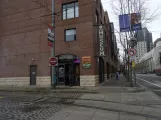
Railway Museum, 77 Steuart Street (San Francisco)
There are 10 photos from Railway Museum, 77 Steuart Street (San Francisco) on Tram Travels.
San Francisco Railway Museum stops
17th Street & Castro Street, 2nd Street & King Street, Beach Street & Jones Street, Beach Street & Mason Street, Beach Street & Stockton Street, Church & 27th, Don Chee Way & Steuart Street, Jefferson Street & Taylor Street, Jones Street & Beach Street, King Street & 4th Street, Market Street & 2nd Street, Market Street & 4th Street, Market Street & Battery Street, Market Street & Buchanan Street, Market Street & Drumm Street, Market Street & Kearny Street, Market Street & Larkin Street, Market Street & Noe Street, Market Street & Powell Street, Market Street & Sanchez Street, Market Street & Stockton Street, Market Street & Taylor Street, Market Street & Van Ness Avenue, Railway Museum, The Embarcadero & Bay Street, The Embarcadero & Ferry Building, The Embarcadero & Greenwich Street, The Embarcadero & Sansome Street, The Embarcadero & Stockton Street, and The Embarcadero & Washington Street.
Photos and videos from Railway Museum, 77 Steuart Street (San Francisco)
Added Model tram: San Francisco in Railway Museum (2025)Car House. Municipal Ry. Fishermans Wharf. Downtown. Last stop. 9th & Market.
Added Model tram: Tram 1940 (2025)Ferry. Civic Center Auditorium. Golden Gate Park and Ocean Beach via McAllister.
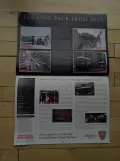
Added Sign: San Francisco inside Railway Museum (2025)See how they run More different types of trasit vehicles have rum along the steets of San Francisco than almost any other city. The Sutter Street Railroad Co. operated some distinctive horsecars designed by owner Henry Casebolt in the 1870s. The car with the round body (left) could rotate on its truck, so at the end of the line, the horse could be walked around to reverse direction without unhitching and rehitching. The car marked 'To Seal Rock Road Direct' (right) features decorative oval windows that let standing passengers see out...very similar to the steamliner PCC streetcars running on Market Street an The Embarcadero today. The Sutter company later upgraded almost all its routes to cable cars. The Powell Street Railway Company's fleet included some open cars that operated on pleasant days. Looking at the heavy wool uniforms of the crew, we hope it wasn't too hot when this shot was taken-somwhere around 1890-probably at what was then the western terminal of Washington-Jackson line, at Central Avenue (now Presidio Avenue) & California Street. San Francisco's early electric streetcars generally followed the 'California-type' design, named for California Street cable cars-operable from either end, with an enclosed center section and open end sections. Adolph Sutro built a streetscar line in 1896 to serve his recreational complex at the city's northwest corner neal Seal Rockks, Sutro Baths, and the Cliff House (the fanciful structure in the background, which burned to the ground in 1907). San Francisco added trolley buses to its variety of transit vehicles in 1935, when Market Street Railway Co. converted the rollercoaster 33-line across Twin Peaks from streetcars. Trolley buses can negotiate much steeper grades than streetcars (and most motor buses as well) with their combination of powerful electric motors and rubber-tired traction. Muni's original E-Union line used high-traction single-truck streetcars to climb grades too steep for conventional streetcars, but even these cars had to detour arund the steep Union Street grades between Van Ness and Larkin. Muni's first trolley buses, purchased in 1941, handled the Union Street hill with ease. Our nonprofit Market Street Railway has preserved one of these orginal Muni trolley coaches, No. 506. When Mayor Roger Lapham wanted to get rid of Powell Street cable cars in 1947, trolley bus technology would have been the best choice for the steep hills. But without funding for the wires and power supply, Muni bought 10 gasoline buses with two large engines that were supposed to work in sync to push the bus over the hills. Lapham lost, of course, and the buses, assigned to other routes, never worked very well, requiring removal of one of the engines. One of these buses (No. 0163)-historic for what it almost did-is preserved by Muni. Identical looking trolley buses by the same builder, Twin Coach, were mainstays of many Muni lines for a quarter-century, until the mid-1970s.
Added Model tram: San Francisco inside Railway Museum (2025)Car 952 New Orleans. Car 1000 Melbourne.
Added Sign: San Francisco in Railway Museum (2025)Streetcars & Cable Cars: What's the Difference? Visitors often confuse the two remaining vintage rail transit vehicle types in San Francisco. Many refer to both as 'trolleys.' Here is an explanation... Cable Cars Cable cars run on steel rails with a slot between them. Underneath the street, there's an endless cable powered by complex winding machinery housed in a central powerhouse. The car grabs the moving cable with a gripper that functions like a giant pair of pliers, reaching through the slot beneath the street. This type of street-running cable car first appeared in 1873, invented in San Francisco by Andrew Hallidie, a British mining engineer, with design work by William Eppelsheimer. Although cable cars were the most advanced form of American urban rail transportation in the 1880s, San Francisco was the last city in the world to operate them in revenue service, doing so until 1957. San Francisco mayor Gavin Newsom introduced cable car No. 42 into Muni's historic fleet during UN World Environment Day 2005. Market Street Railway's volunteers played a key role in restoring this very special cable car. Streetcars Streetcars also run on steel rails but have a trolley pole on the roof that connects to a single overhead electric wire for power. Made practical by Frank Sprague in Richmond, Virginia, in 1887, electric streetcars dominated urban mass transit in the US until World War II. In some cities, especially in the Eastern US, streetcars were called trolleys after the wheel at the end of the pole that collects current (today represented by a carbon slider in San Francisco). In most parts of the country, however, they were known as streetcars or simply cars—back when what we now call cars were called automobiles, horseless carriages, or machines. Trolley Buses Trolley buses add more confusion. San Francisco is one of the few North American cities still operating these rubber-tired electric buses with two poles and double overhead wires. These vehicles don't run on rails, but their powerful electric motors let them climb hills that a cable car could handle—and streetcars couldn’t. Their pollution-free operation makes them very popular among San Franciscans.
Model tram: San Francisco inside Railway Museum (2023)Model tram: Tram 1940 (2023)By Henrik Boye - .
Model tram: San Francisco on Railway Museum (2023)Model tram: Tram 105
6
Municipal Ry.
Fishermans
Wharf
Downtown
Last stop
9"& MarketBy Henrik Boye - .
Calendar: San Francisco inside Railway Museum (2023)Looking Back from 2023
Notable anniversaries
We keep San Francisco's vintage transit on tranck
San Francisco Railway Museum
Join, support, or volunteer to help Market Street RailwayBy Henrik Boye, San Francisco Railway Museum - .