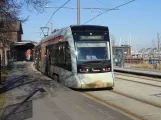
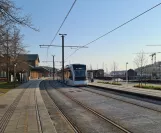
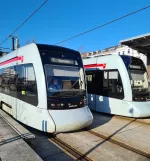
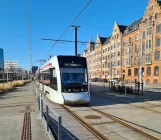
Østbanetorvet (Aarhus)
There are 48 photos from Østbanetorvet (Aarhus) on Tram Travels.
Aarhus Letbane stops
Aarhus H, Assedrup, Beder, Dokk1, Gammel Skejby, Grenaa, Gunnar Clausens Vej, Hessel, Hjortshøj, Hornslet, Hovmarken, Humlehuse, Klokhøjen, Kollind, Kongsvang, Lisbjerg Bygade, Lisbjerg-Terp, Lisbjergskolen, Løgten, Lystrup, Malling, Mårslet, Mølleparken, Mørke, Nehrus Allé, Nørreport, Nørrevænget, Nye, Odder, Olof Palmes Alle, Øllegårdsvej, Østbanetorvet, Risskov Strandpark, Rosenhøj, Rude Havvej, Ryomgård, Skolebakken, Stjernepladsen, Stockholmsgade, The University, Thorsager, Torsøvej, Tranbjerg, Trustrup, Universitetshospitalet, Universitetsparken, Vandtårnet (Ringvejen), Vestre Strandallé, Viby, and Vilhelmsborg.
Photos and videos from Østbanetorvet (Aarhus)
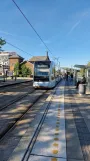
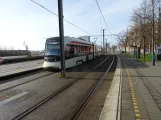
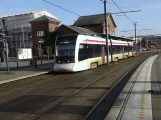
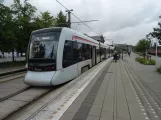
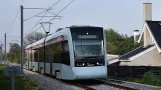
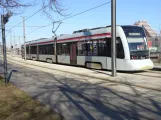
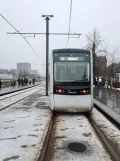
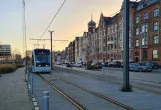
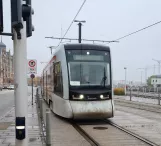
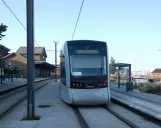
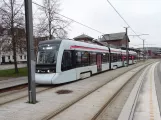
Aarhus light rail line L1 with low-floor articulated tram 2102-2202 at Østbanetorvet (2025)By Henrik Boye..
Aarhus light rail line L1 with low-floor articulated tram 2102-2202 on Østbanetorvet (2025)By Henrik Boye..

2:05
Aarhus Light Rail between Aarhus H and Østbanetorvet (2025)Thank you for watching Aarhus Light Rail between Aarhus H and Østbanetorvet.By Elias Sode Karup - .
9:02
Aarhus Light Rail from Vestre Strandallé to Central Station (2025)Light Rail Line L1. Light rail type: Stadler Tango.
00:00 Intro
00:09 Stadler Tango 2111/2211
00:37 Departure from Vestre Strandallé
01:18 Arrives at Risskov Strandpark
01:45 Departure from Risskov Strandpark
02:21 Arrives at Østbanetorvet
03:36 Departure from Østbanetorvet
04:15 Track change
04:40 Arrives at Skolebakken
05:12 Departure from Skolebakken
05:50 Arrives at Dokk1
06:12 Departure from Dokk1
07:23 Arrives at Aarhus Central Station
08:20 Stadler Tango 2111/2211
08:51 OutroBy XKWRCK 25KVAC - .
17:06
Cab View - Lystrup - Aarhus H with Tango (2024)Lystrup Station to Aarhus Central Station with Tango 2105
Stops include: Lystrup, Torsøvej, Vestre Strandallé, Risskov Strandpark, Østbanetorvet, Skolebakken, Dokk1 & Aarhus H.
Trains in operation in the video: L1 & L2
Filmed in HD at 60 frames per second.
0:00 - Intro
0:04 - Lystrup Station
0:07 - Lystrup - Torsøvej
4:43 - Torsøvej Station
4:54 - Torsøvej - Vestre Strandallé
6:41 - Vestre Strandallé Station
6:49 - Vestre Strandallé - Risskov Strandpark
8:25 - Risskov Strandpark Station
8:32 - Risskov Strandpark - Østbanetorvet
11:24 - Østbanetorvet Station
11:32 - Østbanetorvet - Skolebakken
13:50 - Skolebakken Station
13:56 - Skolebakken - Dokk1
14:45 - Dokk1 Station
14:54 - Dokk1 - Aarhus H.
16:56 - Aarhus Central Station
17:00 - OutroBy Danish Trainspotting - .
21:47
I Rode EVERY Light Rail System in Denmark! (2024)...at least until Copenhagen opens its light rail system in 2025.
In just 24 hours, I'll ride the entire light rail system in Denmark, covering both of them. We've arrived in Odense, Denmark's third-largest city. We're on the 8:13 train to Svendborg. Oh my gosh, it's a tiny train, and this is so exciting—lots of like, oh my gosh, nice big tray table with a coffee thingy. We're only on this for a couple of stops; we're basically using it to get to the end of the light rail here. Well, thanks for the trip, you little weirdo. I love how tiny this platform is—it's so cute. Over here is the end of the light rail, which I actually can't ride until 8:30. I did this weird thing where you can pre-book a ticket via the app, but you have to schedule it, so it's not available until 8:30, so I'm stuck in this weird little area until then. Look how little space it takes to fit all these bikes—that’s think how much more space it would take to fill with cars if you’d use the same number. This line runs every 7.5 minutes throughout the day, which is very convenient. And something cool is they have separate countdown clocks for each platform, so there's only one train here now, but we know it's leaving in 6 minutes. The next train on this platform isn't leaving for 13 minutes. Slightly concerning, but it appears I need to be online for the ticket to be processed. That is a bit of a concern, given there's no Wi-Fi here. Here's a fun fact: besides the card, which is mainly for residents in Denmark, there's no way to get a physical single ticket. I guess if they yell at me, I'll say there was nothing else I could do. Here’s the route we're taking. We’re going to make our way through the university slowly, then up into town, looping around the city center, and ending at what I believe is a shopping mall. It’s actually quite a long trip, about 40 minutes. This is nice; it's very open. Looks like a couple of stops at the university are temporarily closed or something—first of all, the grassy tracks. Second, I assume this is slated for redevelopment because there's nothing here currently. Light rail station, accessible car dealership—that’s really the middle of nowhere. There are just some random office parks here and there, along with Park and Ride facilities. Wow, these bike racks are so cute. This is a park-and-ride facility with an indoor waiting room. Oh my God, there's a lot of construction going on here now, so in a few years, this will be a much bigger deal than it is now, and the tram will be more useful. Here are the closed areas—there will be a new hospital built on this site. Again, a lot of development around this line. It’s impressive how the tram here has its own right-of-way, with no roads crossing it. On both sides, there’s just construction. That outbound tram is very busy—I think the peak direction now is probably toward the university, not into the city. Perhaps it's the fog, but this large park appears quite ominous. I didn’t know Carl’s Jr. was exported here. There’s a whole stop just for IKEA—that's awesome. I think that's the building the station serves. It’s annoying how there's parking right between us, and you can't tell from this angle that this apartment complex also has parking out front. I wonder if some of these complexes were built before the light rail came in because the newer ones seem to be designed around the line, whereas these older ones were probably here first. The train I’m on is standing room only. I was going to complain about how twisty this line is, but clearly it doesn't matter—tons of people are using it now. We’re entering more old-school dense residential neighborhoods, and I think because of that, we're just seeing more tram passengers commuting into the city. This is a great use of street space, featuring tram tracks, one lane for cars, a protected bike lane, and a sidewalk. Now it's fully pedestrianized, which is even better. Here’s the Central Station, which apparently has this huge building attached. Oh, a light rail-accessible stadium right here. Now we’re at Tarup Center, which is pretty desolate, and the mall doesn't open until 10, so I think we'll take the tram back into the city center. Here’s the mall—you definitely can't say it's not transit-accessible. And given that the mall isn't open, this stop seems very popular—there are already several people here. I got off in the pedestrianized city center, which I’d call an old town, but it's actually quite modern. Overall, this is a perfect tram line—it covers a large part of the city. The university generates a lot of ridership. It runs straight through the city center on its own dedicated track, which is really cool.By Miles in Transit - .
Most viewed - Aarhus light rail line L1 with low-floor articulated tram 2105-2205 at Østbanetorvet (2024)By Janus Boye.
.
Aarhus light rail line L1 with low-floor articulated tram 2104-2204 at Østbanetorvet (2024)By Henrik Boye..
Aarhus light rail line L1 with low-floor articulated tram 2109-2209 at Østbanetorvet (2024)By Henrik Boye..
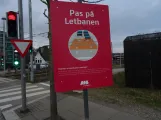
Sign: Aarhus at Østbanetorvet (2024)Hjortholmsvej
Beware of the
Light Rail
Why is the lane orange?
Many drivers drive through the first traffic light, even though there is no room in the turning lanes on the other side of the intersection. When this happens, a dangerous situation can arise. The Light Rail can be delayed, and residents in the area can be bothered by the Light Rail's horn.
Light RailBy Henrik Boye - .
Aarhus light rail line L1 with low-floor articulated tram 2106-2206 at Østbanetorvet (2023)By Henrik Boye..

7:51
Tripreport: Letbanen line L1 Grenaa to Aarhus centralstation (2023)Today we are taking the letbanen from Grenaa to Aarhus centralstation in Denmark.By Liams Universe - .
4:03
Aarhus Light Rail at Djursland (2023)Video clip of Letbanen's Tango train set running on the track to Grenå. The cliffs are recorded in the easternmost part of the track, between Ryomgård and Grenå.
1. Tango set 2111 in the overpass on Engvej in Kolind.
2. Tangosett 2104 at the station in Kolind on the way to Grenå.
3. Tangosett 2102 east of Ryomgård on the way to Grenå.
4. Tangosett 2104 runs from Ryomgård towards Aarhus.
5. Tangosæt 2103 runs over the Grenå in Grenå towards Aarhus.
6. Tangosset 2110 runs between Hessel and Grenå on the way to Grenå.By Lasse Duusgaard - .
5:14
Aarhus Light Rail at Aarhus H and Vestre Strandallé (2023)By Felix - Trainspotting and churchhunting..

37:01
Trams in Aarhus, Denmark: Aarhus Light Rail (2022)Aarhus in Denmark is home to the country's first 21st-century light rail system, known as the Aarhus Letbane. In the first edition of the Trams in Europe series, we focus on Aarhus, Denmark's second-largest city, where this documentary-style video explores the history, lines, fleet, and future of the Aarhus Letbane tram system. No commentary footage of the line itself follows this segment.
Timestamps:
00:00 Commentary overview of the Aarhus Letbane
16:18 No commentary footage of the Aarhus Letbane
16:19 Line L1 (Stadler Tango Tram-Trains)
21:13 L1 exterior
21:42 Line L2 (Stadler Variobahn)
34:39 L2 exterior
This series explores trams in Europe, examining various tram and light rail systems across the continent. That's how I plan to structure it, although that may change. The first part of the video will feature commentary providing an in-depth overview of the history of the current fleets and general context for the city's transit network. Additionally, there are plans for the tram network, if any. To start the series, we're in our house in Denmark, so let's begin with a brief geography lesson and some background on Aarhus. Aarhus is the second-largest city in Denmark, situated in Scandinavia, a region in Northern Europe. It has a population of around 350,000, but it is part of the larger capital region, which has a much bigger population. This will be relevant later when discussing the Aarhus Light Rail or the Odderbanen. The plan is first to provide a brief history of the system, including a fun fact—though I wouldn't necessarily call it fun, just an interesting observation—and then discuss the lines, trams, and offer some additional context, concluding with plans. Afterward, I'll turn off the mic. While this is being edited, a timestamp will be added, allowing you to enjoy the footage without commentary and appreciate the system's charm. So, let me know what you think of this series. If you like the format, we appreciate your feedback. Basically, the R, whose leg band is lightweight, refers to the light rail system in Aarhus. I believe that band is similar to a light rail tram, as it is also referred to as such in other cities.
Aarhus Light Rail was the first tram to operate in Denmark since 1971. Like many other cities in Northern and Western Europe, Denmark previously had a tram system. However, in 1971, which was quite late compared to most European cities, many other Western European cities had already abandoned their trams much earlier. It's somewhat strange that they stopped trams in 1971, but Copenhagen stands out as a global leader in this area. After 1971, Denmark lost some of its charm in this regard. The Aarhus light rail essentially marked the start of discussions about building a light rail system in Denmark, which began in the early 2000s.
As you are aware, such projects often require a substantial amount of time. There is a legislative process, and construction began around 2012. The line was opened in three stages, with the initial section being completed.
The first stage was initially scheduled to launch in 2016. However, as we all know, these transfer projects were delayed and didn't open until 2017. 2017 was a significant year for Aarhus because it was named European Capital of Culture. If they were going to visit our area, you'd see them along the paths unless they had moved them earlier. However, in 2022, they're still present on the paths. The European Capital of Culture designation in 2017 helped promote Aarhus as a cultural hub, although things may not have gone entirely as planned. The opening was actually scheduled for December 21, 2017, which is about as late as you can get before Christmas. And yes, realistically, you wouldn't see everything open until much later in the year. Another interesting fact is that the trams reportedly traveled 100,000 kilometers, effectively running as ghost vehicles without passengers during their testing phase. There was a safety concern, so the trams only ran 110 kilometers during testing. I'm not sure if that's entirely accurate, but that's the sense from the article—trams running 100,000 kilometers as ghost vehicles because the testing occurred before they started regular service. The first section opened, but the process was somewhat uneven, as there was a lot to cover. This is part of the Oracle Light Rail system, which is unique and different from most tram or light rail systems. Essentially, the first part that opened was between two areas, which I’ll show you now. Sorry, I mean the initial segment was part of the L2 line, running from Rødhusring, which translates to 'Archery Central Station' in Danish, all the way up to the University Hospital, which is essentially our university hospital.By TransportEnthusiast - .
Aarhus light rail line L1 with low-floor articulated tram 2106-2206 at Østbanetorvet (2022)By Henrik Boye..
Aarhus light rail line L1 with low-floor articulated tram 2107-2207 at Østbanetorvet (2022)By Henrik Boye..

0:50
Historic Map of Aarhus Light Rail (2022)Map of Aarhus tramway and its opening dates for the lines in stage 1, along with a proposed future line to Brabrand.
The first line to open was the inner line connecting Aarhus Central Station and University Hospital. The following year, 2018, marked the first time you could ride the tram to Odder. Passing through Viby J, Beder, and Malling to the north, as well as Lisbjergskolen, the line became fully operational on April 30, 2019. This was the final year the line was ready to serve Grenaa, allowing passengers once again to travel by train on Djursland. On the same day, the line from Lisbjerg to Lystrup opened. This improvement makes it easier to transfer lines without needing to go to Skolebakken or Aarhus H, which takes more time. Currently, ongoing surveys are exploring the possibility of a future line connecting Aarhus East and Brabrand, linking these popular areas to the network.By Roth Production - .
Aarhus light rail line L1 with low-floor articulated tram 2110-2210 at Østbanetorvet (2021)By Janus Boye..
Aarhus light rail line L1 with low-floor articulated tram 2102-2202 at Østbanetorvet (2021)By Janus Boye..
Aarhus light rail line L1 with low-floor articulated tram 2106-2206 near Østbanetorvet (2021)By Janus Boye..
Aarhus light rail line L1 with low-floor articulated tram 2106-2206 at Østbanetorvet (2021)By Janus Boye..
Aarhus light rail line L1 with low-floor articulated tram 2109-2209 close by Østbanetorvet (2020)By Janus Boye..
Aarhus light rail line L1 with low-floor articulated tram 2109-2209 near Østbanetorvet (2020)By Janus Boye..
Aarhus light rail line L1 with low-floor articulated tram 2109-2209 at Østbanetorvet (2020)By Janus Boye..

1:17:32
Aarhus Central Station - Grenaa 01:17 min (2020)Fast track: Aarhus H to Grenaa with the light rail in Denmark
Take the train from Aarhus to Grenaa in Denmark :)By Icebraker78 - .
Aarhus light rail line L1 with low-floor articulated tram 2102-2202 at Østbanetorvet (2019)By Henrik Boye..

7:53
Light rail to Grenaa (2019)On 12 May 2019, the last stretch of the Århus light rail's first stage was dedicated to Greena. Throughout the day, there was free travel between Aarhus and Grenaa, where the event started with an inaugural train (or tram train) to Grenaa that stopped at certain places along the way, where the various municipalities welcomed the light rail.
However, it also meant that a few departures along the way were canceled and all the departures during the day were full of happy people who were going to try the light rail and even though the space was tight, people were good at making room for each other. By SJB Media 1996 - .
1:31
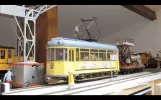
Aarhus streetcar (2018)Aarhus, Denmark, streetcar that ran until 1971: maintenance train. Scale G model (45mm gauge), with excerpt from the film "Farvel sporvgn" by Midtjysk Reportage Film and Schiby Film.
Aarhus, Denmark, streetcar that ran until 1971. Maintenance train, G scale. Aarhus tram, train maintenance. Scala G model. Film from "Farewell railcar" by Midtjysk Reportage Film and Schiby Film.By pierre phliponeau - .
15:54
Most viewed - Aarhus and the Tram in the City (2018)Aarhus [ˈå·ˌhu’s] or Århus (official spelling Århus 1948 – 31 December 2010[3]) is Denmark's second largest and Jutland's largest urban area with 269,022 inhabitants (2017). Aarhus Municipality has 335,684 inhabitants (2017). In the larger urban zone, Eurostat estimates a population of 845,971.

10:03
Århus Sporveje 100th anniversary (2017)Ove Hansen discusses his over 30 years at Århus Sporveje.
Aarhus Tramway is celebrating its 100th anniversary today. A large exhibition at Magasin previously marked this milestone. The celebration has a special wish from the birthday boy. During the era when trams ran in Aarhus, the steering wheel was a symbol of that time. Here is a relic from an old tram. Ove Hansen is also from the period when trams operated on rails in the inner part of Aarhus. Back then, there was much more contact with people on the street. You could open the door and wave to the girls in the summer, or do similar things. It's not really possible today. Ove Hansen made his last trip on the rails on November 3, 1971. The next day, trams again became part of the cityscape, coinciding with the 100th anniversary of Aarhus Tramway, celebrated with an exhibition at Magasin. There’s talk about trams again—whether to restore them and whether they would disrupt the cityscape. Should we bring trams back? Isn't that right?
Now, action is needed soon. I believe it's realistic, within a 10- to 20-year timeframe, to explore reintroducing them before I retire. Yes, I’d definitely advocate for it. The exhibition offers a trip back in time, including a look at a Volvo from the mid-1950s. Aarhus Trams is also using this anniversary as an opportunity to look ahead. Director Torben Højer plans to revisit the city center, which will look different in the future. In fact, the tram system is planning new bus routes that could be converted to trams in the future. Taking a tram is a significant quality upgrade, especially considering environmental noise levels. The city council has already agreed to reintroduce trams.
We need to secure funding, and I believe we will manage to do so eventually. Ove Hansen, who last drove a tram over 30 years ago, has already submitted a bid if the city council agrees before he retires. Our sports director has promised that if trams return during his tenure, he’ll be one of the first allowed to drive one. So I’ve been trying to keep that dream alive. Welcome, O. Hansen. You've been driving buses for more than 36 years, and you also have some experience with a little tram. How does it feel to celebrate a 100th anniversary? I think it's fantastic to be part of a company culture that has existed for 100 years—an electric tram running from the train station to the main square, and now to the efficient transport system we have today in Aarhus. Recent studies rank it as one of the best in the country. The question is how long it will stay that way. This might be the last anniversary for this private company. I believe so, at least for me. It’s a shame because the company's spirit has always been strong. It’s a bit sad to think about going back to the good old days soon, after 36 years—that’s a long time. How has your work changed over the years? It’s changed a lot. I started in May or April 1968, at an old tram depot on Dalgas Avenue. When I first began, we handed out tickets from a sidecar, and later, I obtained a bus driver's license, allowing me to drive extra buses. Within six months, I trained as a tram driver—though we didn’t call it that back then. We called it a tram driver, the person who drives the tram, like Dirk Fits. I did that for the last three years before trams were phased out. It’s a shame today. Since then, I've driven buses and been very happy doing so. It’s a lively company—fun, sometimes in trouble, but mostly enjoyable with passengers. It makes you feel like you’re serving a good cause. So, you’ve driven a tram. Do you have any memorable stories? Yes, there was a lot of teasing among us. For example, some would say on TV they lived off the army, and we lived off passengers. Sometimes, we’d joke that if it weren’t for those damn passengers, we’d have a good time. I remember when Palads closed after an evening lecture, and someone pulled the cord—there was no power on the tram in front. The driver didn't leave until five minutes late, so he had to take all the passengers to Magasinet. That was always fun to mess around with afterward. Another story involves a colleague who applied the handbrake as he drove up from Skovvejen in the tram, then turned left off Trøjborgvej, and…By Ole Svend Rasmussen - .
6:46
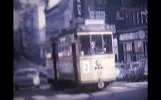
Aarhus Tram by Per Glundal (1971)Last day for the tram in Aarhus in 1971 7 Nov.
Filmed by Per GlundalBy michael glundal - .
1:56
Aarhus' last tram (1971)Aarhus is saying goodbye to the city's last tram today. Journalist Preben Heide interviews driver Jens Nielsen.
A farewell was said at a tram parade with music and many guests. We have been able to ride the electric trams since 1904, and they have been well used. They have run a short distance through the whole city, benefiting both those who wanted to see something and those who wanted to be seen. However, it has been quite a few years since they discovered that having such iron-clad trains running between cars, cyclists, and pedestrians was not a very good idea. And today they are worn out, the old line ones and twos. Are they sad that the trams are stopping running? Yes, in a way. It takes away a bit of the big city atmosphere, I think. It's as if a bit of the big city disappears when the trams are gone. How many years have they been running the trams? 40 years. Car traffic is getting too heavy, and the streets are too narrow. There is no room for trams anymore. Where trams once filled the picture, there is now more quiet.
The Strøget, or at least the majority of it, will be converted into a pedestrian street. Pedestrians will have it all to themselves. In return, they will be given access to a new street bus that has been cut through part of the old town. It is a parallel street to the Strøget. Here, the buses will be allowed to pass through. They will take over the tram passengers and will connect the north and south of the city. The bus street is reserved exclusively for buses, in conjunction with the reorganization of public transport. If a new system of one-way streets has been implemented, it should also be extended to private drivers in Aarhus.By P3 Essensen - .
4:47
Most viewed - Trams in Aarhus (1971)The tram's last trip in Aarhus November 1971. Produced by Tom Skjønberg and Bjørn Nedergaard. The sound in the first 10 seconds has unfortunately been lost.

1:41
Trams in Aarhus C (1971)Narrow film recordings from when there were trams in the cityscape in Aarhus. My grandfather filmed it.By Martin - .
18:20
The Escape to Aarhus (1971)A short film made by our father, Jørgen Frigaard, who was a general practitioner in Skolebakken in Aarhus.
The plot starts with two boys who are bored and cause accidents. After a beating, they decide to empty their piggy bank and escape from Holme (Højbjerg) to the big city of Aarhus. They take one of the Blue buses and go wild in the city. They also just drop by their father's consultation.
Meanwhile, the family searches for them around Holme.
The two brothers regret it now that all the money has been used up, except for a 25 øre. It is used in a phone booth to call their mother, who picks them up in her Saab 93.
The film was a regular feature at children's birthday parties in the house at Mølleskovvej 6.By Lars Frigaard - .
1:54
The trams in Aarhus 2nd part (1971)Several newly edited clips from the film 'Farewell Tram' from 1971.By TelevisionDk - .
2:14
Aarhus trams (1963)A newly-discovered further Standard 8 cine-film of Århus trams filmed in May 1963 on the Light Railway Transport League tour of Scandinavia and North Germany. The thumbnail photo, though, is one taken by me on a visit in February 1969 as I couldn't extract a good enough thumbnail from the video.By Peter X - .
3:37
Trams in Aarhus (1963)Amateur 8mm silent cine of Århus trams, filmed on the Light Railway Transport League tour of May 1963. The two-line system closed in 1971.By Peter X - .
1:43
The Streets of Aarhus (1905)This video has been AI colorized and the frame rate has been interpolated.By RestoringOldStuff - .
12:03
Aarhus runs in tram tracks (1904-2015)Århus Sporveje (abbreviated ÅS) was a traffic company owned by Aarhus Municipality, which was established on 1 January 1928 and merged into Midttrafik on 1 January 2007. The company took over the tram operation in Aarhus when it was established, which had been started by the private company Aarhus Elektriske Sporvej 7 July 1904. In 1929 the tram network was expanded by extending it up through Tordenskjoldsgade to Marienlund by Riis Skov; one more line was built from Banegårdspladsen over Frederiksbjerg to Harald Jensens Plads, a line that was later extended to Kongsvang. The original line from Dalgas Avenue to Trøjborg was extended to double track; originally it was only single-track, with many sidings on the stretch.
When the municipality took over the company in 1928, 46 people were employed. In 1940, the company had 225 employees, and a stock consisting of 23 trams, 22 sidecars and 43 buses. [1]
Tramway operations were discontinued on 7 November 1971. Before then, however, the company had opened several bus lines, and even more were added after the municipal reform in 1970, when Aarhus Municipality grew significantly. The Aarhus city buses were called trambuses for many years, but that name has long since fallen out of use. For many years, contrary to other Danish cities, boarding took place at the back and exiting at the front, but from 1 January 2012 this was abolished, and it is now permitted to enter and exit from all doors in the buses. As one of the only places in the country, there is still self-ticketing on the buses to this day.
On 1 January 2005, Århus Sporveje was split into Trafikselskabet Århus Sporveje (administration and planning) and Busselskabet Aarhus Sporveje (driving). Both were owned by Aarhus Municipality until 1 January 2007.
Trams were operated in Aarhus in the period 1904-71. It happened under the same company that still runs the city's bus traffic, Århus Sporveje, as it has been called since 1928. Nowadays, Århus Sporveje is part of the regional transport company Midttrafik.
Catering & companies
To EAT WELL, no wish is too big. With contact with the most quality conscious suppliers of raw materials, we ensure that the customer ALWAYS gets the best gastronomic experience.
We make all the food from scratch based on the season and trade items on the various Aarhus squares.
Our gastronomic style is inspired by everything from the Asian wok pan towards the southern European cuisines and up to the Danish country kitchen.By FAMILIEN OSSELV - - .
4:16
Drive through Aarhus (1904-1965)Come and drive down the pedestrian street in Aarhus. In these two clips, you can ride a tram in 1904 and then see the same route by car from 1965.By Bymuseet - - .
15:54
MY TK Aarhus tram in the city (1903-2013)From May 31, 1884, to November 6, 1971, Aarhus had a tram service. Initially, horse-drawn trams were used, but starting in 1903, the company Aarhus Elektriske Sporvei introduced electric operation. The last trams rolled through the city on November 7, 1971, after which Aarhus Sporveje fully switched to bus service.
Here’s a great collection of tram photos, which also shows the tram route across Aarhus—a snapshot of the streets, cars, clothing, people, houses, and more from that time. I lived near the terminus in Kongsvang, where it once changed from Kongsvang Trælast Handel to Marselis Boulevard - Åhavevej.By Sammy Stjer - - .