Kongsvang, Trams (Aarhus)
There are 14 photos from Kongsvang, Trams (Aarhus) and 5 trams in the direction of Kongsvang, Trams (Aarhus) on Tram Travels.
Aarhus Tramway (ÅS) stops
Banegårdspladsen, Dalgas Avenue, Kongsvang, Marienlund, Sct. Pauls Kirkeplads, Store Torv, and Trøjborgvej.
Photos and videos from Kongsvang, Trams (Aarhus)
1:31
Aarhus streetcar (2018)Aarhus, Denmark, streetcar that ran until 1971: maintenance train. Scale G model (45mm gauge), with excerpt from the film "Farvel sporvgn" by Midtjysk Reportage Film and Schiby Film.
Aarhus, Denmark, streetcar that ran until 1971. Maintenance train, G scale. Aarhus tram, train maintenance. Scala G model. Film from "Farewell railcar" by Midtjysk Reportage Film and Schiby Film.By pierre phliponeau - .
10:03
Århus Sporveje 100th anniversary (2017)Ove Hansen discusses his over 30 years at Århus Sporveje.
Aarhus Tramway is celebrating its 100th anniversary today. A large exhibition at Magasin previously marked this milestone. The celebration has a special wish from the birthday boy. During the era when trams ran in Aarhus, the steering wheel was a symbol of that time. Here is a relic from an old tram. Ove Hansen is also from the period when trams operated on rails in the inner part of Aarhus. Back then, there was much more contact with people on the street. You could open the door and wave to the girls in the summer, or do similar things. It's not really possible today. Ove Hansen made his last trip on the rails on November 3, 1971. The next day, trams again became part of the cityscape, coinciding with the 100th anniversary of Aarhus Tramway, celebrated with an exhibition at Magasin. There’s talk about trams again—whether to restore them and whether they would disrupt the cityscape. Should we bring trams back? Isn't that right?
Now, action is needed soon. I believe it's realistic, within a 10- to 20-year timeframe, to explore reintroducing them before I retire. Yes, I’d definitely advocate for it. The exhibition offers a trip back in time, including a look at a Volvo from the mid-1950s. Aarhus Trams is also using this anniversary as an opportunity to look ahead. Director Torben Højer plans to revisit the city center, which will look different in the future. In fact, the tram system is planning new bus routes that could be converted to trams in the future. Taking a tram is a significant quality upgrade, especially considering environmental noise levels. The city council has already agreed to reintroduce trams.
We need to secure funding, and I believe we will manage to do so eventually. Ove Hansen, who last drove a tram over 30 years ago, has already submitted a bid if the city council agrees before he retires. Our sports director has promised that if trams return during his tenure, he’ll be one of the first allowed to drive one. So I’ve been trying to keep that dream alive. Welcome, O. Hansen. You've been driving buses for more than 36 years, and you also have some experience with a little tram. How does it feel to celebrate a 100th anniversary? I think it's fantastic to be part of a company culture that has existed for 100 years—an electric tram running from the train station to the main square, and now to the efficient transport system we have today in Aarhus. Recent studies rank it as one of the best in the country. The question is how long it will stay that way. This might be the last anniversary for this private company. I believe so, at least for me. It’s a shame because the company's spirit has always been strong. It’s a bit sad to think about going back to the good old days soon, after 36 years—that’s a long time. How has your work changed over the years? It’s changed a lot. I started in May or April 1968, at an old tram depot on Dalgas Avenue. When I first began, we handed out tickets from a sidecar, and later, I obtained a bus driver's license, allowing me to drive extra buses. Within six months, I trained as a tram driver—though we didn’t call it that back then. We called it a tram driver, the person who drives the tram, like Dirk Fits. I did that for the last three years before trams were phased out. It’s a shame today. Since then, I've driven buses and been very happy doing so. It’s a lively company—fun, sometimes in trouble, but mostly enjoyable with passengers. It makes you feel like you’re serving a good cause. So, you’ve driven a tram. Do you have any memorable stories? Yes, there was a lot of teasing among us. For example, some would say on TV they lived off the army, and we lived off passengers. Sometimes, we’d joke that if it weren’t for those damn passengers, we’d have a good time. I remember when Palads closed after an evening lecture, and someone pulled the cord—there was no power on the tram in front. The driver didn't leave until five minutes late, so he had to take all the passengers to Magasinet. That was always fun to mess around with afterward. Another story involves a colleague who applied the handbrake as he drove up from Skovvejen in the tram, then turned left off Trøjborgvej, and…By Ole Svend Rasmussen - .
6:46
Aarhus Tram by Per Glundal (1971)Last day for the tram in Aarhus in 1971 7 Nov.
Filmed by Per GlundalBy michael glundal - .
1:56
Aarhus' last tram (1971)Aarhus is saying goodbye to the city's last tram today. Journalist Preben Heide interviews driver Jens Nielsen.
A farewell was said at a tram parade with music and many guests. We have been able to ride the electric trams since 1904, and they have been well used. They have run a short distance through the whole city, benefiting both those who wanted to see something and those who wanted to be seen. However, it has been quite a few years since they discovered that having such iron-clad trains running between cars, cyclists, and pedestrians was not a very good idea. And today they are worn out, the old line ones and twos. Are they sad that the trams are stopping running? Yes, in a way. It takes away a bit of the big city atmosphere, I think. It's as if a bit of the big city disappears when the trams are gone. How many years have they been running the trams? 40 years. Car traffic is getting too heavy, and the streets are too narrow. There is no room for trams anymore. Where trams once filled the picture, there is now more quiet.
The Strøget, or at least the majority of it, will be converted into a pedestrian street. Pedestrians will have it all to themselves. In return, they will be given access to a new street bus that has been cut through part of the old town. It is a parallel street to the Strøget. Here, the buses will be allowed to pass through. They will take over the tram passengers and will connect the north and south of the city. The bus street is reserved exclusively for buses, in conjunction with the reorganization of public transport. If a new system of one-way streets has been implemented, it should also be extended to private drivers in Aarhus.By P3 Essensen - .
4:47
Most viewed - Trams in Aarhus (1971)The tram's last trip in Aarhus November 1971. Produced by Tom Skjønberg and Bjørn Nedergaard. The sound in the first 10 seconds has unfortunately been lost.

1:41
Trams in Aarhus C (1971)Narrow film recordings from when there were trams in the cityscape in Aarhus. My grandfather filmed it.By Martin - .
18:20
The Escape to Aarhus (1971)A short film made by our father, Jørgen Frigaard, who was a general practitioner in Skolebakken in Aarhus.
The plot starts with two boys who are bored and cause accidents. After a beating, they decide to empty their piggy bank and escape from Holme (Højbjerg) to the big city of Aarhus. They take one of the Blue buses and go wild in the city. They also just drop by their father's consultation.
Meanwhile, the family searches for them around Holme.
The two brothers regret it now that all the money has been used up, except for a 25 øre. It is used in a phone booth to call their mother, who picks them up in her Saab 93.
The film was a regular feature at children's birthday parties in the house at Mølleskovvej 6.By Lars Frigaard - .
1:54
The trams in Aarhus 2nd part (1971)Several newly edited clips from the film 'Farewell Tram' from 1971.By TelevisionDk - .
2:14
Aarhus trams (1963)A newly-discovered further Standard 8 cine-film of Århus trams filmed in May 1963 on the Light Railway Transport League tour of Scandinavia and North Germany. The thumbnail photo, though, is one taken by me on a visit in February 1969 as I couldn't extract a good enough thumbnail from the video.By Peter X - .
3:37
Trams in Aarhus (1963)Amateur 8mm silent cine of Århus trams, filmed on the Light Railway Transport League tour of May 1963. The two-line system closed in 1971.By Peter X - .
12:03
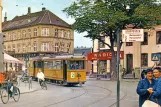
Aarhus runs in tram tracks (1904-2015)Århus Sporveje (abbreviated ÅS) was a traffic company owned by Aarhus Municipality, which was established on 1 January 1928 and merged into Midttrafik on 1 January 2007. The company took over the tram operation in Aarhus when it was established, which had been started by the private company Aarhus Elektriske Sporvej 7 July 1904. In 1929 the tram network was expanded by extending it up through Tordenskjoldsgade to Marienlund by Riis Skov; one more line was built from Banegårdspladsen over Frederiksbjerg to Harald Jensens Plads, a line that was later extended to Kongsvang. The original line from Dalgas Avenue to Trøjborg was extended to double track; originally it was only single-track, with many sidings on the stretch.
When the municipality took over the company in 1928, 46 people were employed. In 1940, the company had 225 employees, and a stock consisting of 23 trams, 22 sidecars and 43 buses. [1]
Tramway operations were discontinued on 7 November 1971. Before then, however, the company had opened several bus lines, and even more were added after the municipal reform in 1970, when Aarhus Municipality grew significantly. The Aarhus city buses were called trambuses for many years, but that name has long since fallen out of use. For many years, contrary to other Danish cities, boarding took place at the back and exiting at the front, but from 1 January 2012 this was abolished, and it is now permitted to enter and exit from all doors in the buses. As one of the only places in the country, there is still self-ticketing on the buses to this day.
On 1 January 2005, Århus Sporveje was split into Trafikselskabet Århus Sporveje (administration and planning) and Busselskabet Aarhus Sporveje (driving). Both were owned by Aarhus Municipality until 1 January 2007.
Trams were operated in Aarhus in the period 1904-71. It happened under the same company that still runs the city's bus traffic, Århus Sporveje, as it has been called since 1928. Nowadays, Århus Sporveje is part of the regional transport company Midttrafik.
Catering & companies
To EAT WELL, no wish is too big. With contact with the most quality conscious suppliers of raw materials, we ensure that the customer ALWAYS gets the best gastronomic experience.
We make all the food from scratch based on the season and trade items on the various Aarhus squares.
Our gastronomic style is inspired by everything from the Asian wok pan towards the southern European cuisines and up to the Danish country kitchen.By FAMILIEN OSSELV - - .
15:54
MY TK Aarhus tram in the city (1903-2013)From May 31, 1884, to November 6, 1971, Aarhus had a tram service. Initially, horse-drawn trams were used, but starting in 1903, the company Aarhus Elektriske Sporvei introduced electric operation. The last trams rolled through the city on November 7, 1971, after which Aarhus Sporveje fully switched to bus service.
Here’s a great collection of tram photos, which also shows the tram route across Aarhus—a snapshot of the streets, cars, clothing, people, houses, and more from that time. I lived near the terminus in Kongsvang, where it once changed from Kongsvang Trælast Handel to Marselis Boulevard - Åhavevej.By Sammy Stjer - - .Location on a map
Trams in the direction of Kongsvang, Trams (Aarhus)
15:54
Most viewed - Aarhus and the Tram in the City (2018)Aarhus [ˈå·ˌhu’s] or Århus (official spelling Århus 1948 – 31 December 2010[3]) is Denmark's second largest and Jutland's largest urban area with 269,022 inhabitants (2017). Aarhus Municipality has 335,684 inhabitants (2017). In the larger urban zone, Eurostat estimates a population of 845,971.

7:19
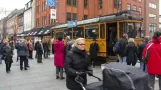
Strøget's 40th anniversary was celebrated with a tram in Ryesgade (2012)The street association Strøget in Aarhus, in collaboration with the museum Den Gamle By, has decided to display an Aarhusian tram on the street to celebrate the 40th birthday of the street, which was recently celebrated. We talked with former tram driver Ove Hansen. The former tram driver, Leif Bisbo, provided a vivid account of how trams operated in the old days in Aarhus.
The street association Strøgt in Aarhus, in collaboration with the museum Den Gamle By, has decided to put an Aarhusian tram on display in connection with Strøt's 40th birthday, which has just been celebrated. We talked to former tram driver Ove Hansen. Yes, it is the street association's 40th anniversary. They have chosen to mark it by finding the old spur because they couldn't build the pedestrian street before, as the spurs had been removed. The trams disappeared 41 years ago, and they spent a year restoring the pedestrian street and building it, which is why they have now recovered the spur rather than just marking it. The trams in Aarhus belong to a bygone era, unfortunately for those who worked on the trams and for those who preferred electric operation over diesel. Yes, I drove the tram for the last three years.
I started at the Tramway in 1968 and drove until it closed in 1971. They shut down on November 6, 1971. That was the last day the track was in operation. The day after, on the 7th, there was a big parade that you can see in various old movies and videos, but how do you actually feel about it now that you've ridden a tram? Do you feel sad that they no longer run, or is it something else? Yes, you could say I feel a little ambivalent about it because, back then, we thought it was something ancient. But you can see that maybe we should have had a bit more foresight. Of course, you couldn't have kept the tracks on the street, but perhaps you could have used some of this for something like in San Francisco—for example, something that could become a tourist attraction. Let's go back in time a little and stand on the first tram that ran through the street in 1948. The former tram driver, Leif Bisbo, vividly described how the trams operated in old Aarhus. There were ten contact points. When you arrived at a stop nearby, there would be some passengers. You pulled the handle back, which oppositely braked the dynamo, then you took the handbrake, making sure the tram stopped when people boarded.
After they finished boarding, you pushed the arm up here. You were a bit lazy, so you drove up like this, then moved it up there—it faced forward. It still says 'Here,' and at the back, you could pull the handle to drive the tram backward. It also had an emergency brake, which, when activated, engaged four magnetic brakes that clamped down, gripping the track at the same time as a sandbox in front. The sandbox was used to put sand on the rails to prevent slipping. The wheels were small, so sand was needed. I can tell you that the tram would come to a complete stop when the brakes were fully engaged. People would get off and greet the drivers, and those still on would wave.
Aarhus got its first tram line in 1884. It was horse-drawn and ran from the railway station to Store Torv, made possible by the construction of Klemens Bridge. Back then, merchants on Store Torv found the tram stop a big nuisance on market days and asked the city council to move it. They decided the tram should stop at Klemens Torv on market days. Now, people from Den Gamle By have plans to bring this tram and sidecar down and display them in the area being developed in the 1970s, which I've heard about. They want visitors to see it. Even the director, Thomas Block Ravn, has ideas about possibly running it there, but that's probably too expensive—something I can't imagine.
On a different note, there's a fantastic interest in riding the tram. It's fun to watch. We are three colleagues who have driven the tram, and we've been surprised by the significant interest that has developed over the past three days. We've met a lot of people, mostly in their 50s. They get on and say, 'Wow, wasn't it bigger?' It turns out they mean because it was the size that children and young people experienced back then. So, what was the biggest challenge in driving a tram? Honestly, I'm not entirely sure. It followed the tracks and essentially took care of itself. But you had to be careful, especially in areas like Søndergade and Sallings, where it drove right up to the curb. That meant you had to be cautious not to hit pedestrians walking with a bakery bag or something similar. Sometimes, accidents happened, but overall, the operation was manageable.By atvdenmark - .
Postcard: Aarhus tram line 2 with railcar 8 at Nørreport (1955-1960)Tram Museum Skjoldenæsholm
Nørregade / Knudrisgade / NørrebrogadeBy Henrik Boye, Sporvejshistorisk Selskab (SHS) - - .
12:03
Aarhus runs in tram tracks (1904-2015)Århus Sporveje (abbreviated ÅS) was a traffic company owned by Aarhus Municipality, which was established on 1 January 1928 and merged into Midttrafik on 1 January 2007. The company took over the tram operation in Aarhus when it was established, which had been started by the private company Aarhus Elektriske Sporvej 7 July 1904. In 1929 the tram network was expanded by extending it up through Tordenskjoldsgade to Marienlund by Riis Skov; one more line was built from Banegårdspladsen over Frederiksbjerg to Harald Jensens Plads, a line that was later extended to Kongsvang. The original line from Dalgas Avenue to Trøjborg was extended to double track; originally it was only single-track, with many sidings on the stretch.
When the municipality took over the company in 1928, 46 people were employed. In 1940, the company had 225 employees, and a stock consisting of 23 trams, 22 sidecars and 43 buses. [1]
Tramway operations were discontinued on 7 November 1971. Before then, however, the company had opened several bus lines, and even more were added after the municipal reform in 1970, when Aarhus Municipality grew significantly. The Aarhus city buses were called trambuses for many years, but that name has long since fallen out of use. For many years, contrary to other Danish cities, boarding took place at the back and exiting at the front, but from 1 January 2012 this was abolished, and it is now permitted to enter and exit from all doors in the buses. As one of the only places in the country, there is still self-ticketing on the buses to this day.
On 1 January 2005, Århus Sporveje was split into Trafikselskabet Århus Sporveje (administration and planning) and Busselskabet Aarhus Sporveje (driving). Both were owned by Aarhus Municipality until 1 January 2007.
Trams were operated in Aarhus in the period 1904-71. It happened under the same company that still runs the city's bus traffic, Århus Sporveje, as it has been called since 1928. Nowadays, Århus Sporveje is part of the regional transport company Midttrafik.
Catering & companies
To EAT WELL, no wish is too big. With contact with the most quality conscious suppliers of raw materials, we ensure that the customer ALWAYS gets the best gastronomic experience.
We make all the food from scratch based on the season and trade items on the various Aarhus squares.
Our gastronomic style is inspired by everything from the Asian wok pan towards the southern European cuisines and up to the Danish country kitchen.By FAMILIEN OSSELV - - .
15:54
MY TK Aarhus tram in the city (1903-2013)From May 31, 1884, to November 6, 1971, Aarhus had a tram service. Initially, horse-drawn trams were used, but starting in 1903, the company Aarhus Elektriske Sporvei introduced electric operation. The last trams rolled through the city on November 7, 1971, after which Aarhus Sporveje fully switched to bus service.
Here’s a great collection of tram photos, which also shows the tram route across Aarhus—a snapshot of the streets, cars, clothing, people, houses, and more from that time. I lived near the terminus in Kongsvang, where it once changed from Kongsvang Trælast Handel to Marselis Boulevard - Åhavevej.By Sammy Stjer - - .