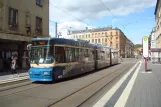
Klinikum (Zwickau)
There are 6 photos from Klinikum (Zwickau) and 4 trams in the direction of Klinikum (Zwickau) on Tram Travels.
Städtische Verkehrsbetriebe Zwickau (SVZ) stops
Eckersbach, Georgenplatz, Hauptbahnhof, Hauptmarkt, Klinikum, Neumarkt, Neuplanitz, Pölbitz, Saarstraße, Virchowplatz, Zentralhaltestelle, and Zentrum.
Photos and videos from Klinikum (Zwickau)
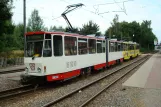
13:37
Tram ride Zwickau Line 4 from Städtisches Klinikum to Neumarkt in GT6M-NF 902 (2018)You can see here: a ride in a GT6M-NF 902 (car number 14) in Zwickau from the Municipal Hospital via Marienthal/Paulusstraße and Georgenplatz to Neumarkt (Bosestraße). Since everything was filmed in operation, I apologize for a few cuts at stops and background conversations on the train.By MAFASONET - .
43:52
Cab ride KT4D Zwickau, depot - Line 4 (2015)Yes, of course, it has been rolling out for a very long time. It now automatically changes position. The switch is already in place where it should be; the others moving here could be opened up. They're already positioned right in front of the switchboard. It also opens, but we still need to pause for a moment. Keep in step so the lights turn on. My chair is in front of me. That's it. Do we need to signal now, or can we skip this step? If I signal right, then it's like this. Oh, right, so left, left, okay, still standing. KUS, that almost doesn't work. I have to enter, turn left, proceed, drive out, and then take a look. I then need to return here and not set the switches. I have to stop at the signal. I need to see what’s happening with the A. It just means I'm logged on. It works really well; it’s best to keep it rolling on curves. Exactly, yes, now you really need to accelerate. Rig, the maximum allowed speed is 50. That’s the max, yes, they're all 50. Here too, draft retire, full throttle, everything available. Up to panel B, and it’s more economical to accelerate quickly and then keep rolling than to crawl over a longer period. So, we keep rolling if it stays clear; otherwise, we have to stop, but it looks quite good here in front of K. We roll, expecting it to close. Yes, you have to stop when driving on the road to go much further. Yes, yes, such a situation calls for action, SPI. What SPI, everything is where I have my signal now—up here—I can't see anything right now, but I can sense it isn’t easy. That’s why we stand at the back, okay? Okay, are you just a driving instructor, or do you also go? I participate, and then we go. Yes, I am otherwise a driving master. I supervise drivers. Great road driving—both do 100 miles a year, and we also offer one or two courses at the driving school each year. It’s not that demanding; we don't have many drivers coming in. That’s the case here, too. We have many beginners who have been here for a long time, with new attitudes. It's always the case that government agencies only hire trained bus drivers, and then they are hired for a limited period, such as the first year. Once they’re hired, we conduct driver training, both on the road and in slow zones. Those are the yellow signs hanging somewhere on the overhead line or on the mast—oh, not the one saying '0', because it says '1.5'—and we don't know how far they extend, so now we can analyze what we can do with the transporter. It’s actually just the concrete—the asphalt limit for the railway, yes, in this case. But it isn’t always the same, and the light rail is also 10 cm wider. Does it automatically take a photo, or does the camera go with it? No, that was my question just now. Oh, someone from behind—behind—well, the soft, individual signals always need to be set manually; they need to be established. Yes, there is an option to set them automatically—that's what Leipzig does, for example—but it has major disadvantages. We’ve already had some drivers going the wrong way because they rely on it. If it doesn't switch, then it's wrong. Yes, the parking brake. If it's on, it stays on; you can release it, and the magnet is released. It only releases when power is supplied or when the air slowly escapes. I don't know what they're doing here. Oncoming traffic? Okay. If the bridge remains, then we can go further, but the speed is good. At our driving school, we have a specific crosswalk set up to teach students how to brake when crossing it. Cars can exit from our lane when the brakes are released, which is similar to what's happening now. The acceleration isn’t bad—it’s not so little that standing still isn’t possible. Yes, up to the blue light, give it power again, exactly. The TE is a section separator. At these points, the sections are separated from each other, so in case of a collision, it's over, and the third segment continues—30 km/h. Or the yellow light. In this case, it was a point limiter just for this S-curve. That means the entire train. It said that the three-and-under state is the end of cancellation—okay, exactly. The application for the traffic lights works, but automatically via radio. When I show you—here—we have poles on the side, on the masts, with transmitters on the tram’s receiver unit. The vehicles then register there, and with wheel rotation, it’s practically defined when to send the radio signal to the traffic lights so they know we’re there. At this point, can it proceed? At the line—don’t forget about the brakes now. Just a moment—no, not now—we're at the track crossing.By Laserfreak - .
26:21
OnTour Tram Zwickau (2014)A 26-minute tour of the Zwickau tram system. The four tram lines operated by the Zwickau Municipal Transport Company mainly use KT4Ds from CKD, along with some GT6Ms from Bombardier/Adtranz. The Vogtlandbahn also serves the city center in the Zwickau model.
Hello and welcome to another episode of NVP and Tour. Today, we want to introduce you to the Zwickau tram. Zwickau is located in the southwestern part of Saxony, about 40 kilometers west of Chemnitz. Around 92,000 people live in the five city districts. The public transportation provider in Zwickau is the municipal transport company, SVZ. They operate four-meter-gauge tram lines over 18.5 miles, with 40 stops. Twenty-two high-floor Tatra KT4D vehicles and twelve low-floor GT6M trams are used. Using this graphic, we want to examine the route network first. This time, for clarity, we will start from the back.
Line 7 connects the central station with the Pöllwitz industrial estate in the north. It passes the central stop, Georgen Platz, and Neumarkt. All three stops are essential junctions in the SVZ network. Line 5 also starts at the central station but branches off to the west at Georgenplatz. After crossing the Marienthal district, the line reaches its terminus at the municipal hospital. Line 4 complements the services on lines 5 and 7 by connecting the hospital and Pöllwitz. Together, these three lines offer a convenient service through overlapping schedules. At the central stop, you can also transfer to most city and regional bus lines. Between 6 a.m. and 6 p.m., a limited service runs, with buses also serving Neumarkt, where they connect with the trams to form a star-shaped route. The east and south parts of the city are served by line 3. This service between Eckersbach and Neuplanitz is almost self-sufficient and only meets the other trams at Neumarkt. Tram lines: At the Zentrum stop, there is an option to transfer to the Vogtlandbahn, as in the Zwickau model—more about that later. We begin our documentation at the loop central station. Welcome to the Zwickau Lake District, because the forecourt of the central station definitely needs improvement. It’s also noticeable that there are surprisingly many bus stops for the bus lines running here. The tram loop at the central station is designed as a bypass, traveling counterclockwise. There is a siding at the stop itself. Now we move to the northern terminus, Pöllwitz. This loop is also traveled counterclockwise to avoid track crossings at the start. The loop itself is single track, but the stop has two siding tracks near Brunnenstraße. The routes of lines 4 and 5 pass under the railway viaduct on timetable route 510 between Dresden, Zwickau, and Hof. The tracks have been spaced out slightly to allow streets to pass around each bridge on the right and left. Here are some photos of the section of track between Kopernikusstraße and Lindenhof stop. We are now in the Marienthal district at Fritsche Platz. Here begins a tram bypass that uses two one-way streets. At the end of this bypass is a turning point, which a bus line also uses for breaks during the day. Behind Paulusstraße, the tracks and road meet again. We’ve now reached the endpoint, the municipal clinic. This loop is single-track and, like all the loops so far, runs in an anti-clockwise direction. The unique feature is that there are two platforms at the entrance where trams pause, and only when the departure time arrives do they continue through the loop to the boarding stop. Now, let’s get on the vehicle currently traveling through the loop. Join us and enjoy the return trip along the route just described. Alight from the tram and continue in the direction next to, well, as we approach the city center again. First, we will make two stops at the Georgen Pflanzt stop and then disembark at the central stop. From there, we will enjoy exploring the city center. Line 3 stops in Essen. The Zwickau city center area offers many beautiful photo and film opportunities. One is Schuman Square with the Fountain of Friendship. Here, the tram makes an S-curve between Neumarkt and Alter Steinweg stops. West of Neumarkt, line 3 leaves the city center heading toward Eckersbach and crosses the Zwickau Mulde on its own bridge. Now, here are some photos from the West Saxon University stop. From the road bridge, you get a good view of the route, both Kahl and Bergw.By nahverkehrsportal - .
9:43
Tram Zwickau & Vogtlandbahn (2010)These railcars do not drive for the "German Rail". The "Vogtlandbahn" is private! She goes there as planned in the city.By Hausgeist1977 - .Location on a map
Trams in the direction of Klinikum (Zwickau)
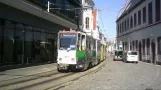
9:43
Tram Zwickau & Vogtlandbahn (2010)These railcars do not drive for the "German Rail". The "Vogtlandbahn" is private! She goes there as planned in the city.By Hausgeist1977 - .