TRAM TRAVELS

Hovedbanegård (Copenhagen)

There are 6 photos from Hovedbanegård (Copenhagen) and 2 trams in the direction of Hovedbanegård (Copenhagen) on Tram Travels.

Copenhagen Tramway (KS) stops

Åboulevard, Ålestrupvej/KB Hallen, Ålholm Plads, Axeltorv, Bispebjerg, Blågårds Plads, Blegdamsvej, Bodenhoffs Plads, Brønshøj, Christiansborg Slotsplads, City Hall Square, Dalgas Boulevard, Degnemose Allé, Dyrehaven, Dyrskuepladsen Bellahøj, Emdrupvej, Femvejen, Formosavej, Frederiksberg Runddel, Frederiksholm Sydhavns Plads, Frederiksvej, Frihedsstøtten, Fuglebakken, Gammel Torv, Hans Knudsens Plads, Hellerup, Holmbladsgade, Hovedbanegård, Husum, Kammasvej, Klampenborg, Kongens Nytorv, Lille Vibenshus, Mozarts Plads, Nordre Fasanvej, Nørre Farimagsgade, Nørrebro, Nørrebro Station, Nyelandsplads, Øresundsvej, Østerport Station, Polititorvet, Ryparken, Sjællandsgade, Slotskroen, Strandboulevarden, Studiestræde, Sundby, Sundby Hospital, Sundbyvester Plads, Svanemøllen, Taksigelseskirken, Toftegårds Plads, Trianglen, Trommesalen, Valby (Skellet), Vanløse, Vanløse, Ved Langebro, and Vibenshus Runddel.

Copenhagen Tramway (KS) depot

Allégade, Århusgade, Enghavevej, Nørrebro Remise/Nørrebrohallen, Sporvejenes Hovedværksted, and The old Valby depot.

Photos and videos from Hovedbanegård (Copenhagen)
Line 16 transitions to bus operation (1970)
8:36
Line 16 transitions to bus operation (1970)On 26 April 1970, the Copenhagen tram line 16 switched to bus operation.By SporvognDK - .
Farewell to the old carriages - On a trip with line 16 (1966)
5:00
Farewell to the old carriages - On a trip with line 16 (1966)50 years ago - on 1 May 1966 - Copenhagen's Sporveje decommissioned the last old two-axle carriages. The Tram History Society organized a number of trips on different tram lines - in this film you can see a look back at the trip on 5 June 1966, which took place on line 16.By SporvognDK - .
A walk around Vesterbro (1960-1970)
6:42
A walk around Vesterbro (1960-1970)Old Vesterbro in the 1960s – Experience Copenhagen before the transformation. 🎧 Listen in! This video features audio from my podcast, "Know Your City", where I, along with archaeologist and city walker Hanne Fabricius (known from the History Quiz on DR), delve into the history of Vesterbro. 📢 The podcast can be heard on all paid podcast and audiobook services – and completely FREE on eReolen! 📽️ In this unique video recording, you see: ✔️ Street life in Vesterbro, as it looked over 60 years ago ✔️ Trams, small shops, and everyday life in Copenhagen ✔️ People on the streets – from children playing to adults on their way to work 📜 Do you want to delve deeper into history? Listen to the entire episode of "Know Your City" and learn more about Vesterbro's development over the years. 🔔 Subscribe for more historical recordings! Original clip: City Engineers Directorate film collection, TMF film. The clip has been restored to 2K resolution and interpolated to 60 FPS using artificial intelligence. The most important thing about Vesterbro is that what is today called Vesterbrogade, which partly lies on old country roads or the old main road—since roads change over time—is that the original country road into the city port dates back, let's say, to the Viking Age. That’s where most of Zealand originally came from. If you're from Funen, Jutland, Lolland, Falster, Germany, England, and so on, you're coming through the Middle Ages along that country road into Vesterport. Picture yourself arriving from the countryside and looking down toward the island where the fish market and houses are today—the old shoreline actually ran along Halmtorvet and Sønderboulevard. Previously, there was a sea view when entering the city. Large green fields, cattle, and grass once lined the area. We know from the 13th century that the city's citizens could pasture their cattle without paying grazing taxes, which were a tax on the city's common land. The term 'fælledpakken,' which is preserved in Amarfælde, refers to the city's shared grazing area. As for Vesterbro, as we know it today, it appears like a big bridge guard. When did it start taking shape? It actually only formed in the latter half of the 19th century, after 1852, when the military demarcation line was moved. This line arose after the Swedish siege of 168-60—when they burned parts of Vesterbro, among other areas. After they withdrew, the city required protection, so they established a demarcation zone—a kind of invisible line. Initially, it was positioned inside the lakes, extending to Copenhagen's fortifications—Vestervold, Nørrevold, and Østervold—where only low, lightweight buildings could be constructed. This was because, in the event of an attack, these areas could be burned to prevent enemy access. It was effective for its purpose until the English arrived in 1807, when they established a British military presence of 30,000 soldiers around Copenhagen. Once they left, the line was moved outward—roughly to where Karlsberg is today—and followed Pileal, Allegade, Jagtvej, all the way to Falkoneralæ and out to Øresund. This larger zone only permitted low-rise, light buildings—anything except brick or stone, just a single story. That might have worked well in the 18th century, but by the 19th century, industrialization and population growth caused a boom. People poured into the city from the countryside, especially from the west, and expanded beyond Copenhagen's walls. The town was exploding—adding floors to existing buildings, extending into backyards—and eventually, space became scarce. In 1852, it was evident that the existing arrangement was unsustainable. The demarcation line was moved back to the lakes—restoring the original line—and by 1870, it was abolished entirely as Copenhagen's fortifications were dismantled. After that, from 1852 to the 1920s, there was significant development along the bridge crossings. For comparison, Vesterbro’s population grew from 1,711 in 1841 to 6,500 by 1901. Once the demarcation line was gone, streets were laid out over the old field ditches, building on both sides—and that’s when it became quieter and more peaceful. But then came explosive growth, and they filled in the water. In the 1890s, Vesterbro’s terrain was doubled with land reclamation. Specifically, they filled in Langshavej—an entire stretch—so if you're arriving by train in Copenhagen, you might imagine spotting a Viking ship sticking its nose up between the tracks. This history is closely tied to Vesterbro's development, especially the amusement park scene. The story starts in the 17th century, with the emergence of the first amusement parks in the 18th century. Picture that in Vesterbro, there were once large plots of land, which at some point during the 18th century were divided into two big pieces of land.By Kend Din By - - .
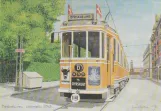
Postcard: Copenhagen tram line 13  near Hovedbanegård (1948)Postcard: Copenhagen tram line 13 near Hovedbanegård (1948)Christmas postcardsBy Carl A. Thejll. Kunstforlag, Henrik Boye - .
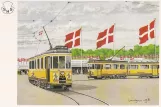
Postcard: Copenhagen animal show line Buh  at Hovedbanegård (1943)Postcard: Copenhagen animal show line Buh at Hovedbanegård (1943)By Henrik Boye, John Lundgren, Sporvejshistorisk Selskab (SHS).
.
Copenhagen transport now and then (1899-2016)
4:58
Most viewed foto -
Copenhagen transport now and then (1899-2016)A Copenhagen-mix from modern street views and dito buses with pictures from the former tram-system on the same locations.

Location on a map

Trams in the direction of Hovedbanegård (Copenhagen)
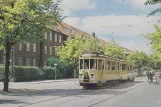
Postcard: Copenhagen animal show line Buh on Borups Allé (1963)Postcard: Copenhagen animal show line Buh on Borups Allé (1963)Tramway Museum Skjodenæsholm Dyrskuelinen - "linie BUH" - transported the animal show visitors from the Central Station to the animal show at Bellahøj in the period 1938-64. In all years, only bogie cars of this type were used on the line. Borups Allé, summer 1963. 31By Henrik Boye, Sporvejshistorisk Selskab (SHS) - .
Postcard: Copenhagen animal show line Buh  at Dyrskuepladsen Bellahøj (1938)Postcard: Copenhagen animal show line Buh at Dyrskuepladsen Bellahøj (1938)SHS Sporvejsmuseet Skjoldenæsholm The special animal show line in front of the main entrance to the Animal Show at Bellahøj, July 1938. Only this first year did the line have the signs with the sower. The following year they switched to the signs with the heifer's head, which gave the line the nickname "Linie Buh". The animal show line ran for the last time in June 1964.By Henrik Boye, John Lundgren, Sporvejshistorisk Selskab (SHS) - .

Add a comment

Last updated: .