Hauptbahnhof (Schwerin)
There are 9 photos from Hauptbahnhof (Schwerin) on Tram Travels.
Nahverkehr Schwerin (NVS) stops
Gartenstadt, Hauptbahnhof, Hegelstraße, Heinrich Seidel Straße, Kliniken, Lankow-Siedlung, Marienplatz, Neu Pampow, Ostorf, Platz der Freiheit, Platz der Jugend, Schlossblick/IHK, and Stadthaus.
Photos and videos from Hauptbahnhof (Schwerin)
25:59
Schwerin Tramways Route 1 Clinics – Hegelstraße Schwerin Tramway Line 1 (2015)The complete journey aboard Schwerin Tramways Route 1 Kliniken to Hegelstraße.By World Of Transit - .
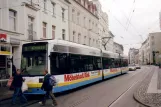
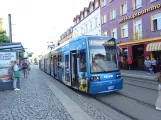
Schwerin tram line 1 with low-floor articulated tram 805 close by Hauptbahnhof (2006)By Henrik Boye..
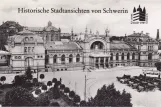
Postcard: Schwerin by Hauptbahnhof (1909)Historical City Views of Schwerin
825 Years of Schwerin 1160-1985
Streets lined with mostly half-timbered houses, often roofed only with wooden shingles, straw, or reeds. Only a few wealthy citizens and nobles owned stone houses.
This confusing and intricate, narrow layout of the city often became a major danger when fires broke out. Large parts of the city repeatedly fell victim to devastating fires, such as in 1531, 1558, 1626, 1651, 1690, and 1697. Thus, we find only a few buildings in Schwerin whose history dates back beyond the 17th century.
Primarily through the work of the architect Georg Adolph Demmler, a number of ducal residential buildings were built in the 19th century, such as the Arsenal at Pfaffenteich, the government building on Schloßstraße, the Marstall (martyrs' stables), and the theater (dismantled in 1882, reopened in 1886). Other buildings were added, such as the cathedral from 1888 to 1892 and the palace from 1843 to 1857. In 1847, Schwerin was connected to the railway network with a line to Hagenow.
Diverse traditions of the Schwerin labor movement can be traced back to the 19th and early 20th centuries. For a time, there was even an office of the Communist League in Schwerin. There was a remarkable development of social democracy; the November Revolution of 1918 and the Kapp Putsch of 1920 are outstanding examples of the self-sacrificing struggle of the working class for a better life without exploitation and hardship.
The strong population increase – approximately 20,000 inhabitants in 1848, approximately 34,000 inhabitants in 1890 – led to considerable external growth and structural expansion of the city, although the establishment of large companies in the city, with few exceptions, was unsuccessful. During the Weimar Republic, these were primarily iron and wood processing industries, a central dairy, and the German Timber Works.
It was only after the collapse of the Hitler dictatorship that the city of Schwerin experienced its major boom, both economically and in terms of structural expansion.
With the creation of entirely new urban areas such as Weststadt (1955-62) for approximately 10,200 inhabitants, Lankow (1963-72) for approximately 17,000 inhabitants, and the Grosser Dreesch (Gross Dreesch), begun in 1971 for over 60,000 inhabitants, efficient industrial complexes emerged close to the city. Companies involved in plastics processing, leather goods production or hydraulics/pneumatics are not only known in Schwerin.By Bild und Heimat, Henrik Boye - .