TRAM TRAVELS

Halász utca (Budapest)

There are 3 photos from Halász utca (Budapest) on Tram Travels.

Budapest Transport Company (BKV) stops

Albertfalva, kitérő, Árpád híd vá., Bécsi útca/Vörösvári útca, Blaha Lujza tér M, Budagyöngye, Clark Ádám tér, Corvin Körút, Deák Ferenc tér, Déli Pályaudvar M, Fővám tér M, Gárdonyi tér, Gubacsi úttal/Határ úttal, Halász utca, Haller utca/Soroksári út, Határ út, Határ út M, Hűvösvölgy, István tér, Izraelita temető, Jászai Mari tér, Kamaraerdei Ifjúsági Park, Káposztásmegyer, Megyeri út, Karolina útca, Kelenföld vasútállomás M, Keleti pu, Kispest, Tulipán utca, Kőbánya alsó vasútállomás, Kossuth Lajos tér M, Közvágóhíd H, Lehel tér M, Március 15. tér, Margit híd, budai hídfő H, Márton Áron tér, Megyeri út, Mexikói úttal, Móricz Zsigmond körtér, Népliget, Nyugati pályaudvar M, Nyugati Ter, Pesterzsébet, Pacsirtatelep, Petőfi híd, Petőfi híd, budai hídfő, Rákospalota, Kossuth utca, Rákospalota, MÁV-telep, Savoya Park, Széll Kálmán tér, Széna tér, Szent Gellért tér-Műegyetem M, Szent János Kórház, Újbuda-központ, Újpalota, Erdőkerülő utca, Városház tér, and Zugló.
Budapest Transport Company (BKV) depot

Bodafok, and Kelenföld.

Photos and videos from Halász utca (Budapest)

Budapest tram: The eight-axle articulated trams from Ganz (2010)
10:35
Budapest tram: The eight-axle articulated trams from Ganz (2010)The eight-axle full railcars were delivered in 1967-1971(1301-1370) and 1972-1978(1400-1481), a total of 151 units. The vehicles can also run in double traction, a feature previously used on Line 4. There are now very few fully double trains running on the line, as the Combinos have almost completely taken over this route. A picture of a double traction can also be seen in the video. In 1997, 30 examples were modernized by Ansaldo, incorporating chopper control and other minor adjustments, such as door openers. From the outside, you can recognize them primarily by the single-arm pantograph. Some non-modernized examples have also received minor adjustments, such as door openers or door closing warning lights. Three examples of this type are now used as driving school vehicles. These eight-axle articulated trams were built between 1967 and 1971 (1301-1370) and 1972 and 1978 (1400-1481). They can also be used in double traction, such as on the highly frequented Line 4. However, today, there are only a few double tractions left because the Combinos have taken over this line. Thirty trams were modernized in 1997 by Ansaldo. They have a chopper steering, a single-arm pantograph (which can be easily distinguished from non-modernized ones due to this feature), and door openers. Some of the non-modernized trams also got door openers and a door closing warning lamp. Data/data: Name: CSMG.2. Length: 26.9 m. Weight: 33600 kg. Axle load: 7560 kg. Vmax: 60 km/h. Engines/motors: 4x66 kW. Capacity: 32 seats and 171 standing places.By Klingl3r - .
BKV Budapest Tram Type UV (2009)
4:44
BKV Budapest Tram Type UV (2009)These locally manufactured vehicles were built between 1954 and 1965, based on pre-World War II designs. Quite popular among tram enthusiasts around the world, BKV recently celebrated its 50 years of service with an elaborate "UV Day" parade. Usually runs in pairs, or pairs with a central trailer car (some of which were built in 1939). The ancient UV vehicles had no heating installed and were phased out in 2008. The idea that UV stands for Új villamos (new tram) is a widespread urban legend.By Public Transport Worldwide - .
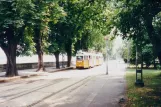
Budapest tram line 19  near Halász utca (1994)Budapest tram line 19 near Halász utca (1994)Groza Péter rakpark (Szilágyi Dezső tér)By Henrik Boye - .

Location on a map

Add a comment

Last updated: .