TRAM TRAVELS

Curt-Becker-Platz, Platz der Einheit (Naumburg)

There are 17 photos from Curt-Becker-Platz, Platz der Einheit (Naumburg) on Tram Travels.

Naumburger Touristenbahn (NTB) stops

Curt-Becker-Platz, Hauptbahnhof, Jägerplatz, Lindenring/Dom, Marientor, Markt, Michaelisstraße, Nordstraße, Poststraße, Salztor, and Vogelwiese.

Photos and videos from Curt-Becker-Platz, Platz der Einheit (Naumburg)

Naumburg (2025)
13:40
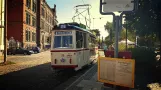
Naumburg (2025)On Saturday, 07.06.2025, we visited Naumburg. Tram traffic started in Naumburg in 1892, at that time still with steam traction. The network was electrified in 1907. Naumburg's tram network consisted of a tram ring built around the city center, which was intended to connect the train station with the city. In the 1970s, due to a track correction, the short downtown section was abandoned, but its remains can still be seen (pictures in the introduction to the video). In 1991, tram traffic stopped due to the extremely poor track conditions. Starting in 2005, the track between the Hauptbahnhof and the Salztor was rebuilt in several sections, and LOWA (ET54), Gotha (T57Z) and Reko (BZ70) motor cars suitable for bidirectional traffic were purchased for the operation. When we were there, the 37 Gotha and the 51 Reko were in traffic, but to our surprise, we sometimes saw a few two-stroke vehicles, besides the trams. #Naumburg #NDK #DDR #Tram #tram #Straßenbahn #Gotha #LOWA #Reko 0:00 Introduction 0:30 Life pictures 8:56 Travel on the Reko tram 12:35 Departure from the HauptbahnhofBy Kocso84 - .
Naumburg tram (2019)
5:51
Naumburg tram (2019)Last Sunday, the Lindner car "17" was used for a few hours. Here are a few impressions from Naumburg.By Justin Heuer - .
"Wilde Zicke": Germany's smallest tram in Naumburg, Saale (2019)
12:22
"Wilde Zicke": Germany's smallest tram in Naumburg, Saale (2019)The Naumburg tram was opened in 1892 as a steam tram between the train station and the city center. After electrification in 1902, the line was expanded in several steps to become a ring line. Due to the poor condition of the infrastructure and a sharp drop in passenger numbers, operations were discontinued in 1991. Thanks to the commitment of some tram enthusiasts, part of the former ring line has been open to traffic again since 1994. Line 4, also known by residents as the "wild bitch," has now become an integral part of the cityscape. In this video, we follow the route from the main station, past the tram depot and along the city wall to the final stop at Salztor. Due to an event, two cars were used on the day of the recording, while one route is sufficient for the normal timetable.By TramChris - .
126 years of trams in Naumburg (2018)
3:58
126 years of trams in Naumburg (2018)In addition to the presentation of Abellio's diesel vehicles, the annual festival of the Naumburger Straßenbahn GmbH also took place. Of course, we didn't miss it and took a few pictures! Only one day earlier, the new old stop in front of the main station was opened. It was 27 years ago when I drove from here in the other direction of the ring. And, according to what we heard on site, that should be within reach again. Transport Minister Thomas Webel and District Administrator Götz Ulrich have spoken positively about the further expansion. A gem that was long thought to be dead, which slowly fought its way back and now seems to be close to its goal of closing the ring. Worth seeing and preserving! Because here, there are daily scheduled services that you can only admire elsewhere standing or on special trips. BLK Regional TV was also there and will certainly report on it in detail. Naumburg is a bit far away and is now in another federal state, but it still has a long connection to Artern. Not only does our Unstrut flow into the Saale at Blütengrund here. Borlach and Novalis also worked in the area. For 117 years, there was a direct train connection between the two via the Unstrut Railway. This has been history since 2006 and since then this connection has unfortunately gradually faded. Closing the gap would be desirable here too and would certainly be in the interest of Abellio, whose workshop is in Sangerhausen.By TV Artern - .
[Documentary] Tram Naumburg (2018)
18:14
[Documentary] Tram Naumburg (2018)The tram in Naumburg is the smallest tram line in operation in all of Germany. There is a regular line on it that is 2.9 km long. Only historic vehicles are used. I will tell you more about the route, vehicles, and the history of the network in this documentary. The city of Naumburg has the smallest regularly operated tram line in all of Germany. At 2.9 kilometers long, it runs the entire route, which includes just one tram line—line 4—that connects the central station with Salztor. What makes the Naumburg tram network unique is that, besides its short length, it operates historic tram vehicles. I want to introduce you to this route, the vehicles, and the history of the Naumburg tram in this presentation. Enjoy! Hamburg is a city of 33,000 residents located in the Boden district of Saxony-Anhalt. The city is famous for its well-preserved historic center and its cathedral. The Cathedral of St. Peter and Paul is a UNESCO World Heritage Site. Its 13th-century tower still stands today, visible throughout the city. Naumburg's old town, which surrounds the Naumburg Cathedral, is also worth exploring, with many historic buildings. In the old town, you'll find the Naumburg market square, which is home to the Naumburg town hall built at the end of the 15th century. After a fire in 1517, it was rebuilt by 1528 and has undergone several renovations. Next to it is the town church of St. Wenceslas, featuring the tallest tower in town at 72 meters. Numerous historic buildings surround the market square. Historically, a tram line ran across Naumburg's market square, as shown here. These tracks were part of the city’s first tram line, which started operation on September 15, 1893, connecting the central station with the town center, which was quite far apart. Originally designed as a steam tram, there were early ideas to convert it to electric power. Electrification didn't happen until May 1906, making steam trams a thing of the past after 14 years. At the same time, an extension from Wenzel Store to Salztor was commissioned, and the electric tram officially opened on January 2, 1907. Over the years, there were discussions about expanding routes, including a proposed extension to neighboring Bad Kösen in 1914. The operations faced challenges during the early 1920s due to World War I and high inflation, limiting service. After World War II, operations became difficult again following bombing raids. By 1990, the Naumburger Straße line was out of service, and after reunification, the tram system was nearing closure. The city needed a budget of twelve million marks to rebuild the tracks and maintain operations, which was beyond its means. Citizens formed a volunteer group to help. In 1994, the tram network was extensively rebuilt, resulting in the system in use today, with new track sections added over time. Just last year, a 90-meter section in front of the central station was relocated to improve transfer facilities. The entire route spans 2.9 kilometers and includes nine stops. The central station and Theaterplatz each have double tracks for sidings. Now, let's talk about the vehicles on the Naumburg tram. The typical service cars are Type T 57 wagons built between 1957 and 1961 by VfB Waggonbau Gotha. Each railcar is approximately 10.9 meters long and 2.2 meters wide. Empty, they weigh around 13 tons and can reach speeds up to 50 km/h. Inside, they have 65 standing places and 22 leather seats for comfort. In addition to daily service, historic vehicles like the Linden railcar number 17 or the Lowa railcar are used for special events and services, such as on the 29th. We’ll now move on to the Naumburg tram line itself and take a closer look. Let’s focus on the new terminus at Salz. The extension between Salz and Vogelwiese, which opened in December 2017, is 400 meters long. The stop's name comes from the Salz Gate, located 50 meters away, a former city gate to Lauenburg’s old town. Today, it serves as an event space and library. The building here, constructed in 1834-1835 as a replacement for the Salz Gate, is designed in neoclassical style. Our trams are now moving. It departs from the Salz Tor stop, where a glazed shelter can be seen. The manufacturer hasn't been around for long. We are now traveling parallel to the old city wall, mainly over the newly laid grass. Next, we're heading toward the Vogelwiese stop, which was the tram line's terminus for many years. We've already passed the tram. This sculpture is found at another entrance to the city center. Near the stop, there's the Nietzsche sculpture and the Vogelwiese, a large parking lot also used for events. The Naumburg Cherry Festival, among other things, is held here. The stop platform is on the right side of the track, and from this stop, we pass the red carriages, which are heading in our direction, once around the curve. We continue along the city wall, parallel to B 180. On the other side of the street, we also want to see the Cineplex cinema. Naumburg can now be viewed as the tram approaches the double-track siding at Theaterplatz, on the side of the stop in our direction of travel. Each stop even has a sheltered waiting area with seating; on the driver's side toward Salz Tor, there's no shelter. The Theaterplatz stop on the tram side is spacious, featuring several green areas and concrete seating blocks. Here’s the school building: the Alexander von Humboldt secondary school, housed in a Wilhelminian-style building, is also located nearby. The eastern entrance to the city center is opposite the now-closed old theater, called Reichskrone, which has been locked for many years. Continuing, we pass through a tree-lined stretch with grassy tracks. The next stop, after another bend, is called Marientor. The Marientor is one of the five former city gates of the old fortifications, built in 1446. In the late 1990s, the city gate was extensively renovated. Right next to the tram stop is a roundabout called Heinrich von Stephan Platz. Behind it lies Naumburg's Postbank Center. We now leave the hall, cross Marienplatz street, and immediately afterward, on the opposite side of Ostring, the Naumburg tram depot comes into view. They now cross-track crossings, diverge onto our route, or split from it, and after just a few meters, we arrive at the Poststraße stop. The distance from Poststraße to Marientor is the shortest on Naumburg's entire tram network. Keep your distance. The tram depot serves as a shelter for the vehicles and functions as a workshop. It has two tracks inside the hall and two outside tracks near the entrance. The tracks inside the building allow access for inspections and repairs of the tram's operating equipment. The depot is open for visits on certain days of the year, and there are regular tours. Next to the depot is the charming brick building of Marienschule, which belongs to the Domschule von Augenblick. We drive a short distance parallel to a parking lot, then cross Gartenstraße, continue a bit further parallel to Stadtpark, and then turn another bend from Poststraße onto Franz Twickler Straße.By Bahnwelten - .
Spring impressions with the Naumburg tram (2018)
18:02
Spring impressions with the Naumburg tram (2018)As always, a lot is happening on the Ille. We experience a ride with the Lowa TW 29. On Easter Saturday, all currently operational railcars are in use: TW29, TW 50, TW 51 and TW 17, built in 1928. As part of a training course, TW 51 with BW 19 was used on April 28, 2018.By Straßen Bahn unterwegs mit dem Schienenonkel - .
Naumburg Tram (2018)
9:54
Naumburg Tram (2018)On March 24, 2018, I went to the smallest tram company in Germany, where historic railcars are still in operation. While in other cities, such cars can only be admired as museum cars, here you can experience 2-axle vehicles made in the GDR in daily service.By Nahverkehrs Journal - .
125th anniversary of the Naumburg tramway visit (2017)
20:12
125th anniversary of the Naumburg tramway visit (2017)Visit to the Naumburg tram on the occasion of its 125th birthday. This was of course celebrated in style. At the depot there was a wide range of food and drink as well as live music and souvenir stands. And every now and then the beautiful trams passed by, always well attended by many tram fans and amazed passengers who just happened to be using the tram and just wanted to get into the city.By Train Gucker - .
A joyful drive through Naumburg (2017)
29:26
A joyful drive through Naumburg (2017)Immediately after the fall of the Berlin Wall, the Naumburg tram was sidelined: it was too worn out, too old-fashioned, and too ineffective. However, many citizens refused to accept the end of "their" tram and managed to get it running again. For ten years now, the trams have been traveling through the cathedral city every day, just like they used to. And what trams! Each one is a historic treasure in its own right. For instance, there are old Gotha trams from the 1960s and so-called Reko trams from the 1970s. Recently, passengers could even ride in a Lindner tram from 1928! Corina Pfrenzinger and Robby Mörre are not going to miss out on this nostalgic experience in the new edition of "On a narrow gauge". They also explore the history of the BR 143 electric locomotive. Developed in East Germany in the early 1980s, it was used for both passenger and freight trains. The locomotive was so dependable that it continued running in the West after the fall of the Berlin Wall and remains in service today as the "Trabilok". For model train enthusiasts, there’s a behind-the-scenes look at a private facility in the Ore Mountains. Here, two men from Ehrenfriedersdorf built a monument to the former local narrow-gauge railway, which in the past transported grit from a quarry. Now, it’s all on display again—fully automatic, of course, and on a 1:87 scale. A warm welcome from Naumburg. The cathedral is here in the city. Many people are aware of it, but Naumburg has even more to offer. For example, the smallest tram service in Germany is just 2 2.5 kilometers long, running from the station into the city. Fortunately, this tram is still operating. After reunification, it was only here that trams began running daily. It's been only 10 years since the Nauenburg trams restarted daily service, so to speak, and with that, this tram faced a similar fate to the narrow-gauge railways in Briegnitz. There was a long stop in Briegnitz, too, but it is now back in operation. The Pollo, a diesel locomotive from Babelsberg, along with three carriages, is how the Pollo departs on a narrow-gauge track. In the driver's cab is Sven Lieberinz, the chairman of the Pregnitz Narrow-Gauge Railway Museum, Lindenberg e. V. When the association was founded 24 years ago, it was only meant to display a few relics from the railway's history. No one believed trains would ever run here again, but Lieberinz recalls that when the volunteers came together, a momentum of its own arose. We started here in '93- it all began with a power socket at the station under the open sky. Most of the vehicles were repaired here, regardless of the weather; the lock shed was only added in 2000. Before that, everything was rebuilt outdoors. We can take pride in the club. The Pregnitz is located in the northwest of Brandenburg. The Pollo now runs again on a 9 km route from Lindenberg station to Mesendorf station. Railway enthusiasts have come from Saxony. They are narrow-gauge railway fans themselves. In Jöstadt in the Ore Mountains, the Pressnitz Valley Railway is a beautiful place - a classic railway, a small train. We are trying to portray the museum railway in the style of the 1960s, which reflects the region's decline and slow development. It's not as low as in towns and cities; that's why it remains truly rural- very rural, just like in the old pictures. That's part of the charm. It's actually the beautiful former Tönning Junction of a 20-km-long narrow-gauge railway network. The railway used to run on steam. Today, there are no operational steam locomotives left, but friends from the Pressnitztalbahn bring one here every year on a low-loader for Thomas Brand. The highlight of the year is when we have a steam locomotive from Höstadt. Of course, it's a significant challenge. It brings back memories of my childhood. I grew up with steam locomotives that ran regularly, so there's a bit of nostalgia involved. In May, there are steam locomotive days at Polllo. This is what it looked like last year. This year, Mario Wolf from the Pressnitztalbahn is already planning for this event. We will bring a steam locomotive here again on loan. We’re also happy it has been so well received. We learn from each other about refurbishing carriages, operating locomotives, or SAS, and that definitely helps. I believe it’s a massive win for both sides. Saxony and Brandenburg support each other — it’s as simple as that. But where does the name Polllo actually come from? Who knows? At the opening, Lieberenz was there with his dog Polllo. When the train approached, the dog got scared and ran away, or probably after it. No one knows for sure anymore. The forester called the dog Polllo, and everyone thought that was the train’s name, so it has stuck in widespread usage ever since. Pollo, that is. The people of Prnitzer are happy that many want to get to know their Po. It is on the road for about 25 days until the end of December. On the last two weekends in May and on Ascension Day, steam can be heard in the Pregnitz. We are still traveling through Naumburg on the retro tram, and everything here has been restored to its original state. The people of Naumburg affectionately refer to their tram as the "Wild Bitch," and there are two theories about why. One reason is that the steam-powered tram always hissed back then, and the other, more likely, is that the poor rails caused the passengers to be jolted back and forth constantly. Whatever the case, one thing is sure: Naumburg once had the largest model railway in the GDR, and you can still see it from Michael. Anyone who plays with this model railway has plenty of options. There are over 40 different trains here. Twelve of them can run on the tracks simultaneously. Michael Schulze from Naumburg is especially proud of this. Four decades ago, the kasermeister started building his masterpiece, and at the same time, he found time to start a family. I built the others.By Thueringer-Bahn Initiative - .
The tram in Naumburg (2012)
8:19
The tram in Naumburg (2012)The tram in Naumburg on September 15, 2012.By EEPSpieler - .
Tram Naumburg HD (2011)
4:40
Tram Naumburg HD (2011)A short visit to the Naumburg tram with the ex-Stralsund two axle tram in service. Since a while the Naumburg tram is again in service and runs every 30 minutes the day, however it does not cover the whole circle line again and it is questionable if this will be the case because the old rails were removed and roads and buildings are now at their former place.By Klingl3r - .
The Naumburg Tram. A report. Part 1 of 2 (2009)
9:54
The Naumburg Tram. A report. Part 1 of 2 (2009)Since the summer of 2007, the "Wilde Zicke" (Wilde Zicke) has been operating regularly again as Line 4. Founded in 1892, it was initially closed unilaterally after the fall of the Berlin Wall to favor private transport and later operated irregularly under difficult conditions. The Naumburg tram is more than just a means of mass transit. As a landmark, it is as much a part of the city as the cathedral and the summer Cherry Festival. Join us and learn more about the current route of the Naumburg tram. Enjoy the impressive images and the unmistakable sound of the Tw 38, a Gotha ET 57. Naumburg an der Saale is a cathedral city in the Saxony-Anhalt region of Thuringia, with around 29,000 residents. Naumburg has the smallest tram in Germany. When arriving at the central station, one of the historic and meticulously restored vehicles is already waiting for us at the terminus. The friendly and helpful drivers are ready to assist guests arriving by train. The landmark vehicles run every 30 minutes daily between the central station and the Vogelwiese. This is where our journey will now take us. Dear spectators, we cordially invite you to join us on board. The area where you can see us is called a siding, used to uncouple the traction unit during trailer operation. Founded in 1892, the Zicke, as the people of Naumburg affectionately call it, once operated as a circular line on a clockwise and counterclockwise route. Today, unfortunately, only part of that route remains, but the number of trips is growing each year. The next stop is Wesenstraße. Today, the ET57 type railcar with the car number 38 is in service. It was built in Gota in 1960. Along with three city bus lines, tram line 4 has been running since summer 2007, serving both locals and tourists regularly. The tram provides an ideal connection to the city center, known for its extensive historic buildings. The Gründerzeit quarter is just as well preserved. The largely independent track layout not only allows for an aesthetically pleasing design but also separates the tram from private traffic, which has steadily increased in recent years. The green track systems also emphasize the historical heritage of the Naumburg tram, fitting harmoniously into the cityscape. A more traffic-friendly side location has replaced the former Central Street location. Lovingly maintained parks and green spaces line our route. Next stop: Oststraße Straßenb. For the people of Naumburg, the tram has become a landmark and an integral part of the cityscape. It’s much more than just a means of transportation. We arrive at the depot. In our workshop, a large portion of the repair and maintenance work is performed by volunteers from the Nahverkehrsfreunde Naumburg eV, who support the company in the workshop and as conductors. Afterwards, we recommend a detour to the cathedral, which is located nearby. It can be reached on foot in just a few minutes—the fine restaurants in the historic old town offer culinary delights to round off the tour. After the roundabout, we reach the Marientor stop. In the background, the depot of the moated fortress shows the course of the medieval city limits. We ride the tram through almost scenic avenues to Theaterplatz, which was completely redesigned in 2009 to reflect its role as a central square. We are only a few minutes from the old town here as well. Next stop: Vogelwiese terminal station; provisional station: Vogelwiese. The Vogelwiese is regularly the site of significant events, including the legendary Cherry Festival.By Contimedia Audiovisuelle Medien - .
The Naumburg Tram. A report. Part 2 of 2 (2009)
9:52
The Naumburg Tram. A report. Part 2 of 2 (2009)Since the summer of 2007, the "Wilde Zicke" (Wilde Zicke) has been operating regularly again as Line 4. Founded in 1892, it was initially closed unilaterally after the fall of the Berlin Wall to favor private transport and later operated irregularly under difficult conditions. The Naumburg tram is more than just a means of mass transit. As a landmark, it is as much a part of the city as the cathedral and the summer Cherry Festival. Join us and learn more about the current route of the Naumburg tram. Enjoy the impressive images and the unmistakable sound of the Tw 38, a Gotha ET 57. You shouldn't miss this, dear spectators, because the street painters also operate their marquee. Our driver is currently helping to unload a pram. We use this short break to review some details. The technology, which has been mainly preserved faithful to the original, arouses the curiosity of many tram enthusiasts and makes us want more, and once again, it's time to board. We were heading back toward the central station at the market. On our brief detour through the old town, we immediately notice remnants of the former route. Meanwhile, motor car 38 reaches Theaterplatz, which is still under renovation. The old and new building materials are for the renovation. The depot is easily accessible from the Post Ring stop. Our tip: why not join one of the regular demonstrations? Here, exciting insights into the technology and nature of the railway will make your heart race. Dedicated employees are happy to answer your questions. Dear spectators, let the following impressions sink in and enjoy the ride on the tram. Through Saale city, with these pictures, we say goodbye and look forward to seeing you again on the Naumburg tram.By Contimedia Audiovisuelle Medien - .
Cab ride on the Naumburg tram (2009)
9:44
Cab ride on the Naumburg tram (2009)Ride in the driver's cab on the Naumburg tram from Vogelwiese to the main station, http://www.naumburger-strassenbahn.deBy pixlux - .
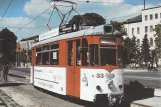
Postcard: Naumburg tourist line 4 with railcar 33 near Curt-Becker-Platz (1994)Postcard: Naumburg tourist line 4 with railcar 33 near Curt-Becker-Platz (1994)Naumburg Tram 1994 Tw 33 Type: ET 57 Year of construction: 1958 Manufacturer: Gotha / LEW Power: 2 x 60 kW 1994 ex Frankfurt / Oder 28 IIIBy Henrik Boye, Krause, Naumburger Verkehrsfreunde - .
Naumburg tram (1991)
42:12
Naumburg tram (1991)Back then, the tram still made a long circuit around the historic city center of Naumburg. One of my first videos on Hi8.By lirrsteve - .
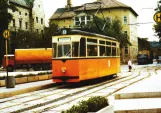
Postcard: Naumburg (Saale) tourist line 4 with railcar 43 at Curt-Becker-Platz (1982)Postcard: Naumburg (Saale) tourist line 4 with railcar 43 at Curt-Becker-Platz (1982)September 15, 1892 to September 15, 2003 111 Years of the Naumburg Tramway ČKD tram 43 (formerly depot 785) at the "Platz der Einheit" stop on August 2, 1982By Henrik Boye, Nahverkehrsfreunde Naumburg & Jena, W. Degener - .

Location on a map

Add a comment

Last updated: .