TRAM TRAVELS

Betriebshof (Gotha)

There are 18 photos from Betriebshof (Gotha) on Tram Travels.

Thüringerwaldbahn und Straßenbahn Gotha stops

Bahnhofstraße, Friedrichroda, Hauptbahnhof, Hersdorfplatz, Huttenstraße, Kreiskrankenhaus, Orangerie, Ostbahnhof, Tabarz, Waltershausen Bahnhof, and Waltershausen Gleisdreieck.
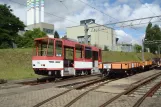
Photos and videos from Betriebshof (Gotha)

New Škoda tram tested in Gotha (2023)
13:37
New Škoda tram tested in Gotha (2023)The Thüringer Waldbahn und Straßenbahn GmbH Gotha (TWSB) is currently testing a brand-new Škoda tram. Starting in 2025, TWSB will gradually add new vehicles; therefore, they are now seeking suitable models for their fleet. The Škoda tram is intended for Rhein-Neckar-Verkehr GmbH Mannheim and was shipped directly from the factory in Pilsen to Gotha. On September 20, 2023, interested visitors had the chance to ride the forest railway line between Gotha and Bad Tabarz free of charge. 00:00 Leaving the hall 00:28 Interview with Klaus Rennau, TWSB Gotha 01:34 Collaboration between TWSB and RNV 02:07 Information on the selection process for new vehicles 03:41 Is everything in Gotha suitable for the Škoda tram? 04:30 Some technical information 06:16 Advantages of the bidirectional railway 07:00 How did the Škoda tram arrive in Gotha? 08:48 Plans for purchasing new vehicles for TWSB 09:55 Information on costs 10:53 Interview with tram driver Marlon Meyer, RNV Mannheim 12:54 And now, we’re heading off on the route! September 20th is World Children's Day, and today we are at the Thuringian Forest Railway and Tramway GmbH in Gotha, where we have once again arranged to meet Mr. Rennerau, as he has something special to share. Currently, a new tram has been running for about a week, having just arrived from the factory in Pilsen. This tram will, of course, stay here for a few more days. How did this whole story come about? It marks the first step toward the future of the Forest Railway, which aims to acquire new vehicles for its fleet in the years to come. Yes, Aschenbren, for the first time in all these years, we have managed to include the procurement of new vehicles in the local transport plan, and we are currently in the prequalification phase. We are examining the market to see which manufacturers offer what vehicles. Our colleagues at Rhein Neckerverkehre are in the middle of their procurement process, which means they have ultimately chosen the vehicle behind us, based on the tender, as the most suitable for their needs. In the past, we have repeatedly used vehicles from R. Necker, specifically the Mannheimers, to increase the number of low-floor vehicles in the area. At some point, we decided to test the newly designed RNV vehicle on the Goar route network. It was a somewhat impulsive idea to suggest relocating the car from the Pilsen delivery site, where it is assembled, to the pit stop before it heads to Mannheim. We then put this plan into action, and you can see the results behind us. The reason for this vehicle test is straightforward. We naturally want to save time during the prequalification process, which allows for thorough calculations. However, in practice, there are often one or two things you can't predict. This is why banks conduct stress tests. Here, we are conducting a stress test for two purposes: first, to assess the vehicle's equipment—how do passengers receive it? We’re observing that today. Second, how the vehicle functions within our infrastructure, and what we need to adapt if necessary. If you look at social media, you’ll see reactions that might have surprised some—they range from many people speaking out positively about the new railway, to discussions about how the Thuringian Forest Railway and tram are losing some of their unique charm with the old railway lines. The numbers may vary, but logically, we have to provide better transportation options for both passengers and drivers. The primary concerns are passenger comfort, which affects not only the driver but also everyone on board. Lastly, we need to upgrade to standard technology and adhere to new standards and regulations. Our current vehicles are over 30 years old, and the supply of spare parts is limited. As the saying goes, if I fit my grandma with a new pacemaker, her heart might still work a little better, but that doesn't mean she'll run a marathon—other parts are worn out. Regarding the new track, a press release mentioned that it is slightly wider, measuring 2.40 meters in width. You’ve already conducted some test runs. Does the vehicle pass smoothly through all areas? You can see from the decorative panel on the wheel arches that new stops have been added to the route network, designed to accommodate both rail and bus services. Currently, we have five old stops remaining that need to be converted to meet new standards and enable the use of low-floor vehicles. The stops have to be upgraded regardless, so we will handle that. Apart from that, the entire network appears to be functioning well, and the vehicles are running smoothly across it. Now, about the track—how big, heavy, and costly is it? To start with the basics, the vehicle is 30.5 meters long. We are working with what’s called a drum train. Our colleagues at DERV don’t just operate trams but also trains, which means for the experts, they drive to BUSTRAPP and ESBO. For us, we only need the BUSTRAPP, which makes us a street vehicle.By Oscar am Freitag-TV - .
Santa Claus in the Waldbahn-Wunderland (2021)
14:43
Santa Claus in the Waldbahn-Wunderland (2021)Santa Claus faces a tough night: first, his sleigh breaks down, then his reindeer have to be quarantined... and all of this happens on Christmas Day! A terrible Christmas, right? In his desperation, he rents a small van and heads for Gotha. But the trip ends suddenly at Boxberg: see what happens next and find out which surprising helpers come to his rescue! Well, I set off from heaven about an hour ago. Oh, now I'm in Gota. Yes, the car is full of people, but I forgot something. I don't know what it is. Oh, it's an issue—reindeer are in quarantine. I didn't like that anyway. Now, here with this strange driving—I don't like it at all. Oops, what’s that? Oh, you fat dancer, what's that now? What’s that supposed to mean? Isn’t that also, my God. Oh, stop first, stop first, and get some fresh air. No, such crap. What’s that? That doesn't work. That’s not good. That’s not good at all. Oh God, oh God, oh God. Are we going to do something now? What do I do now? Call the fire brigade—call the fire brigade. Oh no, call the fire brigade first. ADAC, that's better. We—hello, yes, hello, I'm Santa Claus. Yes, it really is me. No, this is no joke. My car is smoking, and I have to go to G, completely drunk. Can they tow me somehow? Please help me, I'm here. Yes, where am I? I drove over a mountain—I think it's called Boxberg—and now I'm standing where the forest railway runs. Yes, please come quickly; I'm in a hurry. Okay, and now what do we do? Now we need to get something repaired. Okay, now this guy from ADAC called—now he's also broken down. What is that today? I should have driven with racing shoes. God, God, God. Yes, yes, I saw the tram to Boxberg. Did I say it right? It's the wrong direction—or yes, I don't want to go there. I don't have to look here either, and where are the others? Oh, now I don't have my reading glasses with me. What’s that smoke from earlier? Terrible. Look fifty times—it takes ages. There’s a train there. It says SOS SOS SOS SOS—great. Great master, you have such great roads, man. However, you're driving in the wrong direction. You're driving TS. Yes, I'm still driving too. Do you see who I am? Oh, I'm foolish. The reindeer are in quarantine, and the sleigh didn't get out of the TÜV inspection station in time. Back then, I took a rental car, and there it is—oh dear—from heaven. I had driven almost a hundred kilometers so far, and then it was rough. Then there was peace with the car. Now I'm standing here with piles of presents. The children are waiting for me. Now I've checked the timetable—really, when does the next train back go? Oh, that'll take a while. It’ll take another two hours. But I don't think so—that's not possible. That’s not possible. I think we'll make an exception for the children. I think we can manage something. It'll work as if we flip the switch now. We'll drive back quickly and take you to G F, so to speak—not on scheduled service now, as the saying goes. I’d make an exception and drive with you to Guta so the children get their presents in time. GL—that's how we'll do it. Now, please tell me your name. I'm Klaus. You’re Klaus. Klaus, if you're here now and said you want to flip the switch, can we drive back like that? Is that okay? No, that's not possible. However, we're entering the loop now, and then we can deliver your presents, invite you, and you can call somewhere from there. I'll tell the control center that we'll make an exception. I'm so excited—that's never happened to me before—something like this with the car. Oh no, I'll never do that again. Do you always have to do it by hand? Today we'll do it by hand. Okay, then you drive to where the car is parked, right? I'll come to the car, then I'll walk over there. All right. My God, sometimes even Santa Claus gets lucky in life. I think that's great. Well, let's see what was in here. So everything was in here—I think I remember. It’s not that bad. We can easily fit it into the tram. Oh, it's a nice, big tram. I rode the tram for a long time. I just noticed. Okay, SIM salabim isn't working. Aha. Oh, Klaus, you even brought a colleague with you. Look—I have another colleague who is helping you. You found him now while we were looking in the tram. So, yes. What’s the best way to do that? Oh, best we pack everything in, guys. We’ll now pack everything in, and I'll sort it out later on the journey to Gota, as I have two appointments and want to attend the first one straight away. Look out, dear Santa Claus, you're already getting on the train, and my colleague and I are loading the packages. That's a great idea. I have icy hands from all the packing, then you'd need mountain climbing skills—not to step on your coat—to climb in here. Ah, shit, so very nice. Thank you. No, no, not, not—be careful. There’s very delicate glass in there, too. Thank you. And here come the next presents—so many presents—all for you.By Oscar am Freitag-TV - .
Tram in Gotha and the Thuringian Forest Railway (2021)
5:41
Tram in Gotha and the Thuringian Forest Railway (2021)Today, there is a new video from the tram in Gotha and the Thuringian Forest Railway.By Spiegelwagen - .
Documentary Thuringian Forest Railway and Gotha Tram - Part 2 (2020)
16:36
Documentary Thuringian Forest Railway and Gotha Tram - Part 2 (2020)Welcome to the second part of our guide about the street bank robber and the Thuringian Forest. Today, we focus on routes of lines 1, 4, and 6 toward Tabarz and Waltershausen. We hope you enjoy our journey. We will stop again because lines 1 and 4 here share their first stops with the route of line 2, which we already covered in part 1. We will take you directly to the Rote Straße stop, where the routes split. At this stop, you can easily reach the mothers' center in Macht as well as the Margarethenkirche. While the vehicles on line 2 go straight ahead, those on lines 1 and 4 turn left into Gartenstraße. Later in the evening, we will follow this route ourselves, starting from the middle of Main Street. We will circle the Gotha center, then reach the Gartenstraße and Bertha von Suttner Platz stops. After Miconos Platz, we cross Waltershäuser Straße and pass stops 18 at Bergstraße and Ernst Straße near the local Wagenhalle, which is the depot of TBS B. Further toward Sunthausen, the line runs single-track through Schöne Aussicht and Inselberg Straße to Sunthausen. This district has a village-like atmosphere, with small single-family houses along Sunthausen Weg. At the Gleisdreieck junction, lines 1 and 4 split toward the hospital loop. Then they continue on the interurban route toward Boxberg. The stop at the district hospital is the terminus. The Streifen is the newest part of the Gotha tramway. From here, line 4 reaches the interurban section toward Boxberg and Werdershausen. At Boxberg, there's another turning loop. The journey continues along the interurban route to Leine. In Mauthausen’s urban area, we arrive at the small Obershausen stop. Welcome to the Gleisdreieck. What does it mean here? The city is connected to Sondershausen by six lines. Each side has an ascent, making all travel directions possible. Here, it’s daytime. Earn six is coordinated with the four routes, allowing seamless transfers. We want to take a quick detour with line 6 to Mauthausen. Tram line 6 mostly runs along Goethestrasse, passing through Northstop for Goethestrasse and Albrechtstrasse. My house was near the city train station. The South Thuringia Railway connected Fröttstädt to Friedrichroda. In the past, the Waltershausen station’s turning loop was still in use. Today, the line 6 traffic is handled in two directions at the square. Below, it still doesn’t feel like another country—judge and relatives at the Körpers station are back at Waltershäuser. At Gleisdreieck, we continue by line 4 toward Bad Tölz to Das Haus Schnipsen. From Schnitzen, the Thuringian Forest Railway runs parallel to the South Thuringian Railway to Fröttstädt, passing through stops 100 ICE to Friedrich or Reinartz station. Besides Waltershausen with 10,000 residents, Friedrichroda with about 700 inhabitants is the third largest town along the Thuringian Forest Railway. It’s recognized as a health resort. The charming buildings create a beautiful setting in the heart of the Thuringian Forest. The journey on line 4 ends soon. It passes Marin Glashülle and reaches its final stop in Bad Tölz. The Thuringian Forest Railway has now arrived at its destination, Bad Tölz. This town, with a population of 5,000, lies below Großes Insel Berg. The train begins its return. If you haven’t visited yet, you should go to Gottéron, a peaceful little town in the Thuringian Forest accessible by country roads. The scenic trip through the forest and neighboring Gotha is a must for every tram enthusiast, mainly because of the historic carriages. This concludes our documentation. Thank you for watching and listening. Have a great day, and see you next time here on the regional association channel.By Regionalzugverband - .
125 Years of Gotha Tram / 90 Years of Thuringian Forest Railway (2019)
11:43
125 Years of Gotha Tram / 90 Years of Thuringian Forest Railway (2019)The first ex-Basel tram has been in regular service for a few days. It took longer than expected because of all the problems the pandemic brought to the world, and German law was also a huge problem. Due to some German laws, they had to do more paperwork than expected and make more modifications. It isn't easy to do all the needed paperwork to convert a Swiss train into a German tram. You need to know that in Switzerland, there are no trams; all vehicles on the railroad are trains. They needed to be converted into a German train (only on paper) and then into a German tram. This was the first time in German history that someone converted an old Swiss "train" into a German tram. All this paperwork took a long time, but now the first one is finished, and all other trains will take only 6 months to finish.By Matthias Matthias - .
Trams from Basel to Gotha (2018)
12:59
Trams from Basel to Gotha (2018)Thüringerwald- und Straßenbahn Gotha GmbH has bought six trams. They are not brand new and have just under 1 million km on the clock. They come from Basel (Switzerland) and have undergone several modernizations in their 40-year life. There is a good reason why the youngsters, of whom another 30 continue to transport Basel residents safely and well, are coming to Gotha: by 2022, all buses and trams in this country must be barrier-free—i.e., accessible to wheelchair, walker, and stroller drivers at ground level. In technical jargon, these buses and trams are low-floor vehicles. Such a hip new tram costs around 3 million euros, money that the people of Gotha cannot afford, especially since they need more than just one of the low-floor vehicles. So they were looking for good used ones. But here, too, in Germany and other EU countries, nothing. A member of the Gothaer Straßenbahnfreunde e. V. association found what he was looking for while on holiday in Basel. And so an exciting story began. The next rejuvenation of the Basel railways will involve reconstruction. As is well known, Switzerland is not part of the EU. Different rules apply there for the approval of a tram. The Swiss do not differentiate between streetcars and railways - everything there is called a railroad. This means, among other things, that there are uniform approval criteria. If the Thuringian Forest Railway had found what it was looking for within the EU, it might have meant less stress regarding approval. However, the reconstruction would have been quite a lot, as operations manager Jörn Schirrmeister, who has been there for 40 years, explained. Basel tram drivers, for example, do not have to collect the fare: there are ticket machines at every stop, and you can also buy your ticket using your cell phone. Gotha has not yet got that far. That is why validators have to be installed in the trams. The displays for the route and destination also need to be revised or completely reinstalled. The seats with artificial leather covers remain. This is not a nostalgic reference to the past, but rather a very pragmatic idea: artificial leather is easier to clean. The people of Basel seem to have taken bicycles on the tram quite often. In the lowered middle section, into which a very narrow staircase leads to the right and left, there are still plenty of hooks on which the front wheel of the bikes hangs. Before the interested public ponders whether and how practical this is, the forest railway workers have put a hook on the hooks. Jörn Schirrmeister justifies this by saying that the barrier-free access was the main reason for the purchase. The Basel imports offer 66 seats and 147 standing places. They are an impressive 26 m long, like the four trams from Mannheim in 2011, and mainly travel to Bad Tabarz. The fleet also includes Tatra trams, although they are shorter. The first two of the six Basel trams are scheduled to make their maiden voyage on September 21, 2019. There will be two reasons to celebrate that day: Firstly, the 90th birthday of the Thuringian Forest Railway will be celebrated. Construction of the line to Tabarz began in 1914, but was interrupted the following year due to the First World War and its consequences. It took 13 years for construction work to resume. Since July 17, 1929, however, the Thuringian Forest Railway, affectionately known as the "jungle rumple", has been running on the 22.5 km. It is the only interurban tram in the Free State. The second reason to celebrate is mainly for the twelve men in the workshop because the Basel trams will finally become Gotha trams, which will also be painted in the traditional blue and yellow, for example. The six, which did not travel all over the world but at least made it to the residential town, will later run on all lines, serving all 35 stops on the 38 km route network.By Oscar am Freitag-TV - .
Construction site of the Basel railways (2018)
19:45
Construction site of the Basel railways (2018)Gotha (red, March 17). It was October 2018: A team from Oscar am Freitag TV was standing in the Thüringer Waldbahn und Straßenbahn Gotha GmbH (TWSB) depot. The information that the company had bought six trams piqued their interest. That is newsworthy in itself. But when we are talking about almost 40-year-old vehicles, each with a good 1 million km on the clock and coming from Basel (Switzerland), then that arouses journalistic curiosity (video from 2018: https://youtu.be/dCGUeD7kCbM Road vehicles manufactured in Germany from these years would receive an H license plate and be eligible for tax benefits as vintage vehicles when rolling through the country. However, the Swiss sextet from the Baselland Transport AG (BLT) inventory was not intended to enrich the TWSB's historic fleet. Instead, the plan was to give it a fountain of youth and significantly increase the proportion of trams with low-floor technology. However, since new vehicles were only available at unit prices starting at 1 million euros, the TWSB had relied on the old ones, not least because the Free State of Thuringia does not support new purchases but does support modernizations, such as those planned in Gotha. By 2019 at the latest, on the 100th anniversary of the Thuringian Forest Railway, at least one first tram between Gotha and Bad Tabarz is expected to start regular service. That was the optimistic forecast. March 2021. Four of the Swiss trams are in the depot in Gotha-West, having arrived in Gotha in mid-2018. At least six chassis of another were dismantled for repair; since then, it has been resting on temporary bogies in one of the fleet halls. Only the tram with the number "222" has a fresh coat of paint, typical for the TWSB, after more than 30 months. The 26 m long articulated tram of the type Be 4/8 interior, like its five sisters, was built at the end of the 1970s by Schindler Waggon AG in Pratteln. It is still a construction site. Why this is the case, why the Swiss tram first had to become a German "railway" so that it could then be converted back into a tram approved for use in this country, but which is still not operational—Karl-Heinz Koch, the managing director of the Thüringer Waldbahn und Straßenbahn Gotha GmbH (TWSB), tells the almost never-ending story of the "Basler Bahnen construction site" openly and in detail.By Oscar am Freitag-TV - .
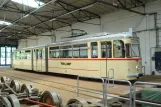
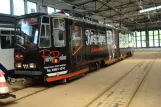
Gotha articulated tram 111 inside Betriebshof (2014)Gotha articulated tram 111 inside Betriebshof (2014)By Henrik Boye.
.
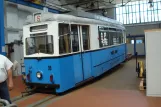
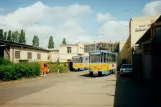
Gotha articulated tram 310 at Betriebshof (2014)Gotha articulated tram 310 at Betriebshof (2014)The rear of the articulated tram 310By Henrik Boye - .
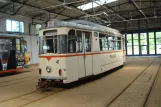
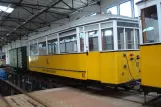
Gotha museum tram 215 inside Betriebshof (2014)Gotha museum tram 215 inside Betriebshof (2014)By Henrik Boye.
.
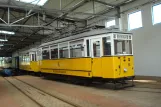
Gotha museum tram 39 inside Betriebshof (2014)Gotha museum tram 39 inside Betriebshof (2014)By Henrik Boye.
.
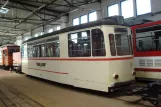
Gotha museum tram 47 inside Betriebshof (2014)Gotha museum tram 47 inside Betriebshof (2014)By Henrik Boye.
.
Gotha museum tram 56 inside Betriebshof (2014)Gotha museum tram 56 inside Betriebshof (2014)By Henrik Boye.
.
Gotha museum tram 82 inside Betriebshof (2014)Gotha museum tram 82 inside Betriebshof (2014)By Henrik Boye.
.
Gotha museum tram 93 inside Betriebshof (2014)Gotha museum tram 93 inside Betriebshof (2014)By Henrik Boye.
.
Trams in Gotha (2012)
17:34
Trams in Gotha (2012)By choppernachladung.
.
Gotha tram // Line 6 in KT4D-ZR (2012)
8:30
Gotha tram // Line 6 in KT4D-ZR (2012)Line 6 of the Gotha tram runs from the central transfer station "Gleisdreieck" to Waltershausen station. Tatra KT4D trams are used on this short line, which also have a full driver's cab at the rear of the vehicle. In addition to this special feature, there are only doors for boarding and alighting on one side. Passengers therefore always change from the same platform in both directions of the line.By metr0p0Iitain - .
Gotha articulated tram 302 at Betriebshof (1998)Gotha articulated tram 302 at Betriebshof (1998)By Henrik Boye.
.

Location on a map

Add a comment

Last updated: .