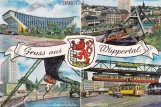
Postcard: Wuppertal (1987)Transport History Working Group of the
WSW. Wuppertaler AGBy Henrik Boye, WSW Wuppertaler Stadtwerke AG - .
Postcard: Wuppertal articulated tram 3814 (1987)Series 871, Image 2
Verkehrsverbund Rhein-Ruhr GmbH
Wuppertaler Stadtwerke AG
Car 3814
--------------------------
Eight-axle unidirectional articulated railcar
Constructed from a four-axle unidirectional railcar (built in 1954)
Gauge: 1435 mm
Manufacturer: Waggonfabrik Uerdingen AG (now: DUEWAG AG)
Year of construction: 1960By Henrik Boye, R. Sörensen, Verkehrsverbund Rhein-Ruhr VRR - .
Postcard: Wuppertal articulated tram 3819 (1987)Series 871, Image 3
Rhine-Ruhr Transport Association GmbH
Wuppertaler Stadtwerke AG
Car 3819
--------------------------
Eight-axle unidirectional articulated railcar
Gauge: 1435 mm
Manufacturer: Waggonfabrik Uerdingen AG (now: DUEWAG AG)
Year of construction: 1960By Henrik Boye, R. Sörensen, Verkehrsverbund Rhein-Ruhr VRR - .
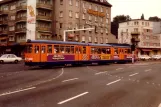
Postcard: Wuppertal railcar 3239 (1987)Series 871, Image 1
Rhine-Ruhr Transport Association GmbH
Wuppertal Municipal Utilities AG
Car 3239By Henrik Boye, R. Sörensen - .
Wuppertal tram 1-4 (1970-2016)In 1970, Wuppertal's last meter-gauge tram was retired, and Johannes Rau, the then-Minister-President of North Rhine-Westphalia, seized the opportunity to criticize this outdated, disruptive mode of transportation, staying true to the SPD motto of the time: "Free travel for free citizens." But the standard-gauge tram didn't fit the concept either, because 20 years earlier, trams had also been abolished in the major model countries, the USA. Here you can see footage from the good old tram days when environmental protection played no role. After all, the auto industry wanted everyone over 18 to drive a car... The Bergische Museum Railways (Bergische Museum Railways) managed to preserve at least part of the former Kohlfurt line and now occasionally offers museum operations there. However, the theft of the overhead line in 2015 and 2016 caused a major setback... Here you can see excerpts from the purchase DVD. Andreas Herr and Strassenbahnvideos.de wish you lots of fun.
In 1969, just before the last Wuppertal meter lanes were built, the Bergische Museumsbahn association was established. The goal was to preserve the ausle, specifically on a section between Kronberg Möschenborn and the Kohlfurt Bridge, to support regular museum traffic. In 1992, the first passenger service between the Kohlfurt Bridge and the Friedrichshammer stop was launched. The 20 J, now known as museum car 105 of the Bergisches Museumsbahn, was still under construction in Lienverkehr and is now also owned by the Bergisches Museumsbahn—specifically, it features sliding platforms for trams. The tram needs to be removed. The bus must come in. Today's pizza and kebab were disappointing. If anyone wants a glass of authentic tram, we’ll check again afterward. The meter-long tram lines, along with the standard tram, kept their stops until 1987. With the Schlebeb for the BU, this is car 3831, formerly from Dortmund, taken over from Karls. The south wing track was early. The fully lane-driven tram went straight down the meter lane in Obertal, but it's unclear if all lines will still be set up today. Car 105, which was seen earlier, leaves the new hall of the Bergisches Museumsbahn and has moved to the site of the BMW from the same collection—266 Vierachser from Ahen. The railcar from Remscheid, built in 1932, was scrapped by 1981 in favor of car 342 on the fixed tram. The four-axle two-way vehicle, built in 1982 at DUB in Düsseldorf, looks great from the outside. It is GT6, replacing the old Schleiflocks Loog 615 and the 610 from BMW. The structure was built together with Stuttgart in Esslingen.
The Exhagner Wagen 318 Max was also decommissioned in 1994, and the car was moved to Schwerte along with other vehicles. It first stood at the freight station in Schwerte. On its axis, it was dragged from the railway wagon. Innsbruck was sold and performed well in Austria until the turn of the millennium. There, they expanded from Austria with a middle section of Achtachs to Romania and also sent some to Belgrade in former Yugoslavia. I heard your protest at this point — a few shots from Hagen Central Station, you didn’t want to give it up if it wasn’t expensive, even if it was costly. Back then, because scrap prices were low, the 1275 received an HU instead of being scrapped and was passed on to the BMB in a slightly deteriorated condition. Now, several tram enthusiasts take an interest in the GT6 annually, and with car 105, we’re heading back to the Kürter Brücke with videos. I’ve always had the German Federal Railway deliver wagons since 1980. The Wuppertaler Bahn, contrary to 1985, took over the entire system in Wuppertal in 1987. Many tram enthusiasts, numbering several hundred, wanted to experience the tram’s carnival traffic firsthand at least once. Without Sch Rupertal, only a single Duwack — the closely decorated Wuppertal Zxer — made the farewell rides. Car 3825 was the only Wuppertal car still in operation, carrying a few passengers that day.
Still, they'd like to sell all of them, even for scrap. However, they were 10 cm too wide for traffic lights and other obstacles. They could have made the tram much more attractive on the outer routes. Driving the Wuppertal GT8 P should evoke the same feeling as being in a big movie, from lines 1 to 611, and also include a vehicle chronicle on a large DVD. You can also see the removal from the road to Graz. Is there a nearby streetcar stop where I can ride with you? If you like forest railway tracks, our DVD about the tram from Gotha and the Thuringian Forest Railway is perfect. It shows the development of the tram from 1990 to 2015, including city routes and forest railways in detail, seamlessly, and in order. There's a streetcar stop nearby so that I can ride with you. The streetcar comes to a halt so I can join you. Can you come closer to the streetcar stop so I can ride with you? The tram stops so I can join you. It connects the road with nature, halts, and then all the stones come out of the streetcar stop so that I can get off again. Streetcar, come stop at beautiful Mon Dorerstraßenbah.By TRAM AKTUELL - - .
Postcard: Wuppertal tram line 601 near Sonnborn (1960)Suspension railway train, class 1900 towards Vohwinkel, meets tram 1, towards Barmen, in Sonnborn.By Henrik Boye, Sammlung RNF, Verkehrshistorische Arbeitsgemeinschaft der WSW - .
Postcard: Wuppertal tram line 611 with articulated tram 8008 near Wuppertal-Oberbarmen (1959)Wuppertaler Stadtwerke AG
Eight-axle articulated railcar No. 8008
Standard gauge
Düsseldorfer Waggonfabrik, converted in 1959 from a four-axle railcar delivered in 1954, sold to Graz in 1984
54 seats
160 standing places
----------------
214 passenger seats
This ticket is distributed by
Bergische Museumsbahnen e. V.
P.O. Box 131936
5600 Wuppertal 1By Bergischen Museumsbahnen (BMB), Henrik Boye - .
Postcard: Wuppertal on Höhne (1957)Classic valley railway train in Barmen on the Höhne.By Henrik Boye, Sammlung VhAg, Verkehrshistorische Arbeitsgemeinschaft der WSW - .
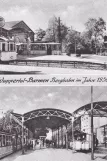
MLHF: 6. The Barmer Bergbahn - Historic Tram in Wuppertal (1894-1959)As early as 1887, Barmen entrepreneurs met to make plans for a railway for the southern heights of their town. The men showed great courage and foresight when they commissioned the first plans to build a railway from Barmen Mitte to the Toelleturm and a connecting line to Ronsdorf that same year. It was quickly recognized that an electric rack railway was the best option among all ideas. In May 1892, construction began on the 1,630-meter-long route, which featured a 170-meter elevation change. The route was closed on July 4, 1959, despite protests from residents.
Material that is over 50 years old takes you back to the time of narrow film and is an impressive reminder of this unique route in Barmen.
As early as 1887, entrepreneurs in Barmen gathered to plan a railway to the southern heights of their town. Men like Geheimrad Molineus and Adolf Vorwerk stood out with great courage and significant achievements when, in the same year, they commissioned the first plans to build a railway from Ben Mitte to the Tölleturm, along with a connecting line to Ronsdorf. It quickly became clear that, because of the steep gradient, an electric rack railway was the best solution. Siemens and Halzke introduced electric drive to the technically eager Barmen visionaries in 1890. This company was soon given the contract to build an electric, double-track, meter-gauge railway, following the Rhenish system. Construction began in May 1892 on the 1,630-meter-long line, and that same year, the Barmmer Bergbahn AG was founded. To reach the highest point in Barmen, the Tölleturm, a 170-meter elevation change had to be crossed. The route mostly followed a downhill path with an 18.5% gradient. The steepest part was right at the start of the route. After crossing the Bergischmark Railway, vehicles were transferred at the terminal stations using transfer platforms. The Bammer Bergbahn started operations on April 16, 1894. In the winter of 1958/59, the railway proved its ability to operate in ice and snow for the last time. The following summer, on July 4, 1959, Germany's oldest electric rack railway closed after 65 years of safe operation, despite many protests. The mountain railway's own power station was located in the vault beneath the mountain station on Kleferstrasse. The original steam dynamos, each with 250 hp, were soon replaced by larger machines. A sizable power station was built to supply energy to both the railway lines and nearby industries.By ML HISTORIC FILM (MLHF) - - .
3:04
Vintage tram in Wuppertal, Germany (1894-1987)On May 30, 1987, a tram ran through Wuppertal for the last time. With two different track gauges, including the first electrically operated rack railway in Germany, and routes to neighboring cities, the city had one of the largest tram networks in Germany. There was extensive freight traffic on the tram tracks, such as from Loh to Hatzfeld. The Barmer Bergbahn closed in July 1959, just a few months after its 65th anniversary. The meter-gauge network was shut down during the wave of closures in July 1970. The remaining standard-gauge lines were gradually closed from the 1970s onward.
In this film, take a look back at the good old days of the tram in the Wupper Valley and on routes to Remscheid and Solingen. Exciting footage of the Barmer Bergbahn in regular operation, the Remscheid tram, the Loh-Hatzfeld narrow-gauge railway, and the origins of the Bergisches Tram Museum take you back to the 1960s and 1970s.
The charm of this era is brought to life again in this modern historical documentary.
Wuppertal, located in North Rhine-Westphalia, had trams operating between 1960 and the 1970s. These vehicles came from various manufacturers, with some converted or built locally. The routes followed stunning scenic paths, crossing bridges, passing through city centers and countryside, and even crossing tunnels. The history of the railway is unique because it only achieved its final form in 1940, after several mergers of independent companies. This resulted in over 270 kilometers of routes with 24 lines in operation, running on both meter and standard gauges. In this film, you’ll see amazing shots from a bygone era when nearly all types of vehicles were in use. You'll also have the opportunity to marvel at Germany's first and oldest electrically operated rack railway. Travel back in time with this approximately 50-minute documentary.By tram-TV - - .