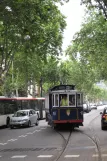
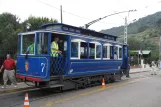
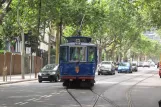
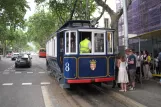
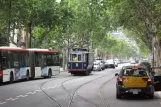
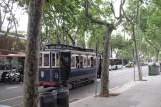
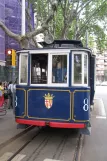
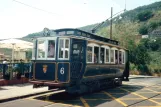
Barcelona Blue Tram (2010)Trams 6 and 7.
They are typical of the line. Built in 1904 by La Industrial Elèctrica, bidirectional, with power outlet via trolley and maximum speed of 13 km/h. It has 2 doors per side, one at each end of the vehicle, which are manually operated bars. The interior has several wooden benches, with a capacity for 32 people seated. These trams have always run along the Tibidabo avenue line. The trams have been reformed and modernized, with hydraulic brakes, optics and a touch screen that controls everything, as well as athermal glass and low-voltage interior lighting. These refurbished trams retain the original controls and engine. Externally they have been painted a lighter blue.
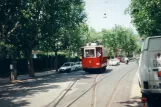
Tram number 129 (gardener).
It is used during the summer season. It comes from the old Barcelona tram network (closed in 1971) and was built in 1906 by the Can Girona workshops. It has no side windows. The interior has several wooden benches, with a capacity of 32 people seated. The planter was re-inaugurated in 1986 with the original red color, despite serving the Tramvia Blau.
-------
Number 6 and 7 trams.
They are the typical tramways for the line. They were built in 1904 by Industrial Elèctrica. They are bi-directional powered with a swing trolley with a maximum speed of 13km/hr. They have two doors on each side, at the ends of the vehicle, with manually opened metallic doors. Inside there are wooden benches with seating for 32 people. These tramways have always run this line in Avinguda Tibidabo. They were modernized and remodeled a few years ago to add hydraulic brakes, lights and a touch screen that runs everything as well as new insulated glass and interior low power lighting. They preserved the original interior controls and the engine. Outside they were painted a lighter blue.
Number 129 tramway ("jardinera" open carriage).
It's used during the summer months. It comes from the old tramway lines from Barcelona (closed in 1971) and was built in the year 1906 by the Can Girona factory. It doesn't have windows. The interior is furnished with wooden benches with a capacity for 32 seated people. The "jardinera" was reintroduced in 1986 with the red paint scheme original to it, although it serves the Tramvia Blau (blue tramway).By Francesc2000 - .
10:00
Tramvia Blau - Barcelona - n 2 (2009)After visiting Tibidabo Park, we take the funicular, then the Tramvia Blau, and finally the metro line 7, followed by the corresponding metro line 5 at Provence, getting off at Maregall. And there we are, San Pau. Then we return to the Gothic Quarter.
The amazing Magic Plane was built in 1935, although it dates back to 1928. The park, inaugurated in 1899, now covers 70,000 m² and features 30 rides. It is dominated by the Church of the Sacred Heart, built in a modernist style with neo-Gothic inspiration, started in 1886 and completed only in 1961. Bye, my friends. Bye. Bye. On the horizon, Montserrat with its famous Cremallera railway. Now let's return to sea level. Barsela, a city of 1,600,000 inhabitants—originally called Barcino and founded by Milka Reevarca, Hannibal's pope—at least, that's the legend. I hurried to the Perteghetta ritual, so dear to me. It's what we have—a transcendent experience. One is ascending, passing the sixth pope. The police, the Volvo, and another vehicle that was approaching—all this enraged me. I'm now sure that the city’s economy, along with the blue-liveried cars 67 and 7, and the red 129 we've already seen, is supported by the blue tram, which has four other vehicles in operation—all in blue and white livery: numbers 5, 8, and 10, dating back to 1904, and the original number 2 from 1901. 10 marks the year the blue tram L'Orissimo was inaugurated. We'll take metro line 7 to Plaza Catalunya, get off at the fourth stop, Provenza, then transfer to line 5 heading toward Orta. After seven stops, we’ll get off at Mareago. What's happening? In various chapters of my Catalonia 2009, I'll avoid those famous, well-known monuments—the Sagrada Familia, Casa Batlló, La Pedrera, and El Parguell—because they deserve their own videos. Instead, we will explore charming places like the Hospital de San Pablo, designed by the great architect Luis Domenetti Montaner, built between 1901 and 1930 in the Catalan Modernist style typical of Barcelona at that period. The gargoyles of the close-knit family peek out from the back. The hospital still operates today. Its origins date back to 1401. Modernism in architecture emerged in the early 1900s and developed uniquely in Barcelona, featuring new concepts and forms inspired by nature, breaking away from traditional standards. Innovative buildings expressed great freedom through floral stone decorations, multicolored stained glass windows, curvilinear balconies, and wrought-iron scrolls on the balustrades: architects like Anthony Gaudí, Luis Domenetti Montaner, and Joseph Puiki Cadafalk. In the evening, passing through Plaza de España, we see the magical fountain of Monjulik, with its colorful displays of lights, water motions, and music. We return to the hotel in the Gothic Quarter, overlooking La Rambla, and early the next morning, as the old city still sleeps beneath the sun, we look out at this spot that was once the center of the ancient Barracino, facing Plaza Rey C.By aloisius1950 - .
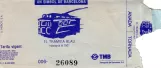
Adult ticket for Tramvía Blau (1997)Un Simbol de Barcelona.
El Tramvia Blau.
Inaugurat el 1901.
Tarifa vigent.
Inclusos IVA i AOV.
Presenteu-Io a peticio de qualsevol empleat Conserveu-Io fins al final del viatge.
TMB
Transports de Barcelona, S.A.
Anada. Tornada.
006- 26089By Henrik Boye, Tramvía Blau - .
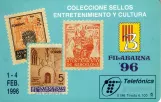
Calling card from Tramvía Blau, the back (1996)Coleccione sellos entretenimiento y cultura
Filabarna
'96
1 - 4
feb.
1996
Telefónica
B 16639879
0196 Tirada 6. 100 MBy Henrik Boye, Telefonica - - .
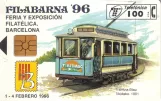
Calling card from Tramvía Blau, the front (1996)Filabarna '96 Tefónica 100 PTA
Freia and Philatelic Exhibition Barcelona
February 1-4, 1996
Tramvia Blau
Tibidabo. 1901By Henrik Boye, Telefonica - - .