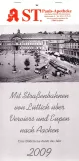
Calendar: ST. Pauls-Apotheke
(2009)ST. Pauls-Apotheke
Apotheker Reiner Bimmermann, Jakobstraß 9, 52064 Aachen
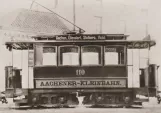
Mit Straßenbahnen von Lüttich über Verviers und Eupen nach Aachen.
Eine Bilderreise durch das Jahr 2009.
Zusammengestellt von Reiner Bimmermann.By Henrik Boye, ST. Pauls-Apotheke - .
8:35
7 Öcher Tram "Farewell trip" (1974)The video is about the last trip of the line, spoken 15 Brandt downtown on September 28, 1974, and the convoy from the depot to Oberstrasse Elisenbrunnen the following day, September 29, 1974. The song "Killing Me Softly" fits like chalk and cheese, as former politicians and the Aix-la-Chapelle traffic management let die the unloved child. Nothing is forgotten; all that was done is still present, especially in writing logs. Hard to believe, really difficult under such circumstances, that in today's Aachen (motto: we always do, we've always done it!) More from the new web is, as the euro grave "Tivoli". Adieu Transport
Hello colleagues, today's video is about the farewell journey—the last tram trip in Aren. I somehow feel a lump in my throat as one line ends after another. Gradually, everything was discontinued, and we got down to business. Nevertheless, I will quote from the platform issue 1274—the last journey in September 1974 at 11:52 p.m. Brand is sleeping in the darkness near a front door. An amateur photographer is freezing, with his camera tripod already set up. At 11:58 p.m., the tram arrives at its final stop. The doors hiss open, shoulders slap, people laugh and curse loudly, and many stay inside. Midnight has come; the time has arrived. Heinrich Burmann has been a driver for 34 years and starts the last tram on schedule. About 60 years ago, his father pedaled on the first journey to Brandach. Burmann feels uneasy. Colleagues surround him. A cassette recorder plays terribly distorted music in the background.
At 1:00, there's a rail blockade. A few hearty jokers sit on the tracks. At 1:05, a driver change occurs. From the nearby restaurant, the landlady sprays out lemonade. Everyone exchanges kisses before heading off. The new farewell driver is Josef Müllerjan, who has been a driver since 1953. At 1:15, a group of four people, accompanied by red earth, is gathered around three bottles. They get in. The regular passengers are slowly moving along. At 1:17, Josef J. is the last to take the wheel after 24 years. Albert Steinweg from Scheibenstraße is the previous passenger. Michael Nagel, a bright student from Lüdenscheid, is surprised. The tree-length toll is celebrated and welcomed. At 1:21, the place is gone, and autograph hunters swarm Josef J.
The Achner tram is history—that was the last trip on Route 15. The tram has no chance in Aren. The traffic experts, in quotation marks, were always opposed to it, and you should read Mr. Nebelung's report carefully. It clearly shows how, in plain English, the tram was allowed to die. Today, local politicians are advocating for the return of a tram. It's all very questionable and costs taxpayers a lot of money, just like the discontinuation of the tram. The next generation of politicians then changes direction again. The next film section shows the farewell trips—the farewell convoy through the city by tram.
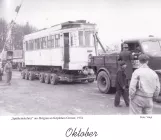
The tram had a long spring and summer reprieve, but when autumn came and nature prepared for winter, the tram said goodbye to Aren after 94 years of loyal service. On its last day of operation, September 28, 1944—a Saturday—from 2 p.m. until rush hour, all trams between Brand and Fahlz ran on this afternoon. The Asiak sent everything that could be driven on its last route. Besides the Gladbachers and those guiding the tram, they also traveled for the last time. The large-capacity Talw cars, 1001 to 101, marked the end of the good days for Asiak. On September 29, 1974, a farewell convoy was organized, announced as number 2574—farewell to the tram. The public showed strong sympathy for the removal of the last tram line by visiting our exhibition and workshops, as well as expressing keen interest in the tram convoy.
Both events proceeded smoothly thanks to the dedicated efforts of many of our employees. We thank the ladies and gentlemen involved, as they significantly improved the public image of our company. Honestly, it was mainly about getting things back on track. Everything was quiet, and operations could continue as usual with buses. Public transport was just as hampered, and after the change, it moved even more slowly than the tram. According to a report by Hernebelung and the Achner administration, no action was taken to improve the situation—in fact, quite the opposite. I think we must be very critical of today's calls for a new tram line after the campus line, because the true spirit and mindset haven't changed. The thinking remains just as narrow as the old 1-meter track. I hope this video has brought some joy to older viewers or those who still remember the train. There aren't many left. It has also prompted reflection and may influence some decisions about the campus train, as it’s essential to understand exactly what happened then and what politicians, and especially the Asiak, are saying today. Nonetheless, I wish only the best for the future and for the Asiak—it was nice to have met you.By Dieter Heindorf - .