TRAM TRAVELS

Photos by Niskopodłogowiec from Amsterdam

There are 1 tram and light rail photos by Niskopodłogowiec from Amsterdam (Netherlands) on Tram Travels.

Photos by Niskopodłogowiec worldwide

Select a country: Czech Republic, Hungary, Netherlands, and Poland.
Amsterdam Transport (2016)
13:04
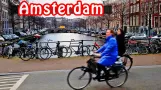
Amsterdam Transport (2016)In Amsterdam, there are more bikes than inhabitants. Behind me, you see, there are plenty of bicycles. This means we're in Amsterdam at the Intertraffic trade fair. We'll see what's interesting at this trade fair, and we'll also see how bicycle-friendly this city is. You might associate this city with a district where streetlights shine only red, not only with the characteristic sweet scent wafting through the air on many streets, but also with the fourth-largest port in Europe in terms of cargo volume. Or maybe it's finally about the dominance of bicycles over all other means of transport. Vehicles with a saddle are here in abundance. And the scale of the phenomenon is revealed by the numbers. As many as 32% of city trips are made by bicycle, 22% by car, and only 16% by public transport. It's estimated that there are around 880,000 bicycles in the city, which is even more than the city's population. And Amsterdam has slightly more than 800,000 of them. A bicycle here, a bicycle there, and sometimes it's even challenging to cross. Pedestrians have to watch their steps to avoid tripping over a bicycle that has fallen over in the wind. Sometimes, a bicycle parking lot is simply a piece of empty sidewalk, and in a more organized manner. There are parking lots on small barges or multi-story parking lots located at interchanges, but there are still not enough spaces. The authorities are even considering building an underwater parking lot near Central Station that would accommodate 7,000 bicycles. Of course, to ensure efficient mobility, there is a dense network of bike lanes and paths here, often completely independent of the road network. It might seem that with such a widespread presence of bicycles, stealing someone else's bike is unprofitable and makes no sense at all. However, the Amsterdam police estimate that between 50,000 and 80,000 bicycles are stolen annually, which is approximately 100% of all bicycles found in the city. They recommend marking your bikes specifically, but above all, effectively securing your bikes when parking so that only the wheel is left. It's important to remember, however, that it's illegal to attach bikes to lampposts, trees, urban furniture, or bridge railings. In such cases, illegally parked, damaged, or permanently abandoned bicycles are removed from the street. Bicycles parked undisturbed in the same spot for more than 6 weeks near the station are considered as such. Incorrectly parked bikes are removed immediately, but in most cases, they are marked with a label indicating the date after which they will be removed. Bikes taken from the street are transported to the Depot. Statistics show that fewer than half of their owners claim their bikes. Suppose the bike is not picked up within a specified time. In that case, it can be donated to social projects, organizations that sell bikes at a reduced rate to students, or even sent to developing countries or auctioned off to used bike sellers. As a last resort, if the technical condition of the bike is poor, it is scrapped. While the electric car market is still in its infancy in our country, the electric revolution has begun in full swing on Dutch streets. At the end of 2015, 90,000 hybrid vehicles that can be plugged in for charging or are fully electric were registered across the country, which still accounts for only 1% of the 8 million cars registered in this country. In the center of Amsterdam, you can easily spot these quiet cars on the road, and practically every street in the city center has special parking spaces for them with charging stations. There are over 1,200 publicly available 24-hour charging stations throughout the city. There are at least twice as many private stations daily. The electric bike market has such promising development prospects that the Dutch parliament is considering a law to ban the sale of cars from 2025. Public bikes are now becoming the standard in Polish cities. However, few consider public vehicles. Wrocław and Kraków are planning a system, and Warsaw has also been considering this idea. In Amsterdam, a Car2Go system is already in operation, utilizing 350 electric Smart cars. Find a free vehicle on the street, unlock it using an app or user card, and begin using it. You can also pre-order a vehicle up to 30 minutes before the rental start time. The service offers minute, hourly, or daily rates, allowing users to select the tariff based on the duration of their vehicle use. A minute of travel in such a car costs 31 euro cents. We no longer have to pay for parking in the available parking zone, although the biggest problem with cars in large cities remains. Finding a free space is the basis for economical car sharing; however, because we use our own vehicles for a minimal travel time, and for most of the day, the car sits idle, occupying the common city space. The highway network is densely lined with LED displays, some of which are variable message signs that control traffic. By Niskopodłogowiec - .
Last updated: .