TRAM TRAVELS
17

Wrocław tram line 17: Sępolno - Klecina

Operational

City: Wrocław (Poland).
Total route length: 12.8 km (8 miles).
Driving time: 44 min.

Track gauge: 1435 mm (standard gauge).

Lines in Wrocław

Select line type: Tram lines, extra lines, museum lines, and special event lines.

Tram lines in Wrocław

1Wrocław tram line 1
Operational

2Wrocław tram line 2: Biskupin - Krzyki
Operational

3Wrocław tram line 3: Leśnica - Księże Małe
Operational

4Wrocław tram line 4
Operational

5Wrocław tram line 5: Księże Małe - Grabiszyńska
Operational

6Wrocław tram line 6
Operational

7Wrocław tram line 7: Klecina - Poświętne
Operational

8Wrocław tram line 8: Karłowice - Uniwersytet Ekonomiczny
Operational

9Wrocław tram line 9: Sępolno - Park Południowy
Operational

10Wrocław tram line 10: Biskupin - Leśnica
Operational

11Wrocław tram line 11: Kromera - Oporów
Operational

12Wrocław tram line 12
Operational

13Wrocław tram line 13
Operational

14Wrocław tram line 14: Osobowice - Krzyki
Operational

15Wrocław tram line 15
Operational

16Wrocław tram line 16
Operational

17Wrocław tram line 17: Sępolno - Klecina
Operational

18Wrocław tram line 18
Operational

19Wrocław tram line 19
Operational

20Wrocław tram line 20: Leśnica - Oporów
Operational

21Wrocław tram line 21
Operational

22Wrocław tram line 22
Operational

23Wrocław tram line 23: Kowale - Wrocław Nowy Dwón (P+R)
Operational

Wrocław tram line 24
Operational

0LWrocław tram line 0L
Closed

31Wrocław tram line 31: Tarczyński Arena - Gaj
Closed

33Wrocław tram line 33: Pilczyce - Stadion Olimpijski
Closed

Wrocław tram line 0P
Closed

Wrocław tram line 32
Closed

Stops

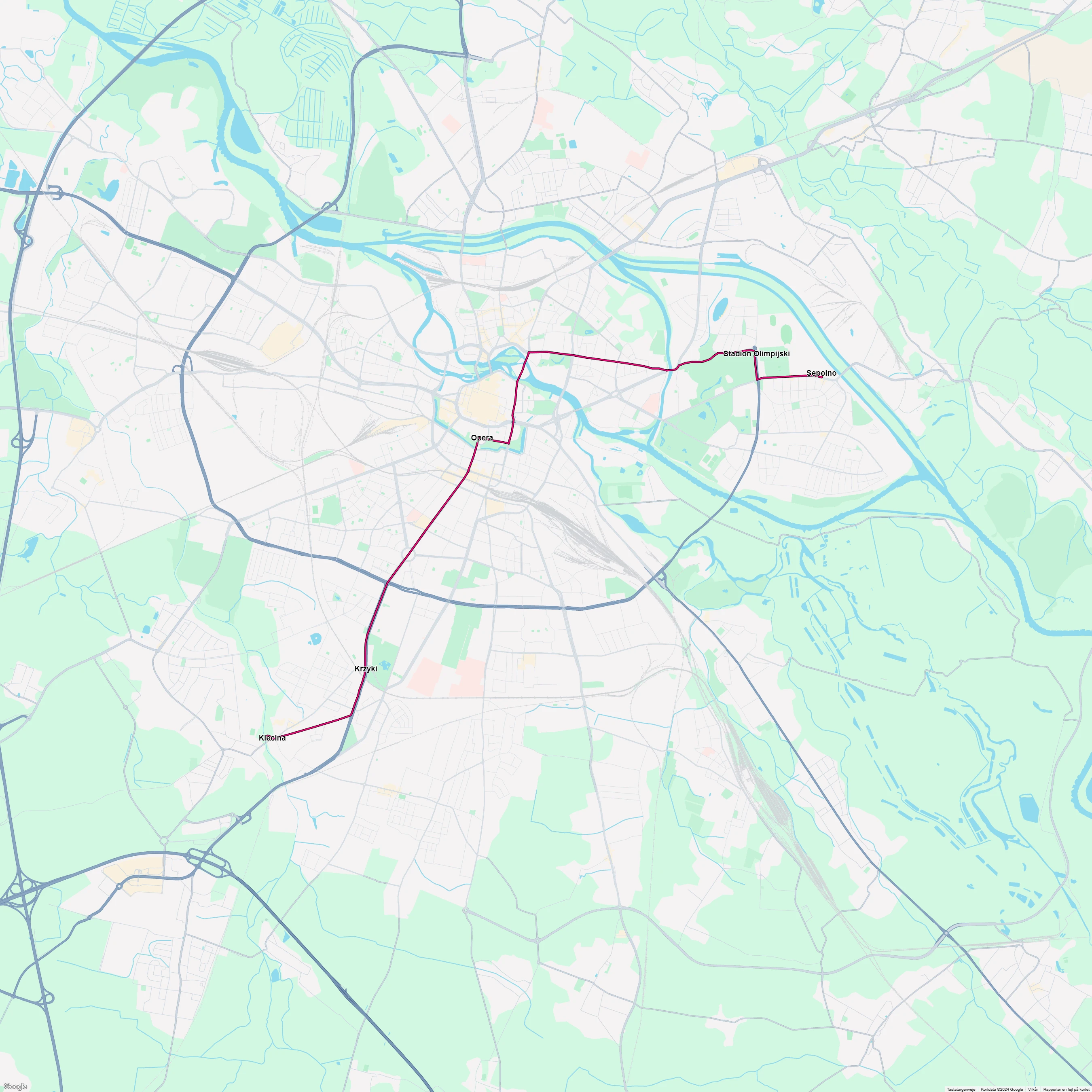
SępolnoKlecinaStadion OlimpijskiOperaKrzyki.

Wrocław tram line 17: Sępolno - Klecina route map

View the route map in high resolution.
Photos and videos of Wrocław tram line 17: Sępolno - Klecina

Wroclaw Tram (2016)
16:19
Wroclaw Tram (2016)We visit the fifth biggest tram network in Poland. What did the free tram market in Wrocław look like, and why hasn't it lasted to this day? Does adding plus mean better when it comes to trams? Why did the Wrocław tram manufacturer miss the chance for growth and eventually go bankrupt? These and many other questions about Wrocław Public Transport will be discussed. In this episode, I'll talk about the low-floor tram. I invite you to watch. We are in Wrocław, the fourth-largest city in Poland, with a population of nearly 640,000 residents today. The development of the capital of Lower Silesia began with the founding of a town on Ostrów Tumski, located on the Oder River. The city is crossed by four of its tributaries and water canals, forming the most extensive waterway system in Poland within an urban area. However, we will stay on land and focus on trams, which are the main form of public transportation in Wrocław. For nearly 140 years, residents of Wrocław have used trams. The first carriages were horse-drawn, but it was the electric tram that was introduced here—the first in Poland—in 1893, which was 123 years ago. In the early 20th century, track construction and tram operation were managed by multiple companies, including two independent from the city, leading to rapid but also chaotic and inconsistent development of the network. To address this, the city aimed to merge these companies into a single municipal entity, so that after reconstructing and connecting the tracks, a coherent tram network could be established. Ultimately, the last company was absorbed in 1931, ending Wrocław's free market for tram networks. Due to the operation of several tram companies over the years, at least 10 depots for this mode of transport were established in Wrocław. Today, only three serve regular tram traffic; one was merged with another, and another still operates on its original site, although it no longer handles trams. There are historic trams, but the other depots are no longer in use. One, depot number 7 on Grabiszyńska Street, was revitalized, and in September 2016, a history center was opened there. This depot, which offers insights into Wrocław’s history, features trams running on 84 km of tracks, making it the fifth-largest tram network in Poland. Its layout includes radially converging routes leading to two ring route systems around Śródmieście. Twenty-two lines serve Wrocław’s tram network. Trams run only during daytime hours and follow a very consistent schedule for most lines: every 12 minutes during peak hours, every 15 minutes outside of peak hours, and every 20 minutes on weekends. Only one line runs more frequently, every 6 minutes, during peak hours, as indicated by line number 33. An interesting feature is the circular lines Zer, L, and P, which detour left or right, respectively. Wrocław planned to create corridors of higher-quality service, including trams. New tracks were built, stop platforms were renovated, power substations were modernized, and low-floor, bidirectional trams were purchased. These trams served three lines numbered starting from 31. These are standard tram route elements. Additionally, a priority service for trains at intersections with traffic lights is operated as part of the ITS system. Did these measures actually enable high speeds? A timetable analysis quickly dispels those doubts. During peak hours, the average speed is about 20 km/h. They aren't fast trams, but can be considered accelerated. Ultimately, the plus designation was dropped, not surprisingly, since these routes, apart from using only low-floor trams, differ little in quality from other lines. I'm feeling things I can control, take hold inside my soul. The tram fleet totals 224 trams, including five Marek trams. Nearly 60% of the fleet is based on the Constal 105na design, the most popular high-floor tram in Poland. One tram is 100 meters long, and in Wrocław, all are combined into two-car trains. Most of these have been modernized by Wrocławski Protram. The Protram repair and modernization plant is located in the former N5 Popowice tram depot. Initially, it modernized the Constal 105 to the 105 NWR standard, which later evolved into producing its own 204 model, based on the 105 NWR. Its following product was a three-section 205 tram with a small bogie—22p—featuring a low-floor section along the entire length. A total of 116 modernized or new trams operate in Wrocław. Meanwhile, the plant also completed orders for other Polish cities, including Kraków, Poznań, and Szczecin.By Niskopodłogowiec - .
Trams in Wrocław, Poland, Part I (2014)
15:54
Trams in Wrocław, Poland, Part I (2014)This is the first episode of a series featuring the tram system of Wrocław in Poland. Wrocław is the 4th largest city of Poland. Its extensive tram network has a track length of 84km which is served by 20 lines, resulting in a total of 250km line length. It is quite dense. Around the downtown area, there are tram tracks almost everywhere, and they reach quite far into the outskirts on some lines. The majority of the fleet consists of Konstal 105Na vehicles and their modernized pendants Konstal Protram 105NWr. However, there are also some low floor vehicles, namely Protram WrAs 204 and 205, and also some newer Škoda 16T and 19T articulated trams. The first part of this series focuses on the downtown area. The film starts at Galeria Dominikańska, which is a quite busy intersection. We then head north toward Hala Targowa, where there are some nice bridges over the Odra river. The film then shows several scenes around Rynek (a quite busy station) and the single-track line that runs through the city centre, before we go to Plac Bema (another busy intersection). We then follow the tracks toward Plac Grunwaldzki (yet another busy intersection), where the first part concludes. Index to the film: 00:00 – Galeria Dominikańska 01:20 – Plac Nowy Targ 02:01 – Hala Targowa 02:36 – Most Piaskowy 03:43 – Most Pomorski 04:31 – Rynek 06:31 – Świdnicka 06:54 – Wita Stwosza 07:30 – Uniwersytecka 08:02 – Plac Bema 09:28 – Sienkiewicza 09:51 – Ogród Botaniczny 11:00 – Katedra 11:53 – Szczytnicka 12:21 – Plac GrunwaldzkiBy Luftschlange - .
Wrocław tram line 17 with railcar 2276 on Świętego Wincentego (2004)Wrocław tram line 17 with railcar 2276 on Świętego Wincentego (2004)By Henrik Boye.
.

Add a comment

Last updated: .