TRAM TRAVELS

Lima Museu de la Elctridad: Museo de la Electricidad - Museo de Osma

Operational

City: Lima (Peru).
Total route length: 0.6 km (0.4 miles).

Track gauge: 1435 mm (standard gauge).

Lines in Lima

Select line type: Tram lines, and museum lines.

Museum lines in Lima

Lima Museu de la Elctridad: Museo de la Electricidad - Museo de Osma
Operational

Stops

Museo de la ElectricidadMuseo de Osma.

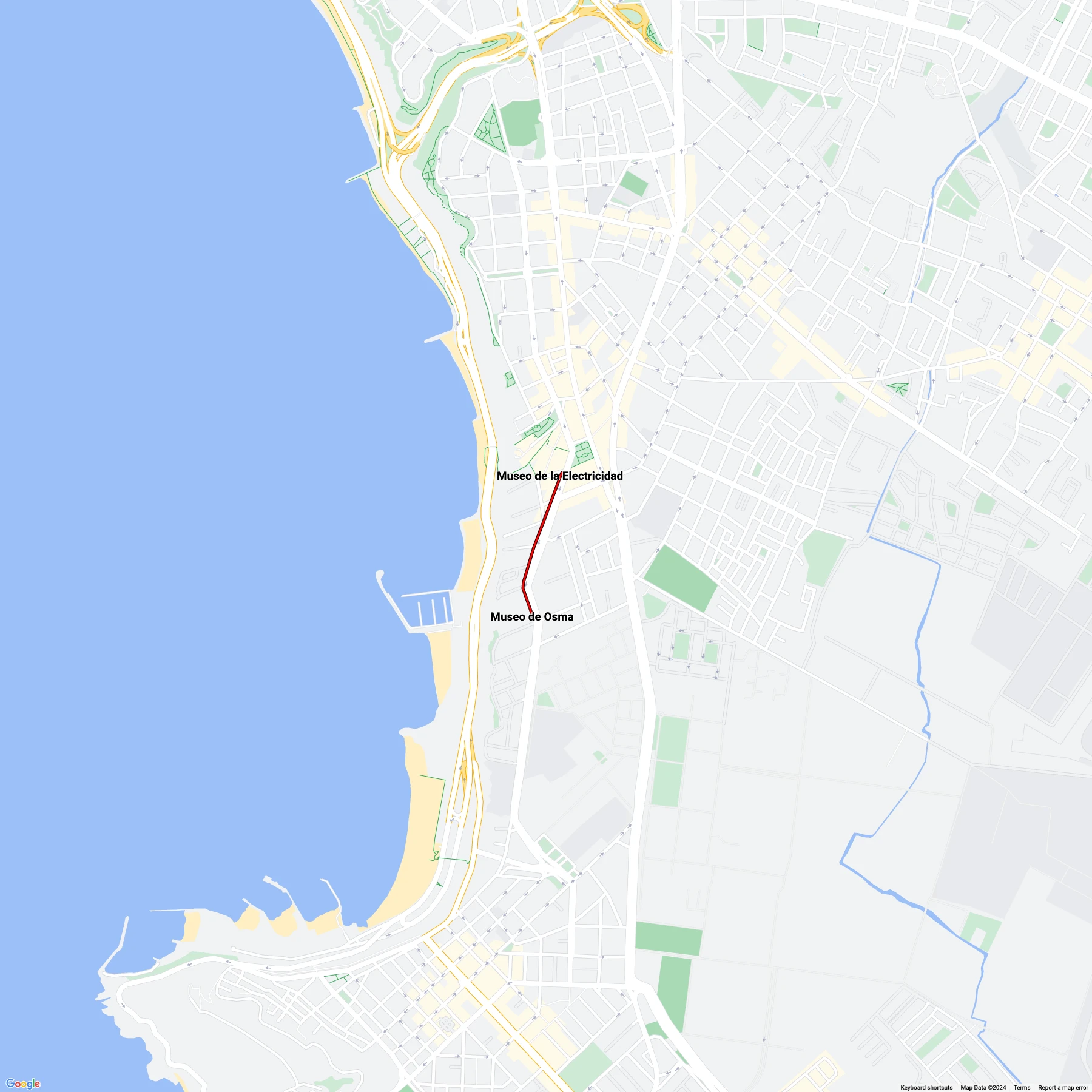
Lima Museu de la Elctridad: Museo de la Electricidad - Museo de Osma route map

View the route map in high resolution.
Photos and videos of Lima Museu de la Elctridad: Museo de la Electricidad - Museo de Osma
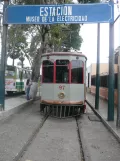
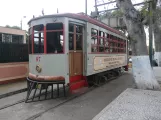
Lima Museu de la Elctridad with railcar 97 at Museo de la Electricidad (2013)Lima Museu de la Elctridad with railcar 97 at Museo de la Electricidad (2013)Station Museum of ElectricityBy Silas Boye Nissen - .
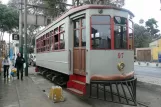
Lima Museu de la Elctridad with railcar 97 on Museo de la Electricidad (2013)Lima Museu de la Elctridad with railcar 97 on Museo de la Electricidad (2013)Electric Tram Rides Take a ride in the Tramway Tuesdays to Sundays from 9:00 a.m. to 5:00 p.m. 4776577By Silas Boye Nissen - .
Lima Museu de la Elctridad with railcar 97 on Museo de Osma (2013)Lima Museu de la Elctridad with railcar 97 on Museo de Osma (2013)By Silas Boye Nissen.
.
Open Door Museums: Lima Electricity Museum - Chapter 1 (2012)
13:20
Open Door Museums: Lima Electricity Museum - Chapter 1 (2012)Automation came quickly. Machines capable of carrying out tasks yesterday carried out by men today. That is modernity. They say the past was better all the time. What desert have we gone to? After this reflection, we are in the traditional district of Barranco, an evocative, romantic place that has for many years housed the bohemia of our city: painters, writers, artists, and many foreign visitors. It also has many tourist attractions. One of them, in addition to the Bridge of Sighs, is the Electricity Museum, located at Avenida Pedro de Osma 105, Barranco. Here, you will be able to learn about the generation, transmission, and distribution of electricity for Greater Lima, and you will also be able to acquire a lot of knowledge about what the Industrial Revolution has meant. Luis Repeto invites us to this interesting program in the New Era of Museums. Museums are changing. It is our present that is saved. The museum's doors are already open. The smoke of time will envelop us. Let's go to the museum. Let's go to the museum. Let's go to the museum. An attractive place, not only because it is a container for the history of technology in Peru and education for the whole family, but also because it is strategically located in a ravine on an avenue adorned with ficus trees and street lamps that keep an old tree of more than 100 years old in all the districts of Lima. Barranco is the one that captures emotion and beauty, visited for its historical and cultural tourist attractions, with only muddy memories of time, and it truly is a dream path in this place. Museum of Electricity from A4. Show the testimonies of the generation, transmission, and distribution of electrical energy, as well as the importance of Industrial heritage to the country's economic development. To talk about Industrial heritage is to revalue what objects, buildings, spaces, or manifestations of industrial laad represent in Elo de laad el electricity. The history of electricity in Lima dates back to 1886, when public lighting was inaugurated in the Plaza de Armas, the Girón de la Unión, and the Puente de Piedra. Currently, Lima is a city of Light. In the first room, the history of electricity is presented chronologically. This is the first room of the Museum of Electricity. Here, we can see how the electrical phenomenon is produced, as it is invisible, and I think this is one of the 10th century's greatest contributions. Electricity has always existed. Here, we have the origins of electricity, coming from Thales of Miletus, Benjamin Franklin, Alexander Volta, the battery, Miguel Faraday, and Tomás Alv. The focus of this journey is the evolution of lighting, from when man learned to make fire, the first years of the founding of Lima, until the 1st and 1st centuries 18, with the hachones, and in the middle of the 10th century, gas lighting emerged, especially for public lighting around the Plaza de Armas. In 1903, the construction of the first hydroelectric plant in the country began with the Santa Rosa plant in Chosca, so I think a visit is mandatory. This is also aimed especially at teachers, schoolchildren, technological institutes, universities, and the entire population. This is a social activity that Electro Perú fulfills. Here, we can find The Pioneers of electricity in Peru. There are great characters. The character is the wise Santiago Antunes de Mayolo. After this second room, we learned about the history of the electric tram. I have worked for 17 years as a driver and as a motorcyclist. The trip from Lima to Chorrillos, then I also worked on Ian de Lima's line from the center of Lima, from the Plaza de Armas to San Miguel. I also drove on the tram. The tram's past also left a trail of deaths. Until I wanted and I was lucky. During the 17 or 18 years that I drove, I didn't kill anyone. A lot of people died here. Some of them jumped onto the line; others, screaming because they wanted to ride the tram and get on, slipped, fell, went inside; I cut off their legs, two times, one of their legs, and at the end you know what the r is, what a Trans is, what it weighs, that's what you go with, don't be careful, don't fall in love with the belt.By TVPerú - .

Add a comment

Last updated: .