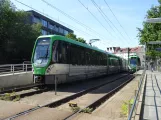
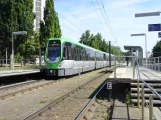
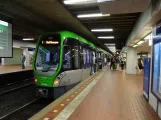
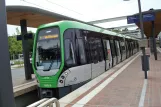
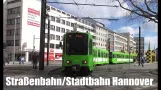
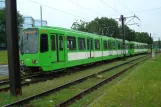
Tram/Light Rail in Hannover (2015)On April 4, 2015, the train departed for Hanover with a permit. Participants were:
RheinbahnFan 2.0 / rheinbahnfan
ThunderSchraeg / thunderschraeg
The TW2000, TW2500, TW3000, and TW6000 models are on display.By tramfreak2000 - .
[1/2] Trams in Hanover - a case study - ideal transport? (2012)Visit my blog http://filmykolejowe.pl/. Today, I'm taking you to Hannover, a city with a population of over 500,000. It has 12 tram lines and nearly 40 bus lines. It's also a city of bicycles. Yet, it boasts a level of public transportation that a town of similar size, Gdańsk, can only dream of. And it's not about the money but about the transfer options.
Hanover is not a large city, and contrary to what it says, it doesn't have a metro, but it does have a very efficient public transportation system based on fast trams. Here, we see the entrance to the underground tram station. Let's take a tram to the transfer hub located two stations above ground. To travel, we need to buy a ticket, so let's go to the ticket machine. This machine features a unique ticket-purchasing system. We can choose the language. Polish isn't available; surprisingly, Turkish is. Yes, we have many languages here. There's Russian, Turkish, and more. It's obvious why, but since we're poets, we'll manage. A single-zone ticket costs 230 EUR and is not very profitable, as we mentioned, because an all-day (24-hour) ticket costs only 4.50 EUR. This time, shopping went much better. She returned our ticket and change.
The ticket reads: 'Now we're heading to the viewing platform.' This tram, like the metro, is relatively shallow. The first interesting thing is that someone will appear at the bottom; those are stairs. Switch to the upward mode. Someone's coming. We'll see if it works as it should, in theory, for now. The stairs come from above. Now, the stairs have switched direction, meaning the escalators are now downward. A clever trick at less busy stops is to check the stairs themselves.
As you can see, compared to the Warsaw metro, these platforms are pretty small and not very spacious either. The metro and tram were built around 1975. From what I remember, according to the info board built into the central tram station, we'll see it later. Now, let's go above ground. The info boards about the next train are obvious—two units, the destination station. Usually, before the train arrives, info about the following three trains and departure times appears. We're at the last station of the underground metro, so we're just heading to the surface. Welcome to the surface. Let's look at this tram route. The first thing that catches your eye is the very high platforms, which means most stations have level floors. Our tram is here; as you can see, the platform is enormous, but there are ramps, so no problem. The tracks continue toward the districts. These aren't suburbs, but areas where running tracks off the road aren't possible. I'll show you something that highlights its simplicity. Let's go to the other bus stop. Buses traveling from that side run along this street, bypassing this tram island, and approach the stop on a slight slope. You can see that some drivers are also having trouble. Thanks to this design, we get excellent transfers because bus passengers can board directly onto the tram platform. The next tram here is also an older model. As you can see, the doors are very high, and there are other differences.
Below are the steps that open when the tram shares platforms with buses. I'm trying to show you such a platform and how these steps operate, but on high platforms, the floor is even. How long did the tram stand? Getting off? Getting on is easier. No one was threatening. Trams only stop briefly at designated stops. You'll see in some videos the speeds in the tunnel; around 60 km/h, similar to the maximum speed of the Warsaw metro until recently. Here, we have dedicated solutions, such as trams running at these speeds. Here's the timetable for this bus line.
As you can see, it runs every 10 minutes. It's a pretty good service, along with the peak line 133. This provides a perfect frequency. Buses probably run every 8-9 minutes. Here's a map of the entire bus and tram network. The white area in the middle is the first zone. We're practically on its border, right there, and we'll go to the other end near the stadium. We'll see from the window what it looks like where the underground exits. The trams run fast, and thanks to the innovative solution at the central station, there are information boards at all tram stops showing the next departures. Unlike Warsaw, this system works much better. It just works. In one minute, there’s a tram; soon, we'll see the TR line 379 operating here. Looking at the map again, or better yet, the tram line map, you’ll see that line 369 is 3. They start at different points but intersect and support each other throughout the section. So, we're practically on the border of the zone now, and on the other side too. These three lines complement each other along this entire stretch, then branch again into two different loops at the other end.By KolejTakPkpNie - .
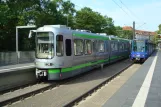
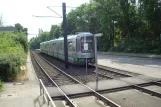
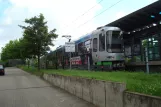
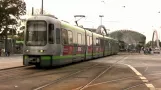
Stadtbahn Hannover - Vehicles (2007)During a visit to Hanover in 2007, these pictures were taken at a few selected locations on the above-ground rail network. My main aim at the time was to capture the various vehicle types, TW 6000, 2000, and 2500. I also managed to capture some beautiful full-length advertisements on camera.By Horst Honig (Horst Honigs Bahnvideos) - .
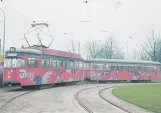
Postcard: Hannover tram line 7 with railcar 404 at Oberricklingen (1971)Hanoverian Interest Group for Local Public Transport
No. 11 - "Eedmann Okay-Shop"
Wide-body railcar 404 (built in 1956, DÜWAG) with trailer 1402 (built in 1970, ex 2002, built in 1957, DÜWAG) at the former Oberricklingen terminus on Line 7.
April 8, 1971By Dieter Höltge, Hannoversche Interessengemeinschaft für öffentlichen Personennahverkehr, Henrik Boye - .