TRAM TRAVELS
2

Budapest tram line 2: Jászai Mari tér - Közvágóhíd H

Operational

City: Budapest (Hungary).
Total route length: 6.1 km (3.8 miles).
Driving time: 17 min.

Track gauge: 1435 mm (standard gauge).
Opened: .
Closed: .
Reopened: .

Lines in Budapest

Select line type: Tram lines, extra lines, fast lines, museum lines, night lines, and special event lines.

Tram lines in Budapest

1Budapest tram line 1: Bécsi útca/Vörösvári útca - Kelenföld vasútállomás M
Operational

2Budapest tram line 2: Jászai Mari tér - Közvágóhíd H
Operational

3Budapest tram line 3: Mexikói úttal - Gubacsi úttal/Határ úttal
Operational

4Budapest tram line 4: Széll Kálmán tér - Újbuda-központ
Operational

6Budapest tram line 6: Széll Kálmán tér - Móricz Zsigmond körtér
Operational

12Budapest tram line 12
Operational

14Budapest tram line 14: Lehel tér M - Káposztásmegyer, Megyeri útca
Operational

17Budapest tram line 17: Bécsi útca/Vörösvári útca - Savoya Park
Operational

19Budapest tram line 19: Bécsi útca/Vörösvári útca - Kelenföld vasútállomás M
Operational

23Budapest tram line 23
Operational

24Budapest tram line 24
Operational

28Budapest tram line 28: Blaha Lujza tér M - Izraelita temető
Operational

37Budapest tram line 37
Operational

41Budapest tram line 41: Bécsi útca/Vörösvári útca - Kamaraerdei Ifjúsági Park
Operational

42Budapest tram line 42: Határ útca - Kispest, Tulipán utca
Operational

47Budapest tram line 47: Deák Ferenc tér - Városház tér
Operational

48Budapest tram line 48
Operational

49Budapest tram line 49: Kelenföld vasútállomás M - Deák Ferenc tér
Operational

50Budapest tram line 50
Operational

51Budapest tram line 51
Operational

52Budapest tram line 52: Határ útca - Pesterzsébet, Pacsirtatelep
Operational

56Budapest tram line 56: Városház tér - Hűvösvölgy
Operational

59Budapest tram line 59: Szent János Kórház - Márton Áron tér
Operational

59BBudapest tram line 59B
Operational

60Budapest tram line 60
Operational

61Budapest tram line 61: Móricz Zsigmond körtér - Hűvösvölgy
Operational

62Budapest tram line 62: Rákospalota, MÁV-telep - Blaha Lujza tér M
Operational

69Budapest tram line 69: Mexikói úttal - Újpalota, Erdőkerülő utca
Operational

8Budapest tram line 8: István tér - Megyeri útca
Closed

18Budapest tram line 18: Széll Kálmán tér - Savoya Park
Closed

33Budapest tram line 33: Bécsi útca/Vörösvári útca - Nyugati Ter
Closed

44Budapest tram line 44: Zugló - Keleti pu
Closed

55Budapest tram line 55: Árpád híd vá. - Rákospalota, Kossuth utca
Closed

Budapest tram line 5
Closed

Budapest tram line 7
Closed

Budapest tram line 9
Closed

Budapest tram line 9A
Closed

Budapest tram line 10
Closed

Budapest tram line 11
Closed

Budapest tram line 13
Closed

Budapest tram line 15
Closed

Budapest tram line 15A
Closed

Budapest tram line 16
Closed

Budapest tram line 20
Closed

Budapest tram line 20A
Closed

Budapest tram line 21
Closed

Budapest tram line 22
Closed

Budapest tram line 23A
Closed

Budapest tram line 25
Closed

Budapest tram line 26
Closed

Budapest tram line 26A
Closed

Budapest tram line 27
Closed

Budapest tram line 29
Closed

Budapest tram line 30
Closed

Budapest tram line 31
Closed

Budapest tram line 32
Closed

Budapest tram line 34
Closed

Budapest tram line 35
Closed

Budapest tram line 36
Closed

Budapest tram line 38
Closed

Budapest tram line 39
Closed

Budapest tram line 40
Closed

Budapest tram line 43
Closed

Budapest tram line 45
Closed

Budapest tram line 46
Closed

Budapest tram line 47B
Closed

Budapest tram line 53
Closed

Budapest tram line 54
Closed

Budapest tram line 57
Closed

Budapest tram line 58
Closed

Budapest tram line 63
Closed

Budapest tram line 64
Closed

Budapest tram line 66
Closed

Budapest tram line 67
Closed

Budapest tram line 75
Closed

Budapest tram line 81
Closed

Stops

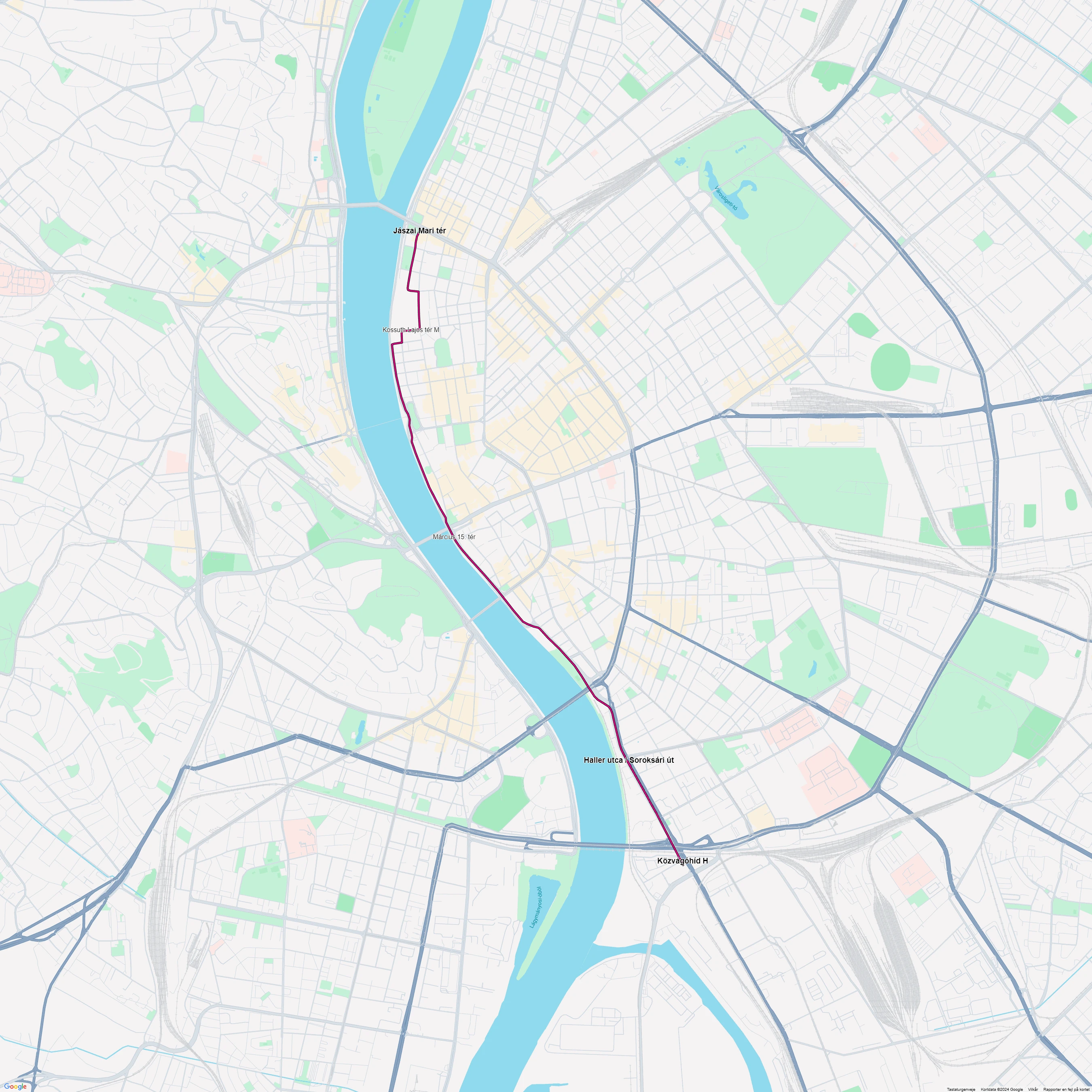
Jászai Mari térKözvágóhíd HMárcius 15. térKossuth Lajos tér MHaller útca/Soroksári útcaFővám tér M.

Budapest tram line 2: Jászai Mari tér - Közvágóhíd H route map

View the route map in high resolution.

Photos and videos of Budapest tram line 2: Jászai Mari tér - Közvágóhíd H
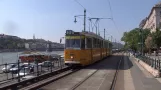
World's Longest Trams in Budapest (2017)
19:52
World's Longest Trams in Budapest (2017)In Budapest, there are the world's longest trams. How long are they? In the video: 4:40 Ganz CSMG / KCSV-7 6:58 Düwag / LHB TW6000 8:50 Siemens Combino Supra 12:00 ČKKD Tatra T5C5 14:35 CAF Urbos 3 14:50 World's Longest Tram Welcome to Budapest. In this episode, we'll explore the tram network in this large city. I invite you to watch. So far, we haven't shared much about the city itself. As you know, Budapest is the capital of Hungary. About one in six residents of the country live there, totaling around 1.76 million people. This is quite similar to the population of Warsaw. Both cities have been competing in recent years in this regard. Historically, Budapest was founded in the 19th century through the merger of three cities: Buda and Obuda on the right bank of the Danube, and Pest on the left. One part of the city lies on the plain, while the other is on the hills, adding to its diversity. The Pöivo, which connected Budapest, also had a tram service in Buda and Pest, launched several years before the merger. Trams have been in use here for over 150 years. This event happened in 1866, the same year, but a few months earlier than in Warsaw. The network is about 150 km long. It’s a few kilometers longer than Prague's, but much shorter than Berlin's. Trams serve most of the city, covering 19 of the 23 districts. The NER 60 rack-and-pinion railway is also part of the network; however, I will show you which one in a separate section. The network features distinctive half-ring tram routes that encircle the city. In Budapest, bidirectional trams are standard. The entire city relies on vehicles with two driver's cabs and doors on both sides of the train. Other types are not used here. Using unidirectional vehicles would be nearly impossible because most tram terminuses end in cul-de-sacs and crossings where the tracks change direction. Crossings, also known as billboards, are strategically placed throughout the tram network to minimize disruptions to car traffic. Interestingly, when parking at the end of the line is full, additional platforms are used, located before the actual end of the line. We'll start our overview of the rolling stock and lines with tram number 2. This route is considered one of the most scenic in Europe from a tourist perspective, thanks to its ride along the Danube River and its proximity to the Hungarian Parliament Building. From the deck of a classic Ganz tram, we enjoy views of Budapest's bridges, buildings, and the hills on the Buda side. For most of the day, the two-car lines run every five minutes, and during rush hours, they're even more frequent, with departures every two to three minutes. Ganz trams were built in the 1960s and 1970s, with some rebuilt in the 1990s. This tram has three sections and a high-floor design. These trams are iconic in Budapest and are often seen speeding along the Danube embankments and the Liberty Bridge. They are 26 meters long. No. M2. The district of high-rise buildings, located away from downtown, can be seen from the window of tram number 69. This line typically acts as a feeder, providing the direct route to the first metro line. It is also the only rail line reaching Újpálotá, although other parts of the city are usually reached by bus. To keep its aging fleet running, the operator is buying used trams that were taken out of service in Hanover. German Marek Duwak and LHB trams are designed to serve both high and low platforms. In Budapest, only low platforms are available, so to serve these stops, automatically unfolding steps are installed in all tram doors. These trams are 28 meters long. One of the busiest routes is the half-ring formed by lines 4 and 6. They run along a stretch called the Grand Boulevard, which forms Budapest's downtown ring. Small barriers are placed along the route to prevent cars from entering the tracks. An interesting stop along this route is Margaret Bridge, with a stop in its center—lines 4 and 6 run every two minutes on their shared section during peak hours. Line 6 is also the only tram operating 24 hours a day. Lines 4 and 6 are operated entirely with Zemens Combino trams. These are very long, measuring 54 meters in length. They consist of six cars, each with eight doors on each side. These were Budapest’s first all low-floor trams. The city has a total of 40 of these, each capable of carrying up to 350 passengers. This change affects Budapest's second tram route, which includes Line 1. The dedicated track is in the middle of the two carriageways of the road, which mostly has three lanes on each side. The route crosses the Danube twice, covering a distance of over 16 km in 47 minutes. The track used by line 1 is not shared with other lines on any section.By Niskopodłogowiec - .
Getting around Budapest by public transport (2017)
10:32
Getting around Budapest by public transport (2017)What do you need to know about public transport in Budapest? You're arriving in Budapest by train or bus and wondering how to get around the city's complex transportation system. I'll try to help you a little. The distance from the airport to the center of Budapest is roughly 20 km. During the day, you can reach the city by express bus 200E with a transfer to metro line 3, and at night by bus 900 with a transfer to bus 950. The airport stop is located in the middle of the walkway between Terminals 2A and 2 B. During daylight hours, you won't have to wait long for a bus. Buses run every 7.5 minutes, and the metro runs every few minutes. But at night, it's a different story because you might wait up to an hour at the airport. The trip to the center will take about 40 to 50 minutes. Arriving in Budapest by train puts you almost in the city center. Each of the major stations acts as a transfer hub, including the metro station. Budapest has three main stations: the Eastern Railway Station, the Western Railway Station, and the Southern Railway Station. If you're coming from Poland, you'll arrive at Keleti Station, approximately 2 km from the city center. Coach companies from Poland usually stop at metro stations that are a bit further from the center, but this still offers the fastest and most frequent connection to Budapest. There used to be a Lu Express, but now Polski Bus operates, stopping at the KEN station. Remember, you'll need a ticket to use public transportation. Ideally, your stay should be based on a network ticket. Daily tickets, available for three or seven days, are valid across the city. You can also purchase a Budapest Card, which, in addition to offering free public transportation, provides complimentary access to select museums and thermal pools, as well as discounts at other locations. Tickets are easiest to purchase at station vending machines, which accept both cash and cards. These machines offer menus in several languages, but Polish is not one of them. Another option is the BKK passenger service points. When purchasing a short-term ticket, you are required to provide a document that verifies your identity. In the metro, ticket inspectors check the validity of your ticket at the machines. On some bus lines, passengers must enter through the front door and show their ticket to the driver if needed. This rule is in force on those lines. Information about this can be found in the timetable. A relevant message will also be displayed on the vehicle's front panel. Mobile inspectors can also board the cars, and they can be recognized by the purple armbands they wear during inspections. The city's transportation organizer is Budapesti Közlekedési Központ, commonly referred to as BKK. As a public transportation rider, you have access to a vast transit network, which includes: metro lines (C), 5 HIV suburban railway lines, 34 tram lines, 15 trolleybus lines, ferry routes, and over 200 bus lines. At the passenger service point, it’s worth downloading a mini-map that covers the main connections in the central part of the city. Please note that tickets are valid within Budapest's administrative boundaries. For example, if you plan to travel on the HI railway section that extends outside the city, you'll need to buy an additional ticket in advance to continue your journey. Most modes of transport have specific colors. For example, we ride blue or steel-navy buses. Watch out for yellow yokes representing our PKS (Public Transport Authority) lines, red trolleybuses, yellow trams, and white and green HIV railway cars. In the metro, trains on two lines are color-coded, while the other two have white vehicles; however, this distinction isn't always crucial in the metro. New cars are labeled with the word "Budapest" and the BKK logo for easy recognition. The timetable often shows departure intervals, such as every 5 minutes. In Hungarian, this is "perc" (derived from "Perc"), which forms the basis of Budapest's Public Transportation System. What does this mean for you? At any given time, public transportation runs frequently, so the maximum wait time for a vehicle is roughly the same. Of course, unforeseen events can occur, but you can rely on the most regular departures from the HIA metro or trams, and the least from buses or trolleybuses, especially those sharing lanes with cars in the city center. Usually, you'll find intervals where lines run at least every 10 minutes. Public transport is organized into corridors with high-frequency lines; these lines cross Budapest Srednicowa or transfer hubs. For longer trips, you may need to transfer, which is a common occurrence. City residents are used to making two or three transfers during their journeys.By Niskopodłogowiec - .
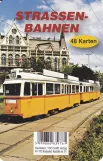
Playing card: Budapest tram line 2 with railcar 3868 (2014)Playing card: Budapest tram line 2 with railcar 3868 (2014)Trams 48 cards Manufacturer: TOP CARD Verlag H-1173 Budapest, Kaszáló str. 31.By Henrik Boye, Top Card Kiadó - .
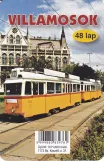
Playing card: Budapest tram line 2 with railcar 3868 at Kossuth Lajos tér M (2014)Playing card: Budapest tram line 2 with railcar 3868 at Kossuth Lajos tér M (2014)Trams 48 sheets 5 999880 839761 Manufacturer: Top Card Publisher 1173 Bp. Kaszáló u. 31By Henrik Boye, Top Card Kiadó - .
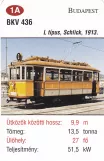
Playing card: Budapest tram line 2 with railcar 436 on Jane Haining rakpart (2014)Playing card: Budapest tram line 2 with railcar 436 on Jane Haining rakpart (2014)1A BUDAPEST BKV 436 Type L, Schlick 1913. Length between buffers: 9.9 m Weight: 13.5 tons Seats: 27 people Power: 51.5 kWBy Henrik Boye, Top Card Kiadó - .
Budapest tram (2013)
27:41
Budapest tram (2013)The Budapest tram has a route network of 155 kilometers and is operated by the Budapest Transport Company, BKV Zrt. It runs at a voltage of 600V, and the track width is 1435mm (standard gauge). The route network consists of 24 lines, with seven additional lines. In 2011, 393 million passengers used the tram to travel through Budapest. The following types are currently in operation: - CSM6 (1967-1978). - T5C5 (1980-1984). - TW6000 (1974-1993), taken over from Hanover in 2002. - Comino (2006-2007). Particularly in urban areas, the persistent service, sometimes available every 3 minutes, is remarkable.By Strassenbahnfreak - .
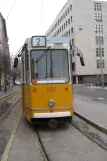
Budapest tram line 2 with articulated tram 1352 at Jászai Mari tér (2013)Budapest tram line 2 with articulated tram 1352 at Jászai Mari tér (2013)By Michael Olsen.
.
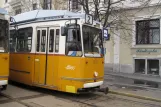
Budapest tram line 2 with articulated tram 1370 at Jászai Mari tér (2013)Budapest tram line 2 with articulated tram 1370 at Jászai Mari tér (2013)By Michael Olsen.
.
Budapest tram: The eight-axle articulated trams from Ganz (2010)
10:35
Budapest tram: The eight-axle articulated trams from Ganz (2010)The eight-axle full railcars were delivered in 1967-1971(1301-1370) and 1972-1978(1400-1481), a total of 151 units. The vehicles can also run in double traction, a feature previously used on Line 4. There are now very few fully double trains running on the line, as the Combinos have almost completely taken over this route. A picture of a double traction can also be seen in the video. In 1997, 30 examples were modernized by Ansaldo, incorporating chopper control and other minor adjustments, such as door openers. From the outside, you can recognize them primarily by the single-arm pantograph. Some non-modernized examples have also received minor adjustments, such as door openers or door closing warning lights. Three examples of this type are now used as driving school vehicles. These eight-axle articulated trams were built between 1967 and 1971 (1301-1370) and 1972 and 1978 (1400-1481). They can also be used in double traction, such as on the highly frequented Line 4. However, today, there are only a few double tractions left because the Combinos have taken over this line. Thirty trams were modernized in 1997 by Ansaldo. They have a chopper steering, a single-arm pantograph (which can be easily distinguished from non-modernized ones due to this feature), and door openers. Some of the non-modernized trams also got door openers and a door closing warning lamp. Data/data: Name: CSMG.2. Length: 26.9 m. Weight: 33600 kg. Axle load: 7560 kg. Vmax: 60 km/h. Engines/motors: 4x66 kW. Capacity: 32 seats and 171 standing places.By Klingl3r - .
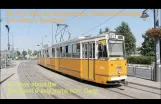
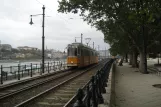
Budapest tram line 2 with articulated tram 1315 on Jane Haining rakpart (2006)Budapest tram line 2 with articulated tram 1315 on Jane Haining rakpart (2006)By Michael Olsen.
.
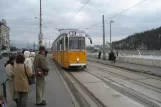
Budapest tram line 2 with articulated tram 1343 at Március 15. tér (2006)Budapest tram line 2 with articulated tram 1343 at Március 15. tér (2006)By Michael Olsen.
.
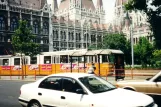
Budapest tram line 2 at Kossuth Lajos tér M (1994)Budapest tram line 2 at Kossuth Lajos tér M (1994)By Henrik Boye.
.
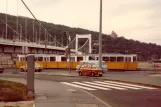
Budapest tram line 2  on Jane Haining rakpart (1983)Budapest tram line 2 on Jane Haining rakpart (1983)By Henrik Boye.
.

Add a comment

Last updated: .