The History of Montreal Tramways (2023)
AddedYouTube name: Propos Montréal.
Date: .
City: Montreal (Canada).
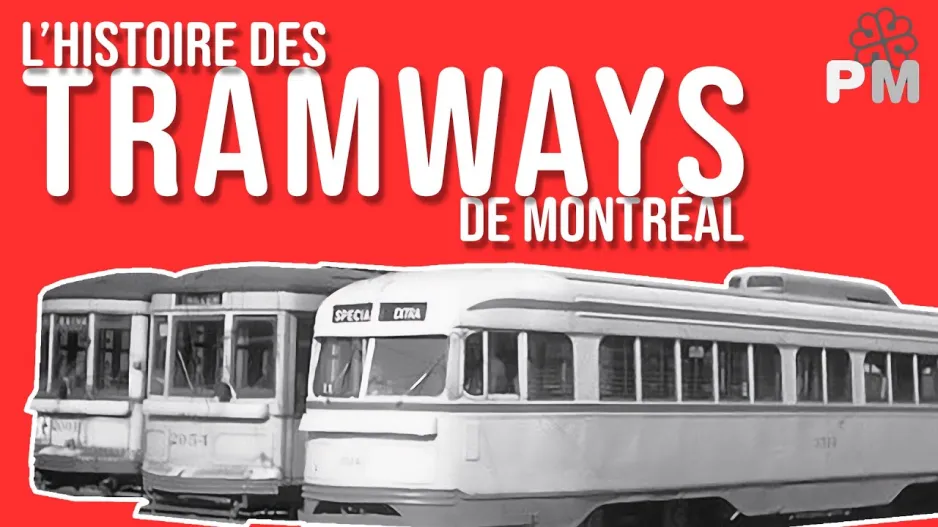
Montreal Tramways Company (MTC)
Closed
The tramway in Montreal had a distinguished history that, like so many others, ended in the 1950s. But today, are only memories left? Do we ever have the chance to see the tracks running on Montreal streets again?
Chapters:
0:00 - Intro
1:09 - Horse-drawn Carriages
2:49 - The Electrification of Public Transit
3:51 - Commuter Trains
4:37 - Dominion Park
5:34 - The Golden Age of the Streetcar
8:33 - The Monopoly of the Montreal Tramways Co.
10:56 - The Bus and the Car
13:39 - The Beginning of the End
15:28 - The End of an Era
Around 1900, Montreal’s streetcar companies competed for passengers. In 1905, Suburban Tramways and Power, a subsidiary of the Montreal Street Railway (MSR), opened Dominion Park beside the St. Lawrence River. Inspired by Coney Island, the amusement park featured roller coasters and large picnic grounds. Its aim was to attract visitors and encourage them to travel on the company’s streetcars.
Streetcars reached their golden age. The MSR absorbed Montreal Park and Island in 1901 and its rival, Terminal Railway, in 1906. By 1907, it controlled nearly all public transport in Montreal. Ridership rose from 17 million in 1893 to almost 144 million in 1910. The network had 225 kilometers of track and 600 cars.
The era also brought innovations. In 1905, car 890, built in Hochelaga, introduced the Pay-As-You-Enter (P.A.Y.E.) system. Passengers paid the conductor as they boarded. This sped up boarding and made fares easier to collect, especially at rush hour. Other cities soon adopted the system. That same year, the MSR introduced golden sightseeing cars, inspired by the 1904 St. Louis World’s Fair. For 25 cents, visitors could tour Montreal without leaving the car. All four cars have since been preserved in museums in Canada and the United States.
The rise of the automobile and growing complaints about service challenged the company. In 1911, the Montreal Tramways Company (MTC) was formed by merging the island’s urban transit operators. Its agreement with the city required improvements to tracks, cars, and service. The large D’Youville workshops were built, new streetcars entered service, and the MTC began operating buses in 1919. Trolleybuses were tested but never became a major part of the network.
Growth in the 1920s gave way to the Great Depression and World War II. Falling ridership hurt finances, while wartime restrictions forced the MTC to conserve fuel and equipment. New PCC streetcars did not arrive until 1944. After the war, car ownership grew, and the city decided to take over transit. In 1951, Montreal bought the MTC for $52,820,941.61 and created the Commission de transport de Montréal, predecessor of today’s STM.
Buses quickly replaced streetcars. The change began in 1956 and ended on August 30, 1959, when routes 45 Papineau and 54 Rosemont became the last in service. More than 200,000 people gathered to mark the end. Tracks were removed or paved over, and overhead wires disappeared. In 1966, Montreal opened a new electric urban railway: the Metro.
Today, streetcars are returning in many cities as a modern, low-emission way to travel. Was Montreal wrong to remove its entire network? Share your view, like the video, and subscribe. Sources are listed in the description. This video was also guided by Jacques Pharand’s book La Belle époque des tramways (Éditions de l’Homme). I’m still Martin Bérubé. See you in the next archival story.