The Belgian City That Built A Metro Line And Never Opened It (2022)
YouTube name: The Tim Traveller.
Date: .
City: Charleroi (Belgium).
Transport En Commun en Wallonie (TEC)
Operational
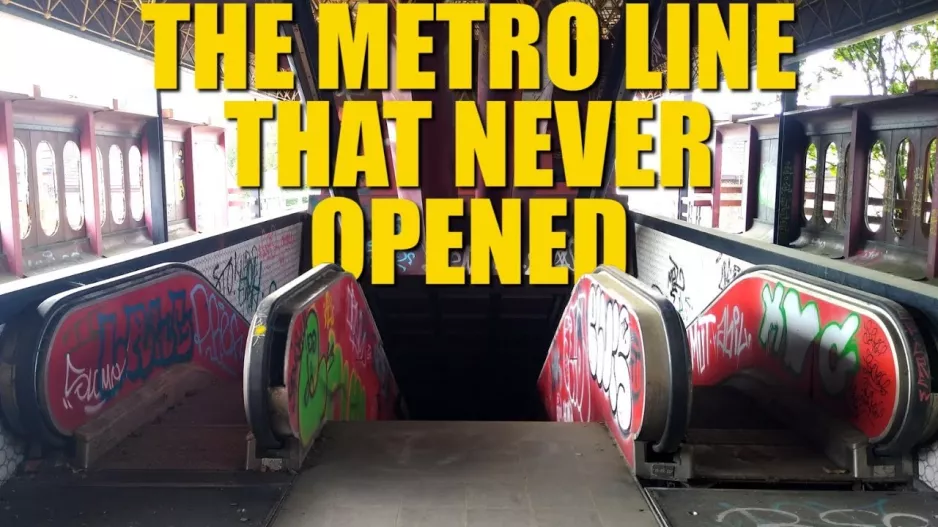
In the mid-1980s, the city of Charleroi started building a metro line. However, with half the stations already completed and the track and signals already in place, construction suddenly came to a halt. The line never opened. What happened? And how much of it is still there? I travelled to the south.
It is spring 2022, and I am in the historic coal-mining city of Shalawa, in Belgium's former industrial heartland. Today, we're exploring the Shalawa metro, which is arguably more of a tram than a metro, yet it boasts its own bridges and tunnels nonetheless. But anyway, why are we here? According to Wikipedia, the Shalawa metro is famous for sections of the system that were never built, only partially built, or never opened. What’s the story there? Because if you catch line 4 from the center of town and look out the window at the right moment, you'll see some mysterious tracks branching off and heading into the distance, but they don't appear on the map, and trains never seem to go down there. So where do those tracks go, and what would we find if we got off the metro and tried to follow them? This is the metro line that never opened. Today, we're exploring the lost Line 5 of the Shalawa metro. Although it was actually the third one to be built, that's not important at the moment. Our first mission is to locate precisely where the tracks emerge above ground, and fortunately, that's not too difficult. They emerge into the daylight at the back end of a small park on the edge of the city center. In one direction, the tracks head back into the tunnel where we were just now, but we will follow them in the other direction to see what we can find. This is the Novel station, constructed in 1987 and never opened. Apparently, behind here are still escalators leading up to a ticket office and platforms, but the entrance is blocked, so we can't go in. We’re not going to waste any more time here because it’s clear this is not the end of the line. If there are more stations, I want to visit all of them. Stations on the Shalawa metro are often only a few hundred meters apart, and sure enough, it's not long before we find another one. This is the Shi station, or possibly Shet. I really should have asked the locals how they pronounce it. Just like Novel, it was built in 1987 with a pretty much identical design and, of course, never opened. But unlike Novel, I was able to walk straight in. Let’s be clear, I’m not sure I was supposed to, but it seemed foolish not to take the opportunity to show you what these ghost stations look like on the inside. I’ve visited some major wastes of money on this channel, but this is on another scale. It’s not just a ghost station; it's a whole ghost line that was abandoned without ever being used. It’s like something from a horror story if accountants wrote horror stories. So, what on earth happened here? Well, the short answer is Belgian politics. And let's face it, trying to explain Belgian politics is a bit like trying to run a Belgian restaurant—you can't do it without a lot of waffle.
However, we still have a whole abandoned metro line to explore and explain, so let's quickly review the basics. Belgium is divided into three official regions: Flanders, the Dutch-speaking part; Wallonia, the French-speaking part where Shalawa is located; and Brussels, the bilingual and theoretically neutral capital city. There’s also a small German-speaking community, whom I wouldn’t be happy if I didn’t mention. But for major regional issues, they are usually grouped with Wallonia. These days, Brussels has granted Flanders and Wallonia so much autonomy that they make most decisions independently and rarely communicate unless necessary. They’re basically a divorced couple who still live together for some reason. It wasn't always like that—50 or 60 years ago, the ties were closer. Back then, Brussels made most of the big decisions, and the regions had a more sibling-like rivalry—they fought with each other or complained to Brussels because of the other's actions. It seems that way to me from outside—Belgian viewers, you can explain it better in the comments. However, to sum up, Brussels consistently seeks ways to balance the needs of both regions and maintain family unity. In the 1960s, the government devised a clever plan. From that point on, any major project approved in one part of the country had to be matched with an equal project in the other part. This idea that everything done on one side must be mirrored on the other became known in Belgium as waffle iron politics—you can probably guess why. In theory, it was a brilliant idea, ensuring fairness and preventing complaints. But if you haven't spotted the problem yet, it's about to become clear. A few years later, the government decided to make a significant investment by building metro systems in each of Belgium’s five largest cities.