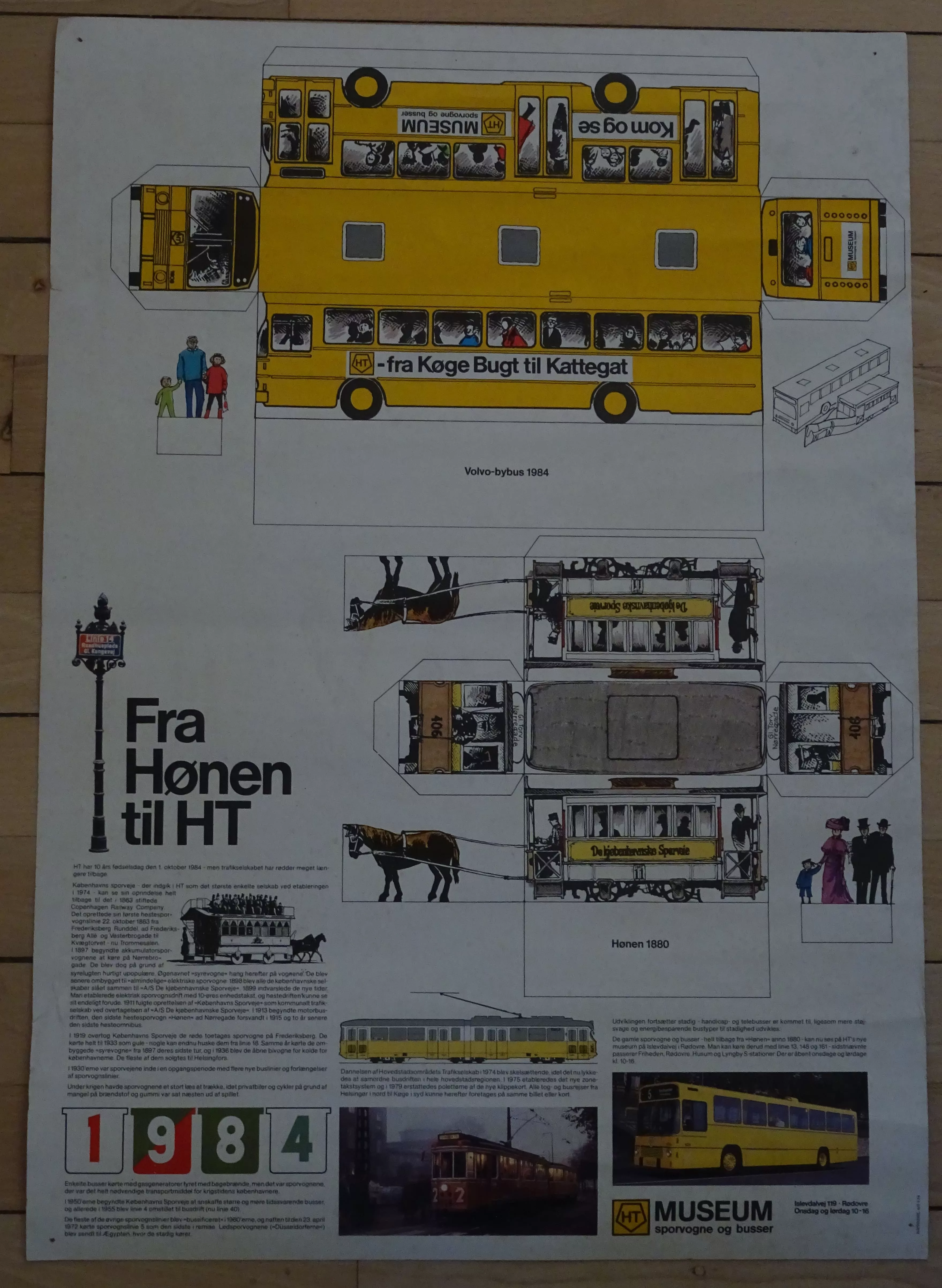
Poster: Copenhagen (1984)
Archive: Henrik Boye.
Publisher: HT museum.
Date: October 1, 1984.
City: Copenhagen (Denmark).
The picture shows
Københavns Sporveje (KS)
Closed
Copenhagen tram line 2: Brønshøj - Sundbyvesterplads
Closed
Copenhagen railcar 528, manufacturer Københavns Sporveje (KS), type Bogiemotorvogn, series 501-618, width 2.02 m, length 12.30 m, manufactured 1930-1941, with 28 seats and 39 standing places.
Hovedstadsområdets Trafikselskabsmuseum (HT-museet)
Closed permanently
Description
Fra
Hønen
til HT
HT har 10 års fødselsdag den 1. oktober 1984 - men trafikselskabet har rødder meget læn-
gere tilbage.
Københavns sporveje - der indgik i HT som det største enkelte selskab ved etableringen
i 1974 - kan se sin oprinelse helt
tilbage til det i 1863 stifede
Copenhagen Railway Company.
Det oprettede sin første hestespor-
vognslinie 22. oktober fra
Frederiksberg Runddel, ad Frederiks-
berg Allé og Vesterbrogade til Kvægtorvet - nu Trommesalen.
I 1897 begyndte akkumulatorspor-
vognene at køre på Nørrebro-
gade. De blev dog på grund af
syrelugten hurtigt upopulære. øgenavnet "syrevogne" hang herefter på vognene. De blev
senere ombygget til "almindelige" elektriske sporvogne. 1898 blev alle de københavske sel-
skaber slået sammen til "A/S De kjøbenhavnske Sporveje". 1899 indvarslede de nye tider.
Man etablerede elektrisk sporvognsdrift med 10-øres enhedstakst, og hestedriften kunne se
sit endeligt forude. 1911 fulgte op af "Københavns Sporvej" som kommunalt trafik-
selskab ved overtagelsen af "A/S De kjøbenhavnske Sporveje". I 1913 begyndte motorbus-
driften, den sidste hestesporvogn "Hønen" ad Nørregade forsvandt i 1915 og to år senere
den sidste hesteomnibus.
I 1919 overtog Københavns Sporveje de røde toetages sporvogne på Frederiksberg. De
kørte helt til 1933 som gule - nogle kan endnu huske dem fra linie 18. Samme år kørte de om-
byggede "syrevogne" fra 1897 deres sidste tur, og i 1936 blev de åbne bivogne for kolde for
københavnerne. De fleste af dem solgtes til Helsingsfors.
I 1930'erne var sporvejene inde i en opgangsperiode med flere nye buslinier og forlængelse
af sporvognslinier.
Under krigen havde sporvognene et stort læs at trække, idet privatbiler og cykler på grund af
mangle på brændstof og gummi var sat næsten ud af spillet.
1984
Enkelte busser kørte med gasgeneratorer fyret med bøgebrænde, men det var sporvognene,
der var det helt nødvendige transportmiddel for krigstidens københavnere.
I 1950'erne begyndte Københavns Sporveje at anskaffe større og mere tidssvarende busser (nu linie 40).
De fleste af de øvrige sporvognslinier blev "bussificeret" i 1960'erne, og natten til den 23. april
1972 kørte sporvognslinie 5 som den sidste i remise. ledsporvognene ("Düsseldorferne")
blev sendt til Ægypten, hvor de stadig kører.
Dannelsen af Hovedstadsområdet Trafikselskab i 1974 blev skelsættende, idet det nuj lykkes-
des at samordne busdriften i hele hovedstadsregionen. I 1975 etableredes det nye zone-
takstsystem og i 1979 erstattedes poletterne af de nye klippekort. Alle tog- og busrejser fra
Helsingør i nord til Køge i syd kunne herefter foretages på samme billet eller kort.
Udviklingen forsætter stadig - handicap- og telebusser er kommet til, ligesom mere støj-
svage og energibesparende bustyper til stadighed udvikles.
De gamle sporvogne og busser - helt tilbage fra "Hønen" anno 1880-kan nu ses på HT's nye
museum på Islevsdalsvej i Rødovre. Man kan køre derud med linie 13, 148 og 161 - sidstnævnte
passerer Friheden, Rødovre, Husum og Lyngby S-stationer. Der er åbnet onsdag og lørdag kl. 10-16.
HT MUSEUM sporvogne og busser
Islevdalsvej 119 * Rødovre
Onsdag og lørdag 10-16
BJØRNBØL A/S 9.84
View the image in high resolution. Please reach out if the image is being used, and please share your tram photos.