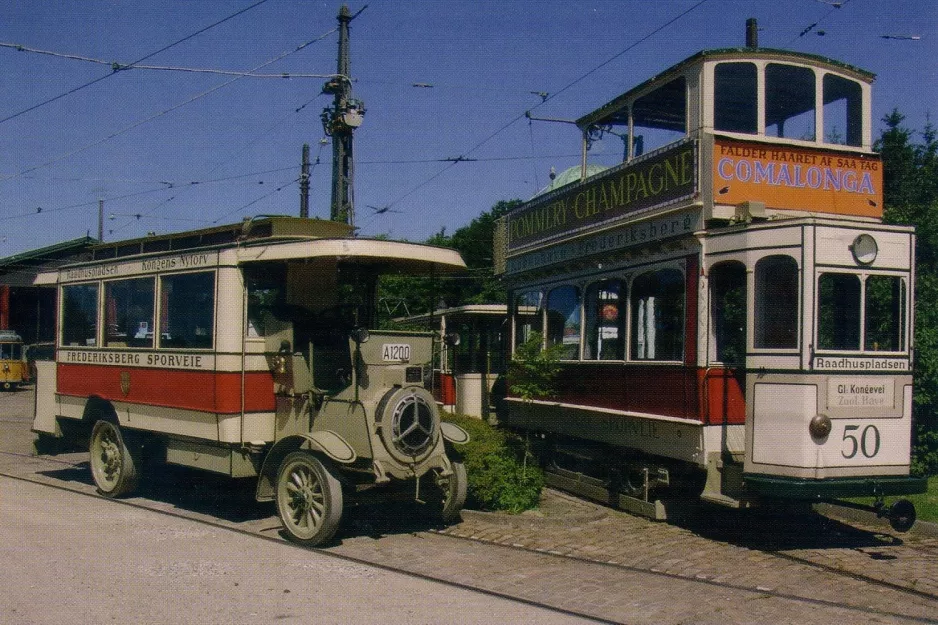
The picture shows Tram Museum Skjoldenæsholm Open regularly Skjoldenæsholm bilevel rail car 50 (ex Frederiksberg bilevel rail car 50), manufacturer Falkenried/N. Larsen/Vulcan, type Frederiksberg Sporveje, width 2.00 m, length 8.00 m, with 43 seats and 6 standing places, 2 axles, signed Raadhuspladsen Gl. Kongevej Zool. Have, with advertising of 'Falder haaret af saa tag Comalonga', interconnected with:Skjoldenæsholm sidecar 78 (ex Frederiksberg sidecar 78).
Read more Read less Description Skoldenæsholm Tram Museum
Until 1919, Frederiksberg had its own tram company, Frederiksberg Sporveje, which operated both tram and bus services.
From 1913, when the Strøget route was converted from horse-drawn to motor-bus operation, the company had 12 motor-buses made by De Dion Bouton. The preserved no. 1 is seen in the picture together with a tram train from the company with motor car no. 50 (Larsen 1915) and sidecar no. 78 (Larsen 1913).
Read more Read less Photos from Tram Museum Skjoldenæsholm Postcard: Skjoldenæsholm standard gauge with railcar 797 outside Remise 3 (2017) "Reko-Wagen 35" type TZ 70 (bidirectional vehicle) built in 1975 at the "Roman Chwalek" repair shop in Berlin-Schönweide (mechanical parts)
VEB Lokomotivbau Elektronische Werke "Hans Beimler" in Henningsdorf (electrical parts)
Reko-Wagen type TZ 70 (bidirectional vehicle)
built in 1975 at the "Roman Chwalek" repair shop (Reichsbahn repair shop) in Berlin-Schönweide (mechanical parts)
VEB Lokomotivbau Elektronische Werke "Hans Beimler" in Henningsdorf (electrical parts). By Henrik Boye, Karsten Paetzold, Rostocker Straßenbahn AG -
2017 .
Postcard: Skjoldenæsholm standard gauge with bilevel rail car 22 by The Tram Museum (2007) In the summer of 2007, the Tram Museum was able to put the restored two-story motor car KS no. 22 into use. The car was built in 1900 as an accumulator car, but was already converted to overhead line operation in 1902. In 1924, the top floor was removed, but the car continued as a traffic car until about 1950, after which it was converted to a rail grinding car. As such, it was used until 1972.
Both of the car train's side cars, the closed KS no. 1253 and the open KS no. 389, were built by Scandia in 1909. By Henrik Boye, Sporvejshistorisk Selskab (SHS) -
2007 .
Postcard: Skjoldenæsholm standard gauge with articulated tram 890 at Eilers Eg (2001) In 2001, the Tram Museum succeeded in bringing back two of the Copenhagen articulated trams that had been running in Alexandria, Egypt for about 30 years. No. 890 (DÜWAG/Copenhagen Trams 1966) and 815 (DÜWAG 1960) are photographed in their Alexandria appearance in the loop at "Eilers Eg" By Henrik Boye, Sporvejshistorisk Selskab (SHS) -
2001 .
Postcard: Skjoldenæsholm standard gauge with railcar 470 at Eilers Eg (2000) Due to a shortage of vehicles during and immediately after the Second World War, Copenhagen Trams built a series of 44 two-axle motor cars and 65 similar sidecars—the so-called "scrap cars"—at its main workshop between 1942 and 1947. Motor car no. 470 was built in 1945, and sidecar no 1065 in 1947. They were in operation until 1967 and 1968, respectively. By Henrik Boye, Sporvejshistorisk Selskab (SHS) -
2000 .
Postcard: Skjoldenæsholm standard gauge with railcar 275 at The tram museum (2001) In 2001, the Tram Museum succeeded in bringing home two of the Copenhagen articulated trams that had been running in Alexandria, Egypt for about 30 years. In the street between the museum's two depots, no. 890 (DÜWAG/Copenhagen Trams 1966) is photographed together with motor car no. 275 (Scandia 1907) and sidecar no. 1460 (Scandia 1920) from Copenhagen Trams. By Henrik Boye, Sporvejshistorisk Selskab (SHS) -
2001 .
Postcard: Skjoldenæsholm railcar 587 by Valby Gamle Remise (2005) The Skjoldenæsholm Tram Museum in Christmas and winter clothes: The late co-founder and honorary member John Lundgren, who would have turned 80 on December 20, 2010, managed to make a total of more than 550 hand-colored drawings with trams and buses as motifs. By Henrik Boye, John Lundgren, Sporvejshistorisk Selskab (SHS) -
2005 .
See all photos from Tram Museum Skjoldenæsholm .