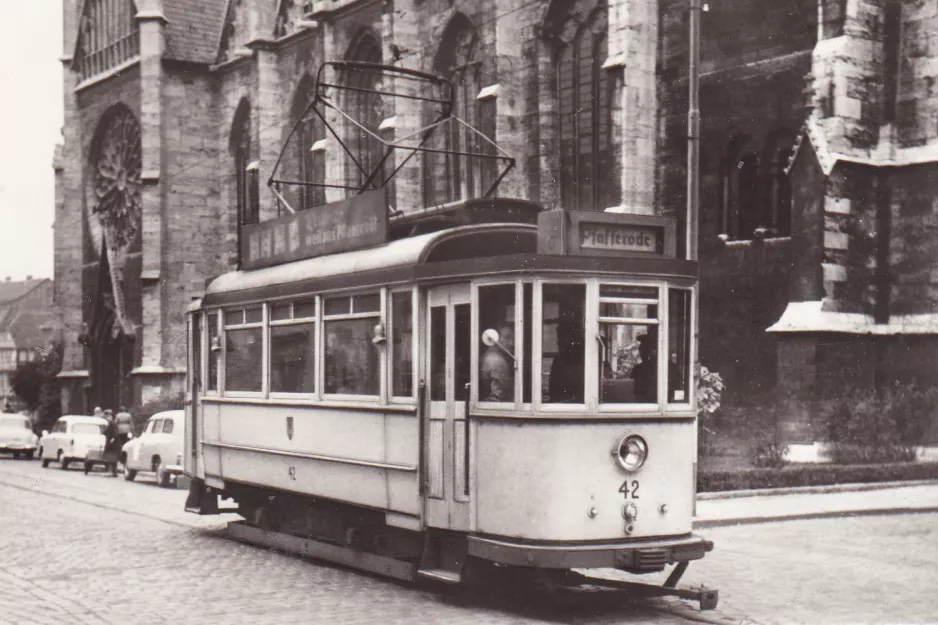
Postcard: Mühlhausen Unterstadtlinie with railcar 42 on Felchtaer Straße (1962) Location: Felchtaer Straße . Archive: Henrik Boye . Archive: Klaus Reichenbach . Publisher: 90 Jahre Stadtverkehr . Date: 1962 . City: Mühlhausen (Germany).
The picture shows Mühlhausen Stadtverkehr Closed Mühlhausen Unterstadtlinie: Bahnhof - Weißes Haus (Zum Wald) Closed Mühlhausen railcar 42 , series 41-44, signed Pfafferode.
Read more Read less Description 90 Years of Mühlhausen Public Works, Thomas Müntzer Town
Motor car 42 (series 41-44, built in 1928) on Felchtaer Straße, St. Blasii Church, 1962
Photo: Hochsteiner, Dresden
Read more Read less View the image in high resolution . Please reach out if the image is being used, and please share your tram photos.
Add a comment Location on a map
Photos of Mühlhausen Unterstadtlinie: Bahnhof - Weißes Haus (Zum Wald) 1:08:32
The History of the Mühlhausen Tram (2014) Here, the history of the Mühlhausen tram is not only presented as before, but also told from its planning stages (around 1875) to the present day. It includes well-known images along with new (old) recordings, the last trips, and photos of the previous (reconstructed) railcar of the Mühlhausen tram, as well as the "legacy" that the Bimmelguste left behind in MHL. Since I had "forgotten" about 6 minutes of film in the last version, here is the final version.
The history of the Mulhouse tramway began in mid-1822. Initial plans for building an electric tramway originated from private initiatives. In July 1892, the project led by senior postal assistant and city councilor Theodor Wiesental gained attention. The first horse-drawn tramway started operating in 1878; concrete plans for a gas or electric tramway date back to 1896. The concession contract for constructing and operating an electric tramway and power station was signed in July and August 1897, paving the way for the construction of the tramway in Mulhouse. It operated for 70 years, 6 months, and 7 days. Using many old photos, I aim to tell the story of the Mulhouse tramway, showcase what still exists as of 2014, and remind us of its rich history—the route map in pink shows the old network. The longest-lasting lower town line ran from 1898 to 1969 via Augustastraße, now August Bebelstraße. Its first route connected Erfterstraße to the Untermark, then via Felchdarerstraße and Wannfriederstraße to the Aue. The upper town line, marked in light blue, was in operation from 1901 to 1967. It started at the station, passing through Friedrichstraße, now KMXstraße, then Gürmerstraße, Steinweg, Herrenstraße, to the Blobach, and later via Johannesstraße and Birkenweg, now MV Allee, to the Aue. From 1903 to 1967, a dark blue section linked parts of the upper and lower lines at the Blobach and Bastmarkt. Since 1898, this has also been the access point to the depot on Waldstraße from Bastmarkt. The outer line, shown in light green, opened in 1899. It initially ran from the Aue via Kasselerstraße, Haerröder Landstraße, Schwanichallee, to the Popröder Quelle, then via Waldstraße to Prinzenhaus and Weißenhaus. This line connected to the lower line, which operated until 1969. In 1911, the yellow Fafferode line opened for freight; passengers traveled on it from 1913 until 1965. Freight to Fafferode stopped in 1968. The dark green section between Prinzenweiche and Gerätebau GmbH only existed from 1938 to 1945. To supply coal to the Fafferode sanatorium, a freight track from the station to the coal depot on Thomasmünzerstraße was in place since 1911. After freight service ended at Fafferode, that track was closed in 1968. Before starting the visual journey through the tram's history, a few abbreviations are necessary: TW stands for railcar/motor car, ATW for work car, BW for trailer/carriage, and GW for freight car or Lohre. The first part of the film covers 1898 to 1945. The tramway's debut was on December 20, 1898, at 11:30 a.m. Mayor Lenze, Director Schulze, along with officials from the royal government, postal authorities, the magistrate, and the police, inspected the tramway and depot on Wahlstraße, then conducted an official test run from Bastmarkt to Fafferode. The next day, December 21, 1898, the tramway officially started service with postcards promoting the new tram for Mulhouse. Power for the tram came from the station on Wahlstraße, next to the depot—an operational photo from 1898 shows Director Schulz with some employees. On January 24, 1899, the extension to Weißes Haus officially opened. Until then, the terminus was at Popperöder Quelle; from 1901, it served as the end of both the lower and upper town lines. Early tram vehicles in the station square were painted brown; later, cost-cutting led to a beige-brown color. During WWI, they switched to simple beige, which remained until service ended. The fleet included work vehicles, such as snowplow car 12, which was active only until 1918, primarily for clearing the outer track. Later, standard railcars had removable snow plows. Postcards from the late 19th century played a vital role in showcasing what the city had to offer. For example, in 1899, TV8 travels along Augustastraße, lined with Wilhelminian-style willows, now August Bebelstraße, next to the ever-fascinating… By TP Projekte MHL -
2014 .
See all about Mühlhausen Unterstadtlinie: Bahnhof - Weißes Haus (Zum Wald) .
Last updated: February 17, 2026 .