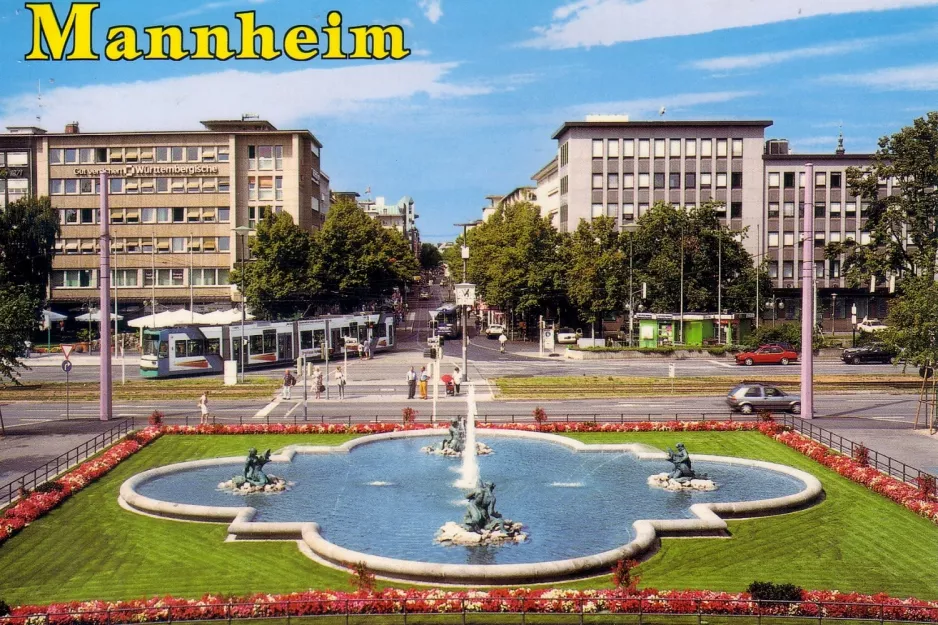
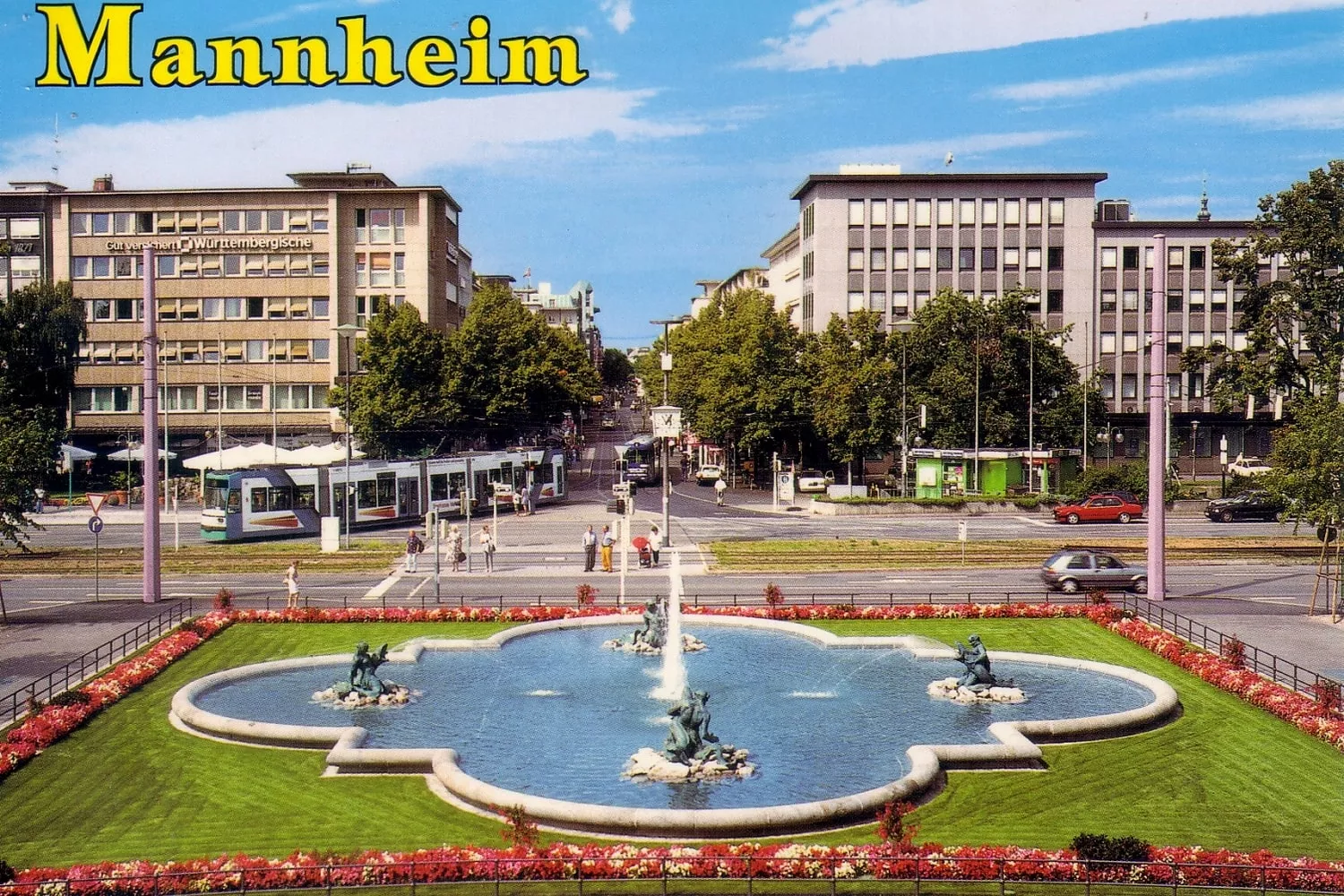
Postcard: Mannheim at Wasserturm (2005) Stop: Wasserturm .Henrik Boye .Kunstverlag Herbert Grochila .2005 .
Operational
Mannheim on the Rhine and Neckar. The Old Town is divided into 136 rectangular blocks in a checkerboard pattern. View from the water tower into the Planken district.
View the image in high resolution . Please reach out if the image is being used, and please share your tram photos.
Add a comment Location on a map
Photos from Rhein-Neckar-Verkehr in Mannheim (RNV) Postcard: Mannheim (1958) National Theater, Friedrichplatz, Am Wasserturm, Christ Church, Jesuit Church, Palace, Paradeplatz with Grupello Fountain, ramp to the Rhine Bridge, Planken, Main Station
6800 Mannheim
31. 956.38 235940 By Henrik Boye, Kunstverlag Herbert Grochila -
1958 .
Postcard: Mannheim tram line 1 on Planken (2010) Mannheim
Mannheim on the Rhine and Neckar
Old town divided into rectangles in a checkerboard pattern
Paradeplatz with Grupello pyramid, water tower with water features and illuminated fountains, Rhine bridges with a view of Mannheim, Planken with water tower By Henrik Boye, Werbeverlag Gorzinski -
2010 .
Postcard: Mannheim near Wasserturm (1889-1989) 100 Years of the Water Tower. 1889-1989. Mannheim
Mannheim on the Rhine and Neckar
The Water Tower, the city's landmark, built between 1886 and 1889, stands 60.33 meters tall, with water features and illuminated fountains. By Henrik Boye, Werbeverlag Gorzinski -
1889 -
1989 .
3:18
RNV: How to change trains at Heidelberg's Bismarckplatz without barriers (2014) Thirty-seven thousand people get on and off here at Heidelberg's Bismarckplatz every day. For many of them, using the barrier-free platforms is very important. The square was completely rebuilt in 2011. To maintain the level ground of the square, all elevated platforms were removed, and so-called platforms were built in their place. The RNV has been receiving numerous inquiries recently, as using the platforms involves some special features that must be taken into consideration. With me today is team leader Rüdiger Schock from RNV. Hello, Mr. Schock. The fact is, we have different types of vehicles here, which is why the stopping positions vary. Perhaps you could explain that briefly.
Yes, we have different types of cars in Heidelberg, as you already mentioned, and I classify them into four categories. Due to their length and design, not all trains can stop at the same position, as this would compromise accessibility. This means that each vehicle must have its own designated stopping point. How is this regulated in Heidelberg? It's very simply managed with a straightforward method. We have placed track nails as markers on the track area. This allows the driver of a specific type of vehicle to know exactly where to stop with a particular wheel position, ensuring barrier-free boarding. One type of vehicle that is special is the one on line 5. You are somewhat dependent on passenger assistance there. Can you explain that briefly? On Bergstrasse, we have installed high curbs on almost everything. This means passengers can board anywhere in the middle without barriers, but cannot get out a little further behind because Malor Hill is in front. The simplest solution, which mainly relies on passenger assistance, is for them to always board at the first door in the direction of travel.
To ensure accessibility, a wheelchair door is available and should be used. This allows passengers to alight barrier-free at Bismarckplatz, which is now a major stop. It's busy, with five tram lines running here alone, so two trams can stop one behind the other. Since there isn't a platform at the back, what do passengers do if a tram is at the rear and they want to board or alight? Do they need accessibility features? We've given the drivers instructions, and we strictly follow and monitor these. They must stop in the correct position at least once while changing passengers to ensure accessibility here as well. This means I can always stand here if the train has already opened at the back. If needed, it will pull up again and reopen at the front. It should always do so. We continue to train staff and ensure this process remains consistent. Yes, thank you very much for the answers. No problem; I was happy to help. After all, we want everyone to feel comfortable when traveling, whether for themselves or our customers. RNV is making an effort. There are stopping positions at Bismarckplatz that require each vehicle type to stop at a specific spot, ensuring the door aligns with the platform. If you are a mobility-impaired passenger traveling on RNV trains and want to get off at Bismarckplatz, it's best to look for the first door in the direction of travel with the wheelchair symbol, as this ensures you can get off at the platform. By Rhein-Neckar-Verkehr GmbH (rnv) -
November 13, 2014 .
Rhein-Neckar-Verkehr in Mannheim (RNV) .
Last updated: October 23, 2026 .