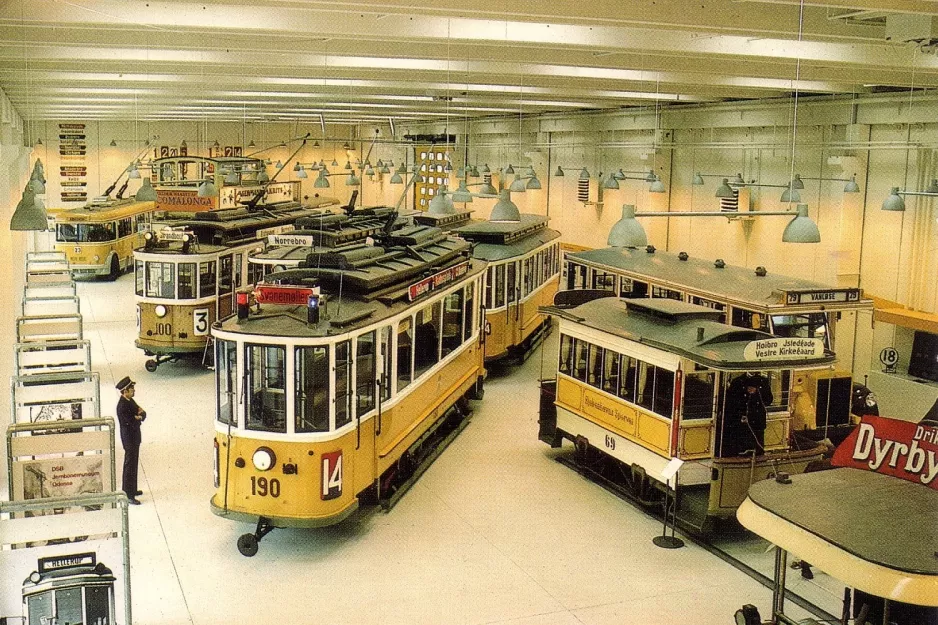
Postcard: Copenhagen railcar 100 in HT museum (1984) Museum: HT museum, Islevdalvej 119, Rødovre . Archive: Henrik Boye . Photographer: Torben Liebst . Publisher: HT museum . Date: November 1984 . City: Copenhagen (Denmark).
The picture shows Hovedstadsområdets Trafikselskabsmuseum (HT-museet) Closed permanently Placed Copenhagen railcar 100 , manufacturer N. Larsen, type DKS, series 90-104, width 2.10 m, length 9.70 m, manufactured 1901, signed line 3 Strandboulev. Placed Copenhagen railcar 190 , manufacturer Falkenried/N. Larsen/Scandia, type Hovedtype, series 105-234, width 2.10 m, length 8.90 m, manufactured 1901-1910, with 20 seats and 26 standing places, 2 axles, signed line 14 Svanemøllen. Placed Copenhagen horse tram 69 "Hønen" (ex Copenhagen horse tram 51 "Hønen"), signed Højbro Istedgade Vester Kirkegaard.
Read more Read less Description HT's museum for trams and buses was opened on HT's 10th anniversary, October 1, 1984.
Read more Read less View the image in high resolution . Please reach out if the image is being used, and please share your tram photos.
Add a comment Location on a map
Photos from Hovedstadsområdets Trafikselskabsmuseum (HT-museet) Postcard: Copenhagen horse tram 51 "Hønen" near Kalkbrænderihavnen (1996) Horse-drawn tram no. 51 (>Hønen<) from the Copenhagen Tram Company was built as a horse-drawn omnibus in 1876 and was converted to a horse-drawn tram around 1882. It ran as a horse-drawn tram until 1915, after which it was transformed into a museum vehicle. The HT Museum restored the vehicle in the mid-1990s. In the picture, it can be seen in traffic in Kalkbrænderrihavnen in October 1996. Together with the HT Museum's other vehicle fleet, it was acquired by the Skjoldenæsholm Tram Museum in 2003, where it can now be viewed. By Henrik Boye, HT museum -
October 1996 .
Free pass for Hovedstadsområdets Trafikselskabsmuseum (HT-museet) (1994) Published together with a stamp folder from Denmark in 1994.
Copy of a KS ticket from 1943.
2225 II-1943 85675
KS 25 øre KS
KS KS
1* 3 * 7 * 9 * 11 * 13 * 15 *
17 * 19 * 21 * 23 * 25 * 27 * 29 * 31
I * III * V * VII * IX * XI *
Transfer ticket 25 øre
Copenhagen Tramways.
Free ticket
Adult
The museum with the many beautifully restored old trams and buses is open all year round on Wednesdays from 10 am to 4 pm and every day during the autumn holidays from 10 am to 4 pm. Closed 24.12-1.1. The ticket is valid throughout 1994.
HT museum. Trams and buses.
Islevdalvej 119 * 2610 Rødovre * Tel 42 91 23 91 By Henrik Boye, HT museum -
1994 .
Poster: Copenhagen (1984) From
Hønen
to HT
HT celebrated its 10th birthday on 1 October 1984 - but the transport company has roots much further back.
Copenhagen's trams - which were part of HT as the largest single company when it was established
in 1974 - can trace their origins all the way back to the
Copenhagen Railway Company, which was founded in 1863.
It established its first horse-drawn tram line on 22 October from
Frederiksberg Runddel, along Frederiksberg Allé and Vesterbrogade to Kvægtorvet - now Trommesalen.
In 1897, accumulator trams began to run on Nørrebrogade. However, they quickly became unpopular due to the
acid smell. The nickname "acid trams" was then attached to the trams. They were later converted into "ordinary" electric trams. In 1898, all the Copenhagen companies were merged into "A/S De Kjøbenhavnske Sporveje". 1899 heralded the new times.
Electric tram operations were established with a 10-øre unit rate, and horse-drawn tram operations could see their end in sight. In 1911, "Københavns Sporvej" followed as a municipal transport company by taking over "A/S De Kjøbenhavnske Sporveje". In 1913, motor bus operations began, the last horse-drawn tram "Hønen" on Nørregade disappeared in 1915 and two years later the last horse-drawn omnibus.
In 1919, Københavns Sporveje took over the red double-decker trams on Frederiksberg. They
ran until 1933 as yellow - some can still remember them from line 18. In the same year, the converted "acid cars" from 1897 made their last trip, and in 1936 the open side cars became too cold for the
Copenhagen residents. Most of them were sold to Helsingsfors.
In the 1930s, the tramways were in a period of growth with several new bus lines and the extension of
tram lines.
During the war, the trams had a large load to pull, as private cars and bicycles were almost out of action due to a
lack of fuel and rubber.
1984
Some buses ran with gas generators fired by beechwood, but it was the trams that
were the absolutely necessary means of transport for the wartime Copenhageners.
In the 1950s, Copenhagen Tramway began to acquire larger and more modern buses (now line 40).
Most of the other tram lines were "busified" in the 1960s, and on the night of 23 April 1972, tram line 5 was the last to be retired. The articulated trams ("Düsseldorferne") were sent to Egypt, where they are still running.
The formation of the Capital Region Transport Company in 1974 was a milestone, as it was now possible to coordinate bus operations in the entire capital region. In 1975, the new zone fare system was established, and in 1979, the tokens were replaced by the new clip cards. All train and bus journeys from Helsingør in the north to Køge in the south could then be made on the same ticket or card.
The development continues - disabled and telebuses have been added, and more noise-
low and energy-saving bus types are constantly being developed.
The old trams and buses - all the way back from "Hønen" in 1880 - can now be seen at HT's new
museum on Islevsdalsvej in Rødovre. You can go there with lines 13, 148 and 161 - the latter
passes Friheden, Rødovre, Husum and Lyngby S-stations. It is open Wednesday and Saturday 10 am-4 pm.
HT MUSEUM trams and buses
Islevdalsvej 119 * Rødovre
Wednesday and Saturday 10 am-4 pm
BJØRNBØL A/S 9.84 By Henrik Boye, HT museum -
October 1, 1984 .
See all photos from Hovedstadsområdets Trafikselskabsmuseum (HT-museet) .
Last updated: February 27, 2026 .