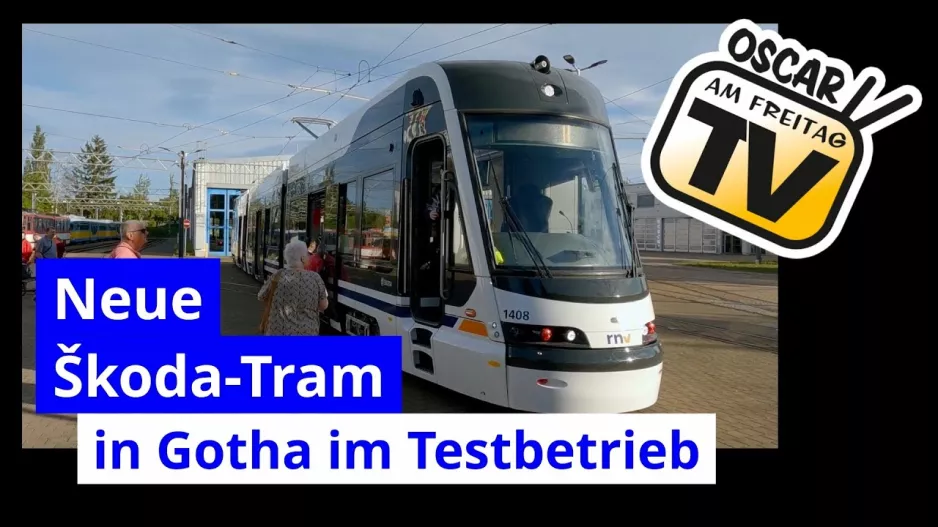
New Škoda tram tested in Gotha (2023)
Tram depot: Betriebshof.
YouTube name: Oscar am Freitag-TV.
Date: .
City: Gotha (Germany).
Thüringerwaldbahn und Straßenbahn Gotha
Operational
The Thüringer Waldbahn und Straßenbahn GmbH Gotha (TWSB) is currently testing a brand-new Škoda tram. Starting in 2025, TWSB will gradually add new vehicles; therefore, they are now seeking suitable models for their fleet. The Škoda tram is intended for Rhein-Neckar-Verkehr GmbH Mannheim and was shipped directly from the factory in Pilsen to Gotha. On September 20, 2023, interested visitors had the chance to ride the forest railway line between Gotha and Bad Tabarz free of charge.
00:00 Leaving the hall
00:28 Interview with Klaus Rennau, TWSB Gotha
01:34 Collaboration between TWSB and RNV
02:07 Information on the selection process for new vehicles
03:41 Is everything in Gotha suitable for the Škoda tram?
04:30 Some technical information
06:16 Advantages of the bidirectional railway
07:00 How did the Škoda tram arrive in Gotha?
08:48 Plans for purchasing new vehicles for TWSB
09:55 Information on costs
10:53 Interview with tram driver Marlon Meyer, RNV Mannheim
12:54 And now, we’re heading off on the route!
September 20th is World Children's Day, and today we are at the Thuringian Forest Railway and Tramway GmbH in Gotha, where we have once again arranged to meet Mr. Rennerau, as he has something special to share. Currently, a new tram has been running for about a week, having just arrived from the factory in Pilsen. This tram will, of course, stay here for a few more days. How did this whole story come about? It marks the first step toward the future of the Forest Railway, which aims to acquire new vehicles for its fleet in the years to come. Yes, Aschenbren, for the first time in all these years, we have managed to include the procurement of new vehicles in the local transport plan, and we are currently in the prequalification phase. We are examining the market to see which manufacturers offer what vehicles. Our colleagues at Rhein Neckerverkehre are in the middle of their procurement process, which means they have ultimately chosen the vehicle behind us, based on the tender, as the most suitable for their needs. In the past, we have repeatedly used vehicles from R. Necker, specifically the Mannheimers, to increase the number of low-floor vehicles in the area.
At some point, we decided to test the newly designed RNV vehicle on the Goar route network. It was a somewhat impulsive idea to suggest relocating the car from the Pilsen delivery site, where it is assembled, to the pit stop before it heads to Mannheim. We then put this plan into action, and you can see the results behind us. The reason for this vehicle test is straightforward. We naturally want to save time during the prequalification process, which allows for thorough calculations. However, in practice, there are often one or two things you can't predict. This is why banks conduct stress tests. Here, we are conducting a stress test for two purposes: first, to assess the vehicle's equipment—how do passengers receive it? We’re observing that today. Second, how the vehicle functions within our infrastructure, and what we need to adapt if necessary. If you look at social media, you’ll see reactions that might have surprised some—they range from many people speaking out positively about the new railway, to discussions about how the Thuringian Forest Railway and tram are losing some of their unique charm with the old railway lines. The numbers may vary, but logically, we have to provide better transportation options for both passengers and drivers. The primary concerns are passenger comfort, which affects not only the driver but also everyone on board. Lastly, we need to upgrade to standard technology and adhere to new standards and regulations. Our current vehicles are over 30 years old, and the supply of spare parts is limited.
As the saying goes, if I fit my grandma with a new pacemaker, her heart might still work a little better, but that doesn't mean she'll run a marathon—other parts are worn out. Regarding the new track, a press release mentioned that it is slightly wider, measuring 2.40 meters in width. You’ve already conducted some test runs. Does the vehicle pass smoothly through all areas? You can see from the decorative panel on the wheel arches that new stops have been added to the route network, designed to accommodate both rail and bus services. Currently, we have five old stops remaining that need to be converted to meet new standards and enable the use of low-floor vehicles. The stops have to be upgraded regardless, so we will handle that. Apart from that, the entire network appears to be functioning well, and the vehicles are running smoothly across it. Now, about the track—how big, heavy, and costly is it?
To start with the basics, the vehicle is 30.5 meters long. We are working with what’s called a drum train. Our colleagues at DERV don’t just operate trams but also trains, which means for the experts, they drive to BUSTRAPP and ESBO. For us, we only need the BUSTRAPP, which makes us a street vehicle.