Colonial Tramcar Restaurant - Coxy's Big Break (2013)
YouTube name: Coxy's Big Break.
Date: .
City: Melbourne (Australia).
Colonial Tramcar Restaurant
Closed permanently
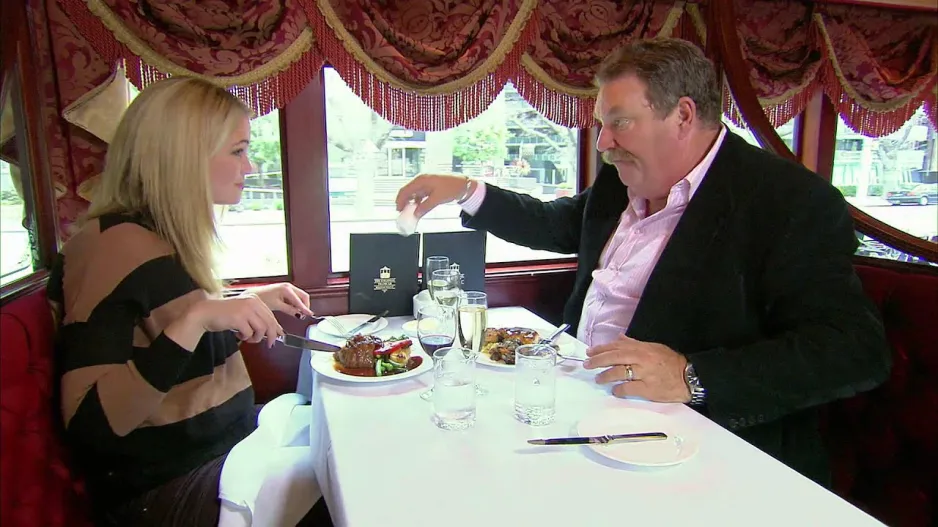
Scherri-Lee and Coxy dine on board the Colonial Tramcar.
The Colonial Tramcar Restaurant was one of Melbourne’s most distinctive examples of the adaptive reuse of historic tramway equipment. Rather than preserving former tramcars solely as static exhibits or operating them as conventional heritage vehicles, the service transformed them into mobile restaurants that combine Melbourne’s tramway heritage with sightseeing and fine dining. In doing so, it capitalized on the close association between the tram and Melbourne’s urban identity.
The restaurant operated as a moving dining experience through the streets of Melbourne. Lunch services typically lasted around two hours, during which passengers traveled through the central business district and surrounding areas while being served a multi-course meal. Routes varied and could include St Kilda, Armadale, St Kilda Road, the northern suburbs and central streets such as Collins Street. The journey therefore provided visitors with an unusual form of sightseeing, in which the city itself served as the continuously changing backdrop to the meal.
Considerable modifications were required to convert the tramcars for restaurant operation. Despite the severe spatial constraints of a tram body, the vehicles incorporated dining accommodation, kitchen facilities and a small toilet. Importantly, meals were prepared on board rather than simply reheated or delivered from an external kitchen. Contemporary accounts describe a menu that includes dishes such as barramundi, chicken, and eye fillet, along with wine and other beverages. The ability to prepare individual dishes, including steaks cooked to passengers’ preferences, demonstrated the relatively sophisticated catering operation that could be achieved within the available space.
The experience nevertheless depended on considerably more than food. The interiors, service and movement of the tram through Melbourne were deliberately combined to create a sense of occasion. Birthdays, anniversaries and marriage proposals became a regular part of operations, and interaction between staff and passengers contributed to the restaurant’s convivial atmosphere. The relatively small capacity of each car further distinguished the experience from both conventional restaurants and large-scale sightseeing services.
From the perspective of transport heritage, the Colonial Tramcar Restaurant is particularly interesting because it illustrates how redundant or historic public-transport vehicles can acquire an entirely new function. The tramcars were neither simply museum objects nor ordinary vehicles retained in their original role. Instead, their historic character became an integral part of a commercial tourism experience. Passengers were not merely transported in an old tram; the tram itself was the principal attraction.
The Colonial Tramcar Restaurant consequently occupied an unusual position at the intersection of public transport, heritage conservation, tourism and hospitality. Its success relied heavily on Melbourne’s exceptionally strong tramway identity: a comparable restaurant could have operated in another type of vehicle, but it was the combination of dining and traveling aboard one of Melbourne’s characteristic trams that gave the experience its particular appeal. The operation thus provides a notable example of how tramway heritage could be incorporated into the everyday life and tourist economy of a modern city rather than being confined to a museum environment.